


Viral Playground Verdict Shows Limits of Hate Crime Law
By Darius Spearman (africanelements)
Support African Elements at patreon.com/africanelements and hear recent news in a single playlist. Additionally, you can gain early access to ad-free video content.
A Playground Incident Sparks National Outrage
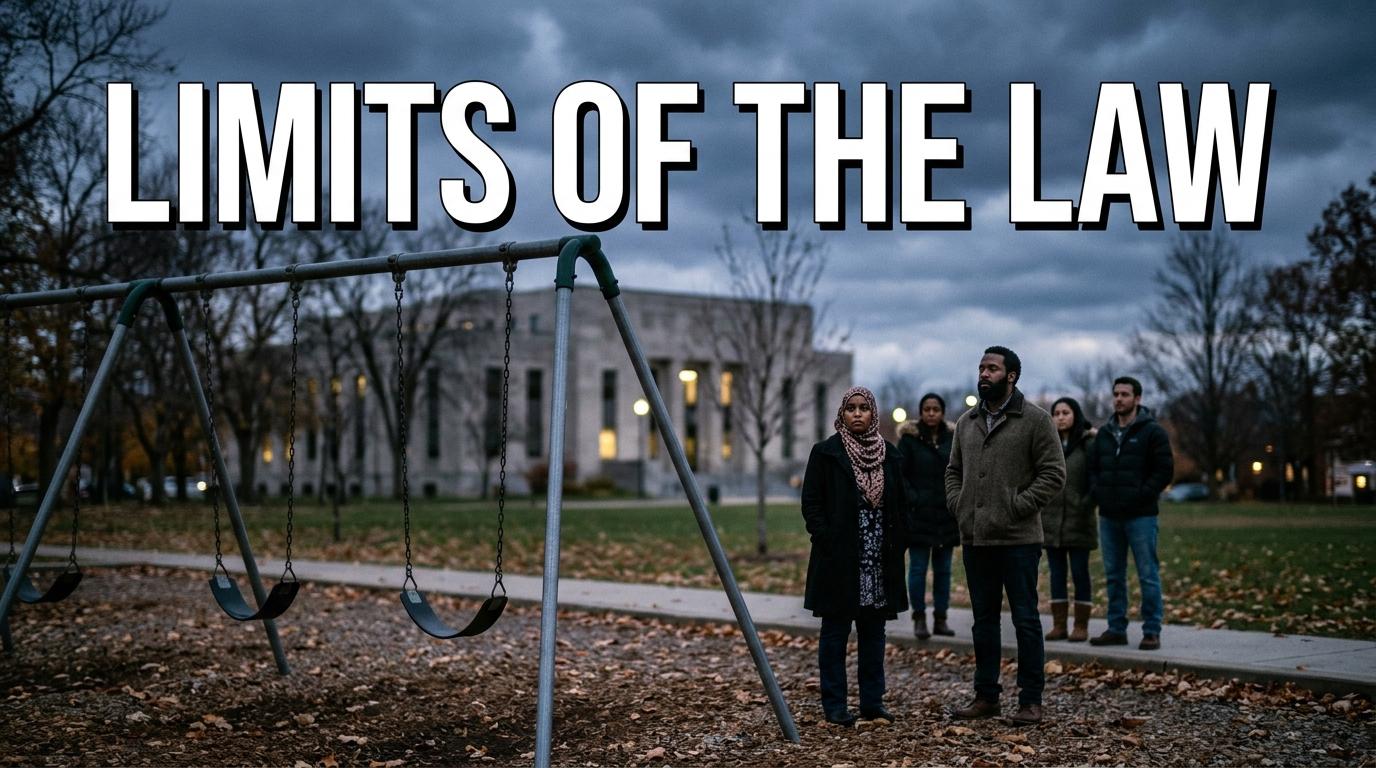
On April 28, 2025, a quiet afternoon at Soldiers Field Park in Rochester, Minnesota, turned into a scene of severe racial harassment (bringmethenews.com). An eight-year-old Black child who is profoundly autistic wandered away from his father, Shire Jimale (bringmethenews.com). The young boy took an applesauce pouch from a diaper bag belonging to Shiloh Hendrix (bringmethenews.com). In response, Hendrix aggressively chased the child onto playground equipment (bringmethenews.com). She repeatedly screamed racial slurs at him, causing the terrified child to freeze in place (bringmethenews.com).
A Black bystander, thirty-year-old Sharmake Omar, witnessed the assault and began recording the interaction on his phone (bringmethenews.com). When Omar confronted Hendrix, she doubled down on her behavior (bringmethenews.com). She asserted that she had the right to call the child a slur and directed the same racial epithets at Omar (bringmethenews.com). She also made obscene gestures and accused him of being a drain on public welfare (bringmethenews.com). The viral video generated massive outrage across the country (mprnews.org). In July 2026, an Olmsted County jury delivered a split verdict (mprnews.org). They found Hendrix guilty of disorderly conduct against Omar, but acquitted her of the charge involving the eight-year-old child (mprnews.org, kare11.com).
Fighting Words and Free Speech Jurisprudence
The legal outcome in the Hendrix trial rests upon decades of legal doctrine surrounding the First Amendment. The prosecution built its strategy around the fighting words exception created in the landmark 1942 case Chaplinsky v. New Hampshire (mtsu.edu). In that decision, the U.S. Supreme Court ruled that certain speech lies outside constitutional protection (mtsu.edu). Specifically, words that by their very utterance inflict injury or incite an immediate breach of the peace are not protected (mtsu.edu). However, later court decisions drastically reduced the reach of that precedent (supremecourt.gov).
In 1971, the Supreme Court ruled in Cohen v. California that offensive speech must be directed as a personally abusive insult to an individual to lose protection (supremecourt.gov). Later, in the 1992 Minnesota case R.A.V. v. City of St. Paul, the High Court struck down local bias laws (texastechlawreview.org). The Court decided that governments cannot selectively criminalize slurs based on race or religion while ignoring other insults (texastechlawreview.org, lawrelatededucation.org). Furthermore, the 1978 Minnesota decision in Matter of Welfare of S. L. J. restricted state disorderly conduct charges strictly to direct fighting words (northstarcriminaldefense.com, mitchellhamline.edu). Because the eight-year-old child froze and could not physically retaliate, the jury determined that the racial slurs directed at him did not meet the state standard for provoking an immediate fight (mprnews.org, kare11.com).
Gaps in Minnesota Hate Crime Statutes
The legal framework in Minnesota creates distinct hurdles when prosecutors attempt to punish verbal bias attacks. Unlike jurisdictions with standalone hate speech laws, Minnesota utilizes a penalty enhancement framework (mn.gov). State law requires an underlying criminal act, such as physical assault or property destruction, before bias motivation can increase punishment severity (mn.gov, washingtoncountymn.gov). Under Minnesota Statutes Section 609.2231, an assault motivated by race becomes a gross misdemeanor (mn.gov). Without physical contact or property damage, verbal harassment remains classified as protected speech (mn.gov).
This statutory gap limits how local authorities respond to public incidents of intense racial harassment (mprnews.org, mprnews.org). Because Hendrix did not physically strike the child, prosecutors could only pursue misdemeanor disorderly conduct charges (mprnews.org, mprnews.org). The case highlights a broader pattern where legal systems struggle to address verbal assaults (mprnews.org). These limitations reflect a long tradition of anti-Black politics where institutional rules prioritize procedural hurdles over protecting vulnerable victims from public terror.
The Somali-American Community Context
The confrontation at Soldiers Field Park hit a delicate nerve within the local population (revivingsisterhood.org, mprnews.org). Rochester and the broader Twin Cities area are home to the largest Somali-American community in the United States (revivingsisterhood.org, wikipedia.org). Members of this community encounter multi-layered discrimination (revivingsisterhood.org). They experience anti-Black racism alongside religious discrimination and anti-immigrant hostility (revivingsisterhood.org, thenation.com). Visible markers of faith, such as the hijab worn by women, frequently make community members targets for public harassment (revivingsisterhood.org).
Many Somali families originally resettled in Minnesota to escape civil conflict and violent political instability (revivingsisterhood.org). Consequently, pre-migration trauma and post-traumatic stress remain prevalent among older generations and refugees (revivingsisterhood.org). Public acts of aggression shatter feelings of safety in civic spaces like public parks (revivingsisterhood.org). Furthermore, bystander Sharmake Omar suffered severe personal fallout after posting the video (bringmethenews.com). He received online doxxing and intense death threats (bringmethenews.com). Community efforts to defend families and demand safety demonstrate how marginalized groups navigate Black political dynamics to preserve dignity under extreme pressure.
Monetizing Extremism Through Crowdfunding
In the aftermath of the viral exposure, the controversy shifted into an lucrative online financial venture (bringmethenews.com, splcenter.org). Mainstream fundraising platforms routinely remove accounts associated with hate speech or racially charged harassment (splcenter.org). However, alternative platforms operate with minimal content moderation (splcenter.org). Hendrix launched a fundraising appeal on GiveSendGo, claiming that public backlash threatened her family’s safety and forced her to relocate (bringmethenews.com, givesendgo.com). The campaign attracted massive financial contributions from conservative donors and ideological sympathizers (splcenter.org, givesendgo.com).
Despite public condemnation of her actions, the campaign raised over $859,000 (givesendgo.com, cbsnews.com). Watchdog groups noted that donor message boards were filled with white nationalist comments and offensive slurs (splcenter.org). In contrast, a local support fund created by the Rochester NAACP for the victim’s family collected less than half that amount (bringmethenews.com). This imbalance reflects a growing phenomenon termed rage giving (splcenter.org). Similar patterns appeared in previous high-profile legal cases involving Kyle Rittenhouse and Daniel Penny (wikipedia.org, wikipedia.org). Research shows that far-right actors raised over $6.2 million across online platforms in recent years (splcenter.org).
Legal Limits on Seizing Crowdfunding Revenue
The accumulation of hundreds of thousands of dollars by a convicted individual raises significant ethical questions regarding legal financial recovery (maine.edu, justia.com). Many wonder if state restitution mechanisms can seize funds generated from viral racial harassment (maine.edu). Minnesota maintains victim restitution statutes alongside legislation modeled after traditional Son of Sam laws (maine.edu, justia.com). However, historical constitutional rulings severely limit how state governments intercept private donations (justia.com). In the 1991 ruling Simon & Schuster v. Crime Victims Board, the U.S. Supreme Court struck down automatic forfeiture of crime-related earnings (justia.com).
The Supreme Court determined that seizing profits from expressive activity violates First Amendment protections (justia.com). Modern statutes apply narrowly to commercial entertainment deals, such as book publishing or movie rights based on a crime (justia.com). Personal donations raised on crowdfunding sites for relocation expenses do not fall under commercial crime proceeds (justia.com). Unless the victim’s family successfully pursues civil litigation for monetary damages, state statutes offer no mechanism to redirect these funds (justia.com). This economic dynamic resembles historical periods where systems of involuntary servitude continued to limit financial equity and legal redress for Black communities.
Evaluating Public Safety and Community Protection
The guilty verdict delivered in Rochester provides partial legal accountability for public racial harassment (mprnews.org, kare11.com). Yet, the split decision underscores structural tensions between constitutional speech protections and public safety (mprnews.org, mtsu.edu). By restricting disorderly conduct strictly to physical fighting words, current interpretations leave vulnerable populations exposed to non-physical attacks (mprnews.org, northstarcriminaldefense.com). Children, disabled individuals, and elderly persons remain unprotected under statutory frameworks that rely on a victim’s physical capacity to retaliate (mprnews.org, northstarcriminaldefense.com).
At the same time, digital platforms allow individuals to convert public hostility into financial rewards (splcenter.org). The case shows how localized racial encounters quickly scale into national political battles (mprnews.org, splcenter.org). Community advocates continue to call for state legislative reforms that address verbal bias attacks without infringing upon core constitutional rights (revivingsisterhood.org, aclu-mn.org). Moving forward, legal scholars and civic leaders face the challenge of balancing constitutional safeguards with the fundamental right of all children to play safely in public parks (revivingsisterhood.org, mtsu.edu).
About the Author
Darius Spearman is a professor of Black Studies at San Diego City College, where he has been teaching for over 20 years. He is the founder of African Elements, a media platform dedicated to providing educational resources on the history and culture of the African diaspora. Through his work, Spearman aims to empower and educate by bringing historical context to contemporary issues affecting the Black community.
