

Why African and Caribbean Nations Demand Trillions in Reparations
By Darius Spearman (africanelements)
Support African Elements at patreon.com/africanelements and hear recent news in a single playlist. Additionally, you can gain early access to ad-free video content.
Milestones of the Global Reparations Movement
The Abuja Proclamation asserts that the damages of slavery and colonialism are legally compensable.
The UN Durban Conference officially recognizes the transatlantic slave trade as a crime against humanity.
CARICOM establishes its Reparations Commission, later releasing the historic Ten-Point Action Plan.
The UN General Assembly passes Resolution A/RES/80/250, setting the stage for the Accra Next Steps Commitments.
The Modern Spark in Accra
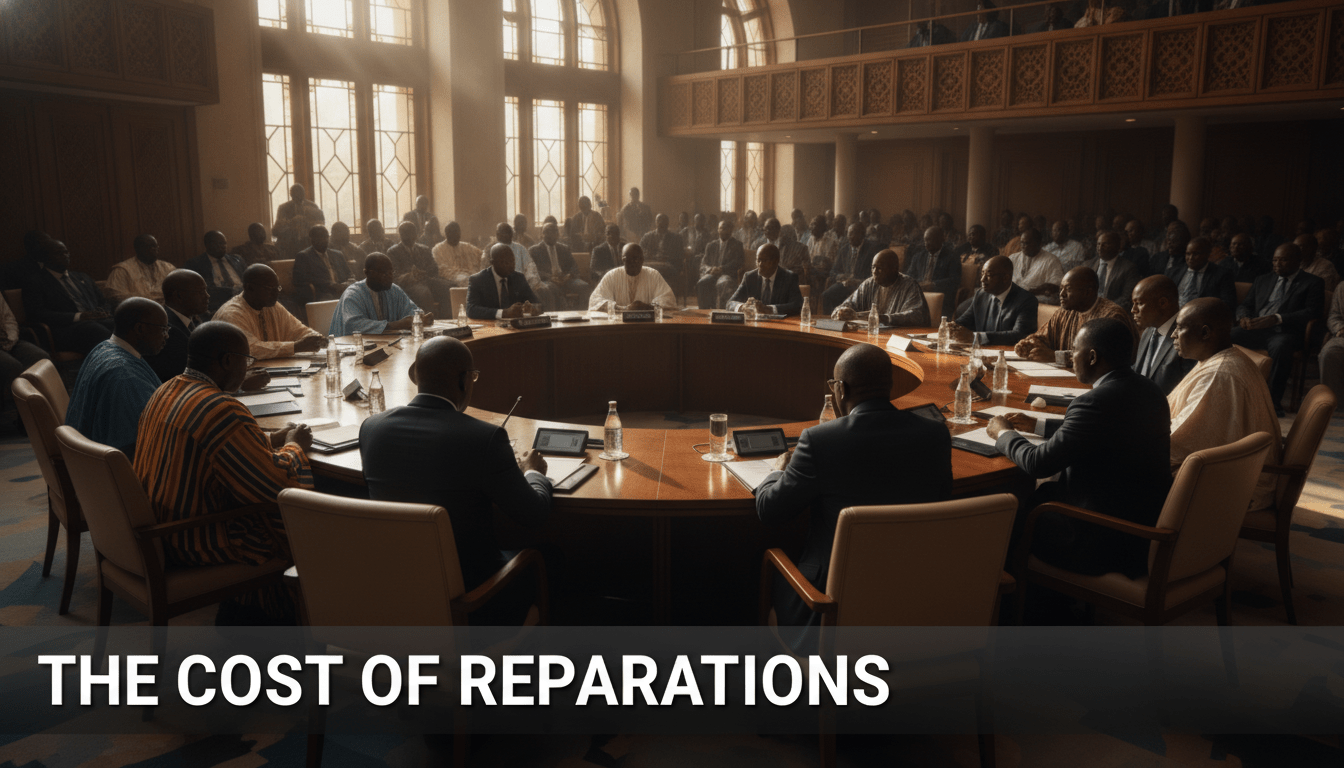
A historic gathering in Accra, Ghana, has fundamentally shifted the global fight for reparatory justice. In June 2026, the global movement for reparations reached an unprecedented milestone at the “Next Steps” High-Level Consultative Conference (washingtonpost.com, gna.org.gh). Over eighty countries sent heads of state, policymakers, and legal minds to adopt a sweeping, nineteen-point framework (gna.org.gh, au.int). This collective effort seeks to force former colonial powers to account for centuries of human exploitation.
The participants at the summit stood united behind a clear and uncompromising mandate. Ghana’s current President, John Dramani Mahama, acted as the African Union Champion on Advancing the Cause of Justice and the Payment of Reparations to lead this momentous push (gna.org.gh, mfa.gov.gh). Leaders from Africa and the Caribbean came together to declare that the legacy of slavery must be addressed through policy, not merely through words. This historic summit established that structural healing requires direct economic and political action.
The Human Toll and the Middle Passage
The historical foundation of these modern demands lies in the massive devastation of the transatlantic slave trade. For more than four hundred years, European empires kidnapped and transported approximately twelve million African people across the Atlantic Ocean (theguardian.com, unesco.org). This forced migration of human beings stripped the African continent of its youth, labor, and potential. This horrific trade built the foundation of global Western wealth while leaving African societies structurally destabilized.
The journey across the ocean, known as the Middle Passage, inflicted unimaginable physical and psychological trauma. Enslaved Africans were crammed tightly below deck on wooden shelves with barely any room to move (wikipedia.org). The lack of ventilation and sanitation caused contagious diseases like dysentery to run rampant, resulting in a staggering fifteen percent mortality rate during the journey (wikipedia.org). Faced with these horrors, many chose to jump into the sea or launch brave shipboard insurrections (wikipedia.org). The psychological weight of this stolen ancestry remains a deep wound for the global Black diaspora, who resisted their capture at every turn as they navigated the terrors of the transatlantic slave trade.
Early Activism from Abuja to Durban
The modern political architecture for reparations did not appear overnight. It was forged through decades of relentless activism and international organizing. A critical early milestone occurred at the First Pan-African Conference on Reparations in Abuja, Nigeria, in 1993 (issafrica.org, berniegrantarchive.org.uk). This historic gathering produced the Abuja Proclamation, which formally asserted that the damage of slavery, colonialism, and ongoing economic systems was unique and legally compensable (issafrica.org, berniegrantarchive.org.uk). This declaration laid the groundwork for viewing global inequality as an ongoing legal violation.
The movement gained massive momentum on the global stage in 2001. During the United Nations World Conference against Racism in Durban, South Africa, activist groups and scholars fought for systemic recognition (theguardian.com, issafrica.org, unesco.org). Prominent figures, including Sir Hilary Beckles, lobbied the international body to declare the slave trade a crime against humanity (theguardian.com, issafrica.org). Beckles famously predicted that the drive for reparatory justice would become the defining political movement of the twenty-first century (issafrica.org). The Durban declaration successfully shifted the international narrative, transforming reparations from a fringe activist cause into an urgent matter of global policy.
UN Resolution A/RES/80/250 Voting Breakdown
Source: United Nations General Assembly Voting Records (March 2026)
The CARICOM Blueprint for Reparations
The Caribbean Community, representing fifteen member states, dramatically advanced the operational side of this movement. In 2013, CARICOM established the CARICOM Reparations Commission under the leadership of Sir Hilary Beckles (theguardian.com, issafrica.org, caricom.org). Rather than focusing only on legal theory, the commission worked to structure practical demands. In 2014, CARICOM approved the Ten-Point Action Plan for Reparatory Justice (caricom.org, caricom.org). This document provided a clear, actionable blueprint that moved the conversation from abstract complaints to specific policy changes.
The Ten-Point Action Plan demands formal, unconditional apologies instead of vague statements of regret from European nations (caricom.org, caricom.org). It calls for massive debt cancellation to relieve the structural economic chokehold on developing nations (caricom.org, caricom.org). Furthermore, the plan includes modern repatriation programs for diaspora members who wish to return to their ancestral homes (caricom.org, reparationscomm.org). This comprehensive framework also demands substantial investments in public health, education, and cultural preservation, ensuring that the healing process addresses every facet of societal development.
The Landmark UN Resolution Shift
The momentum of the June 2026 conference was supercharged by a monumental political victory at the United Nations. On March 25, 2026, the United Nations General Assembly adopted Resolution A/RES/80/250 (un.org, youtube.com). This historic resolution officially declared the transatlantic slave trade and racialized chattel slavery as the gravest crime against humanity (un.org, youtube.com). The declaration was not simply symbolic. It asserted that the consequences of these historical crimes actively shape modern wealth, debt, and global inequality.
The vote on this resolution exposed deep geopolitical divisions between the Global North and the Global South. A decisive majority of 123 nations voted in favor, led by the African Union and Caribbean states (theguardian.com). However, fifty-two nations abstained, including the United Kingdom, Canada, and all twenty-seven European Union members (theguardian.com). Only three countries voted against the resolution: the United States, Israel, and Argentina (theguardian.com). Opposing nations claimed that modern international law cannot retroactively apply to historical acts, but supporters argued that legal structures were deliberately designed to protect colonial plunder.
Geopolitical Alliances and Objections
The voting alignment of the opposing nations revealed strategic geopolitical calculations. The Israeli government rejected the resolution because of concerns over historical terminology. Israel objected to classifying the slave trade as the gravest crime against humanity, arguing that such phrasing could diminish the unique historical memory of the Holocaust (theguardian.com). Similarly, the United States delegation argued that nations should not attempt to create a hierarchy of historical suffering (theguardian.com). These arguments reflected a broader resistance to establishing formal global legal precedents for reparations.
Argentina joined the United States and Israel in voting against the resolution, breaking with its regional neighbors in Latin America (theguardian.com). This vote was a direct consequence of a massive foreign policy shift under Argentina’s administration (theguardian.com). This administration has consistently aligned its international voting patterns with the United States to secure strategic economic and political partnerships. Although the United Nations resolution is technically non-binding, it has provided immense moral and diplomatic leverage to Global South nations seeking systemic change (un.org).
The Staggering Cost of Historical Enslavement
Total calculated debt for the economic harms of chattel slavery across the Americas.
Calculated share owed by the UK to its former Caribbean colonies (approx. $23.4 Trillion).
Calculations based on the 2023 Brattle Group economic consulting report.
The Staggering Economics of Repair
To move the conversation beyond political speeches, economists and legal scholars have worked to calculate the true financial scale of the damage. In June 2023, the economic consulting firm Brattle Group released a groundbreaking, 115-page pro bono study (theguardian.com, brattle.com). This report estimated that the total global reparations owed for the harms of transatlantic chattel slavery range between one hundred trillion and one hundred and thirty-one trillion dollars (theguardian.com, brattle.com). This calculation factors in unpaid labor, lost lives, stolen cultural heritage, and intergenerational trauma.
The report also broke down these staggering figures by individual colonizing nations. It concluded that Great Britain alone owes over eighteen trillion pounds, or roughly twenty-four trillion dollars, to its former colonies (theguardian.com, brattle.com). These figures highlight how colonial extraction systematically enriched Western empires while depriving colonized nations of basic infrastructure. This historical theft forces modern Caribbean and African states to borrow at high-interest risk premiums on international markets, perpetuating generational wealth disparities that began during the era of chattel slavery.
The Ghost of Neo-Colonialism
Modern reparations advocates emphasize that the struggle is not only about addressing the past. It is also about dismantling modern systems of exploitation known as neo-colonialism. The term was coined globally by Kwame Nkrumah, the first president of Ghana, to describe how wealthy nations continue to control decolonized states through economic and political pressure (marxists.org). First officially defined at the 1961 All African People’s Conference in Accra, neo-colonialism relies on indirect control, such as monetary policies and conditional foreign aid, rather than direct military force (wikipedia.org).
The 1993 Abuja Proclamation identified a continuous “trilogy of damage” consisting of the slave trade, colonialism, and neo-colonialism (issafrica.org). This concept explains how historical plunder transitions directly into modern financial dependency. To combat this ongoing extraction, the African Union and CARICOM established the Global Reparation Fund in late 2023 (theguardian.com, issafrica.org). However, the fund has struggled to secure actual capital because the targeted wealthy nations refuse to recognize any legal obligation to pay. While private organizations like George Soros’s Open Society Foundations have funded research and advocacy, the fund itself remains empty of state contributions (theguardian.com, issafrica.org).
Repatriation and Cultural Restitution
Beyond financial compensation, the Accra Next Steps Commitments demand the restoration of culture and identity. The CARICOM plan outlines voluntary, state-supported repatriation programs for descendants of enslaved Africans who wish to return to their ancestral homelands (caricom.org, reparationscomm.org). This is not a forced or mass relocation. Instead, it is a legal pathway of return that restores citizenship, identity, and land rights to those whose ancestors were stolen. Host nations like Ghana have positioned themselves as sanctuaries, creating special legal structures to welcome and integrate the returning diaspora.
The restoration of cultural heritage also requires the return of physical artifacts stolen during colonial conquests. The Accra framework calls on Western museums and governments to return looted cultural property and ancestral remains immediately. The document celebrated the Netherlands’ recent return of two thousand historical artifacts to its former colonies as a step in the right direction. To maintain this momentum, the Accra summit established permanent bodies, including the Global Advisory Panel on Reparatory Justice and the Expert Panel on Restitution of Cultural Artefacts, to coordinate these complex global demands.
The Bridge to the American Struggle
This global movement provides critical moral and political leverage for local civil rights campaigns within the United States. Domestic advocates are leveraging the United Nations’ declarations to validate local initiatives, such as state-level reparations efforts in California and similar local legislative efforts in New York. By framing these local campaigns as part of a globally recognized mandate to correct a crime against humanity, organizers are building pressure to move from research to direct financial compensation.
During the Juneteenth commemorations at Accra’s historic Osu Castle, a former Danish slave dungeon, the Congressional Black Caucus played a vital role (theguardian.com, blavity.com). Executive Director Vince Evans delivered a powerful address, demanding that recognition must become policy and history must become action (theguardian.com, blavity.com). By building a unified front with African and Caribbean nations, domestic organizations like the Congressional Black Caucus and the NAACP are preventing Western governments from isolating and dismissing reparations as a localized issue. For the leaders gathered in Ghana, the era of pleading for recognition has ended, and the era of demanding structural accountability has officially begun.
About the Author
Darius Spearman is a professor of Black Studies at San Diego City College, where he has been teaching for over 20 years. He is the founder of African Elements, a media platform dedicated to providing educational resources on the history and culture of the African diaspora. Through his work, Spearman aims to empower and educate by bringing historical context to contemporary issues affecting the Black community.
