


Why Are Black Activists Convicted as Foreign Agents?
By Darius Spearman (africanelements)
Support African Elements at patreon.com/africanelements and hear recent news in a single playlist. Additionally, you can gain early access to ad-free video content.
In August 2026, a federal appeals court delivered a significant ruling against Black liberation movement leaders (courthousenews.com, reason.com). A three-judge panel of the U.S. Court of Appeals for the 11th Circuit unanimously upheld conspiracy convictions against Omali Yeshitela (courthousenews.com). Yeshitela is the eighty-four-year-old founder of the African People’s Socialist Party (courthousenews.com, justice.gov). The decision also affirmed convictions for fellow movement leaders Penny Hess and Jesse Nevel (courthousenews.com, courthousenews.com).
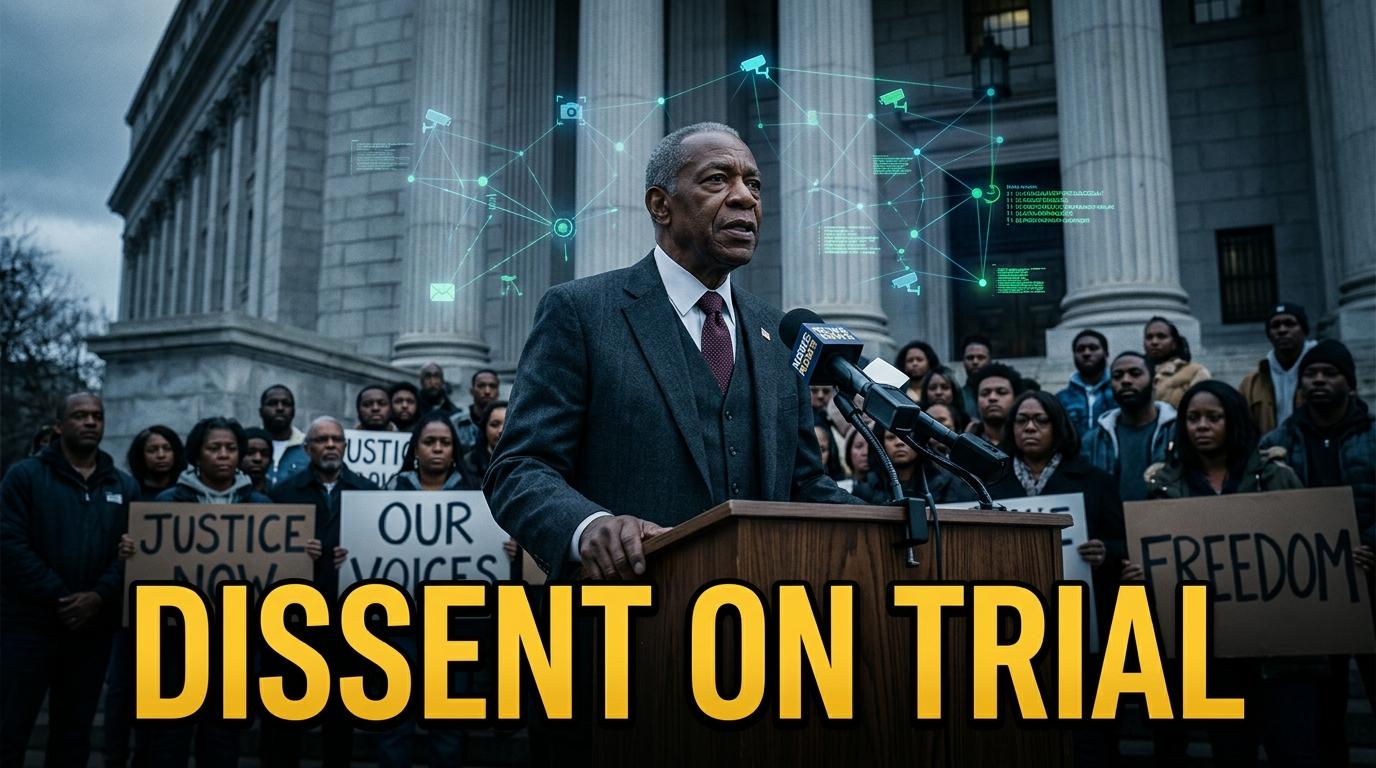
Writing for the appeals panel, Chief Circuit Judge William Pryor stated that federal foreign agent laws do not violate free speech guarantees (courthousenews.com, reason.com). The government prosecuted the activists under a federal statute regulating unregistered agents of foreign powers (courthousenews.com, justice.gov). Prosecutors alleged that the activists coordinated with Russian operatives to spread propaganda inside the United States (justice.gov, justice.gov). However, this legal battle goes far beyond modern headlines about overseas interference. The case reflects a long historical pattern of government surveillance directed at radical Black nationalist movements across the nation (rightsanddissent.org, blackagendareport.com).
The Appeals Court Ruling and the Foreign Agent Statute
The legal fight centers on Title 18, Section 951 of the United States Code (courthousenews.com, reason.com). This criminal law makes it illegal to act inside the country as an agent of a foreign government without prior notification to the U.S. Attorney General (arnoldporter.com, cornell.edu). Defense attorneys argued that applying this statute to political organizers violates the First Amendment (courthousenews.com, eff.org). They maintained that the activists expressed genuine political beliefs regarding foreign policy and political self-determination (reason.com, courthousenews.com).
Chief Judge Pryor rejected those constitutional arguments in his ruling (courthousenews.com, reason.com). The court decided that regulating foreign control over domestic actions serves compelling national security interests (courthousenews.com, reason.com). The panel held that Section 951 targets conduct rather than speech (courthousenews.com, reason.com). Consequently, the ruling established that individuals who agree to operate under foreign direction can face conspiracy charges, even when their statements reflect sincere personal convictions (courthousenews.com, reason.com).
Scope: Covers political lobbyist activities, public relations, and economic interests on behalf of any foreign entity.
Penalty: Primary civil remedies alongside administrative compliance.
Scope: Prohibits acting inside the U.S. under direction or control of foreign government officials without prior Attorney General notification.
Penalty: Criminal prosecution carrying up to 5 years imprisonment.
Understanding Section 951 requires comparing it to the Foreign Agents Registration Act, commonly known as FARA (arnoldporter.com, cornell.edu). FARA acts primarily as a civil disclosure system (arnoldporter.com, thefederalcriminalattorneys.com). It requires public registration for individuals lobbying on behalf of foreign political parties or corporations (arnoldporter.com, cornell.edu). Conversely, Section 951 functions as a strict criminal prohibition (arnoldporter.com, thefederalcriminalattorneys.com). It requires direct prior notification to law enforcement before acting under the command of a foreign state (arnoldporter.com, cornell.edu). The government has historically relied on Section 951 for espionage cases rather than political activism (arnoldporter.com, thefederalcriminalattorneys.com).
The Legacy of Omali Yeshitela and the APSP
To grasp the significance of this prosecution, one must explore the origin of the movement’s founder (wikipedia.org, blackpast.org). Omali Yeshitela was born Joseph Waller in St. Petersburg, Florida, in 1941 (wikipedia.org, blackpast.org). He began organizing community campaigns during the Civil Rights Movement as a member of the Student Nonviolent Coordinating Committee (wikipedia.org, snccdigital.org). His early political work focused directly on dismantling segregation and systemic racism in Florida (wikipedia.org, blackpast.org).
In December 1966, Waller engaged in a direct protest that altered his life path (wikipedia.org, blackpast.org). He walked into St. Petersburg City Hall and tore down a large mural (wikipedia.org, blackpast.org). The painting depicted derogatory, racist caricatures of Black musicians performing for white audiences (wikipedia.org, blackpast.org). Authorities arrested Waller and convicted him of grand larceny (wikipedia.org, wikipedia.org). That legal battle triggered years of appellate litigation (wikipedia.org, wikipedia.org).
Waller’s legal fight eventually reached the United States Supreme Court (wikipedia.org, wikipedia.org). In the landmark 1970 ruling Waller v. Florida, the Supreme Court ruled in his favor (wikipedia.org, justia.com). The court held that state and municipal courts cannot prosecute a citizen twice for the exact same act (wikipedia.org, justia.com). That decision established an important legal precedent protecting citizens against double jeopardy under the Fifth Amendment (wikipedia.org, justia.com). The legal case demonstrated how federal and local governments coordinate their authority, reflecting ongoing questions about how sharing of government power impacts Black communities (wikipedia.org, justia.com).
Upon his release from prison, Waller adopted the name Omali Yeshitela (wikipedia.org, blackpast.org). In May 1972, he unified three local organizations to form the African People’s Socialist Party (wikipedia.org, blackpast.org). Those organizations included the Junta of Militant Organizations, the Black Rights Fighters, and the Black Study Group (wikipedia.org, blackpast.org). The party established its headquarters in Florida and launched The Burning Spear newspaper to spread its message globally (wikipedia.org, theburningspear.com).
African Internationalism versus Traditional Black Nationalism
The African People’s Socialist Party operates under an ideology called African Internationalism (prolewiki.org, marxists.org). Developed by Yeshitela, this political framework views world history through a materialist lens (prolewiki.org, marxists.org). African Internationalism states that global capitalism grew directly from the transatlantic slave trade and colonial exploitation (prolewiki.org, marxists.org). The doctrine asserts that Black people worldwide constitute a single dispersed nation struggling against imperial power (prolewiki.org, apspuhuru.org).
This political philosophy differs sharply from mainstream civil rights strategies and traditional Black nationalism (prolewiki.org, marxists.org). Civil rights organizations usually seek political inclusion within existing American legal institutions (snccdigital.org, blackpast.org). Traditional Black nationalism often focuses on cultural pride or racial solidarity across different social classes (prolewiki.org, marxists.org). In contrast, African Internationalism demands the complete restructuring of global economic relations (prolewiki.org, marxists.org). The ideology insists that the Black working class must lead movements for total liberation (prolewiki.org, marxists.org). Such efforts mirror historical Black working class efforts to secure economic justice against institutional barriers.
The party built a broader framework known as the Uhuru Movement to carry out its agenda (wikipedia.org, apspuhuru.org). The word “Uhuru” means freedom in Swahili (wikipedia.org, blackpast.org). The movement established several specialized mass organizations to address distinct sectors of society (wikipedia.org, apspuhuru.org). For instance, the International People’s Democratic Uhuru Movement mobilizes working-class communities around police accountability and housing access (wikipedia.org, apspuhuru.org).
Additionally, the party created dedicated structures for non-Black supporters (wikipedia.org, uhurusolidarity.org). In 1976, Yeshitela formed the African People’s Solidarity Committee (wikipedia.org, uhurusolidarity.org). This organization organizes white citizens to work under party leadership (wikipedia.org, uhurusolidarity.org). Members raise financial resources for reparations and organize anti-colonial support within Euro-American communities (apspuhuru.org, uhurusolidarity.org). Defendants Penny Hess and Jesse Nevel led these solidarity coalitions before facing federal charges (courthousenews.com, justice.gov).
Historical Echoes: UN Genocide Petitions and Foreign Interference Narratives
A major element in the federal indictment involved a 2015 petition submitted to the United Nations (justice.gov, justice.gov). Federal prosecutors claimed that Russian agent Aleksandr Ionov provided twelve thousand dollars to help fund the petition drive (justice.gov, justice.gov). The petition accused the United States government of committing genocide against Black Americans through police violence and mass incarceration (justice.gov, justice.gov). Prosecutors presented this document as proof of an illegal foreign propaganda effort (justice.gov, justice.gov).
However, petitioning international bodies has been a core tactic for Black activists for over seventy years (wikipedia.org, wikipedia.org). In December 1951, the Civil Rights Congress presented a landmark petition to the United Nations (wikipedia.org, wikipedia.org). Titled We Charge Genocide, the document was delivered by civil rights leader William L. Patterson and legendary artist Paul Robeson (wikipedia.org, wikipedia.org). Scholar W.E.B. Du Bois and nearly one hundred activist leaders signed the filing (wikipedia.org, wikipedia.org). The petition documented lynchings, police killings, and economic deprivation, arguing that American racism violated the 1948 UN Genocide Convention (wikipedia.org, wikipedia.org).
During the Cold War, federal officials strongly criticized international human rights complaints (wikipedia.org, wikipedia.org). The U.S. State Department revoked Robeson’s passport and blocked Patterson from traveling abroad (wikipedia.org, wikipedia.org). Government agencies argued that Black dissidents exposed internal national flaws to foreign enemies like the Soviet Union (wikipedia.org, archives.gov). FBI Director J. Edgar Hoover subsequently launched the Counter Intelligence Program, known as COINTELPRO, in 1956 (stanford.edu, archives.gov).
COINTELPRO specifically targeted Black radical organizing across the nation (stanford.edu, archives.gov). Federal agents infiltrated organizations, planted false news stories, and disrupted political campaigns (stanford.edu, archives.gov). Target groups included the Black Panther Party, SNCC, and prominent leaders like Dr. Martin Luther King Jr. (stanford.edu, archives.gov). Federal agencies repeatedly asserted that radical activists acted under foreign influence rather than organic domestic grievances (stanford.edu, archives.gov). Consequently, the current charges against the African People’s Socialist Party reflect long-standing government strategies used against domestic dissenters (rightsanddissent.org, blackagendareport.com).
Local Roots of Resistance: From St. Petersburg to the Verdict
The party’s domestic influence is rooted in decades of local community activism (wikipedia.org, wusf.org). In October 1996, police violence altered the political atmosphere in St. Petersburg, Florida (wikipedia.org, wusf.org). A white police officer shot and killed TyRon Lewis, an unarmed eighteen-year-old Black driver, during a traffic stop (wikipedia.org, wusf.org). The killing triggered massive civil unrest and protests across the city’s southern neighborhoods (wikipedia.org, wusf.org).
The African People’s Socialist Party helped organize local residents following the shooting (wikipedia.org, wusf.org). Activists demanded officer accountability, community economic control, and political self-determination (wikipedia.org, wusf.org). Police surrounded and tear-gassed the party’s local headquarters during the standoff (wikipedia.org, wusf.org). Despite severe pressure, the movement maintained its physical presence and expanded its radio broadcasts, urban gardens, and community centers (wikipedia.org, apspuhuru.org).
Federal law enforcement escalated its focus on the party decades later (courthousenews.com, justice.gov). On July 29, 2022, armed FBI agents executed pre-dawn raids on party properties in St. Louis and St. Petersburg (courthousenews.com, justice.gov). Agents used flashbang grenades, seized computers, and confiscated organizational archives (justice.gov, courthousenews.com). In April 2023, the Department of Justice unsealed indictments against the activists (justice.gov, justice.gov).
The federal trial took place in Tampa, Florida, during September 2024 (courthousenews.com, courthousenews.com). Prosecutors argued that the defendants accepted funding and strategic direction from Russian operative Aleksandr Ionov (justice.gov, justice.gov). In response, defense lawyers presented decades of party publications to prove that the activists always held their anti-war and anti-imperialist views independently (reason.com, courthousenews.com). The jury returned a mixed verdict (courthousenews.com, reason.com). Jurors acquitted all defendants on the substantive charge of acting as secret foreign agents under Section 951 (courthousenews.com, reason.com). However, the jury convicted them of conspiracy under Section 371 (courthousenews.com, reason.com).
Unpacking the Split Verdict and the Black Hammer Split
The split jury verdict created complex legal questions (reason.com, courthousenews.com). To convict on a substantive Section 951 charge, prosecutors must prove direct foreign command and control beyond a reasonable doubt (arnoldporter.com, thefederalcriminalattorneys.com). The jury decided that the government failed to establish that the activists acted as direct puppets of Moscow (reason.com, courthousenews.com). Yet, the jury decided that interactions with Ionov constituted an illegal agreement, satisfying the conspiracy standard (courthousenews.com, reason.com).
In December 2024, U.S. District Judge William Jung sentenced the defendants (courthousenews.com, courthousenews.com). Although conspiracy convictions carry maximum prison terms of five years, Judge Jung imposed no prison time (courthousenews.com, courthousenews.com). Instead, he sentenced Yeshitela, Hess, and Nevel to thirty-six months of probation and three hundred hours of community service (courthousenews.com, courthousenews.com). The sentence reflected the absence of violent conduct or direct espionage activity (courthousenews.com, courthousenews.com).
Public reporting often mentions four U.S. citizens named in the original federal indictment (justice.gov, justice.gov). The fourth individual was Augustus C. Romain Jr., also known as Gazi Kodzo (justice.gov, courthousenews.com). Romain served as Secretary General of the African People’s Socialist Party until late 2018 (courthousenews.com, medium.com). However, internal organizational disputes led to his expulsion from the movement that same year (courthousenews.com, medium.com).
After leaving the party, Romain moved to Atlanta, Georgia, and established a separate group called the Black Hammer Party (justice.gov, courthousenews.com). Prosecutors alleged that Ionov separately funded Black Hammer campaigns (justice.gov, justice.gov). Although Romain was convicted alongside the Uhuru leaders in September 2024, justice coalitions maintain the term “Uhuru 3” (courthousenews.com, handsoffuhuru.org). That distinction separates the active party leadership from Romain’s independent political group (courthousenews.com, handsoffuhuru.org).
Constitutional Freedoms and the Future of Black Dissent
The 11th Circuit decision creates significant legal precedents regarding foreign agent statutes and political organizing (courthousenews.com, reason.com). Department of Justice officials view the decision as a critical victory against covert foreign manipulation (justice.gov, justice.gov). Prosecutors argue that foreign adversaries actively fund political dissidents to exploit existing racial tensions in the United States (justice.gov, justice.gov). From the government’s perspective, Section 951 provides necessary protection against hidden state foreign intelligence efforts (justice.gov, justice.gov).
Conversely, civil liberties groups and Black social justice coalitions strongly object to the appellate ruling (peoplesdispatch.org, rightsanddissent.org). Organizations such as the Black Alliance for Peace and Defending Rights & Dissent warn that the decision threatens free expression (peoplesdispatch.org, rightsanddissent.org). They argue that defining mutual cooperation with foreign entities as criminal conspiracy enables the government to target political minorities (rightsanddissent.org, blackagendareport.com). Activists caution that this legal standard revives Cold War practices used to silence anti-colonial voices (rightsanddissent.org, blackagendareport.com).
Following the appellate loss, defense attorneys announced plans to petition the Supreme Court of the United States (courthousenews.com, courthousenews.com). The pending appeal seeks a clear constitutional line between illegal foreign agency and protected political speech (courthousenews.com, eff.org). As this legal fight moves forward, the case highlights an enduring historical reality: the ongoing tension between national security laws and Black political self-determination (rightsanddissent.org, blackagendareport.com).
About the Author
Darius Spearman is a professor of Black Studies at San Diego City College, where he has been teaching for over 20 years. He is the founder of African Elements, a media platform dedicated to providing educational resources on the history and culture of the African diaspora. Through his work, Spearman aims to empower and educate by bringing historical context to contemporary issues affecting the Black community.
