


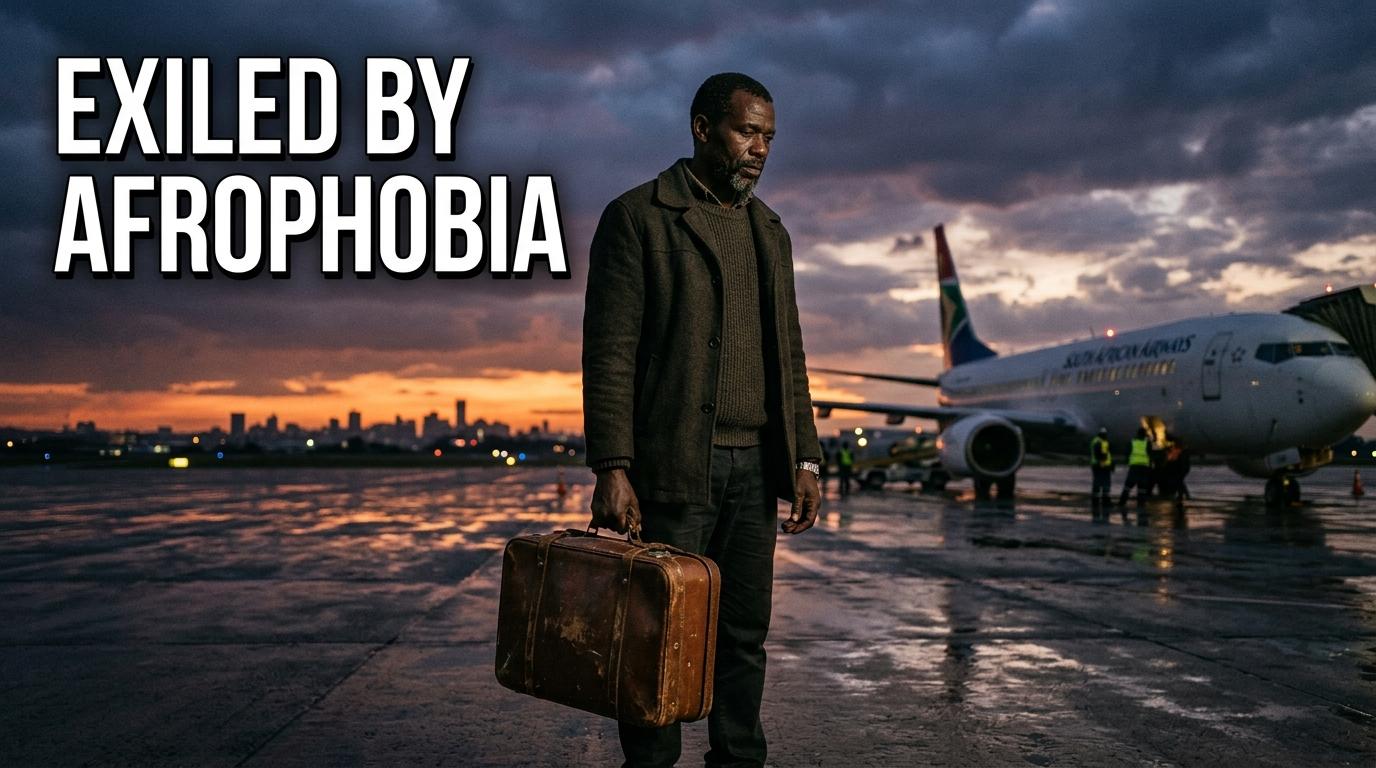
Why Are Black Migrants Targeted in South Africa Xenophobia?
By Darius Spearman (africanelements)
Support African Elements at patreon.com/africanelements and hear recent news in a single playlist. Additionally, you can gain early access to ad-free video content.
The 2026 Crisis and the Evacuation of African Migrants
In mid-2026, severe geopolitical tension erupted between Nigeria and South Africa (thestar.com.my, vanguardngr.com). A coordinated vigilante coalition called “March and March” issued an unofficial ultimatum across major cities (youtube.com, arcgis.com). The group demanded that all undocumented foreign nationals leave South Africa before June 30, 2026 (youtube.com, arcgis.com).
When the deadline drew near, peaceful demonstrations quickly turned into violent anti-immigrant riots (punchng.com, vanguardngr.com). Angry mobs attacked migrant-owned shops across Johannesburg, Pretoria, and Durban (punchng.com, vanguardngr.com). Hundreds of foreign nationals fled their homes to seek shelter in temporary camps or on public pavements (punchng.com, vanguardngr.com).
In response to the violence, the Nigerian government launched an emergency evacuation program (vanguardngr.com, flyairpeace.com). Nigeria partnered with the private domestic airline Air Peace to bring its citizens home safely (vanguardngr.com, flyairpeace.com). Air Peace CEO Dr. Allen Onyema organized multiple flights that evacuated roughly 1,490 Nigerians to Lagos (vanguardngr.com, flyairpeace.com).
During high-level diplomatic debriefings, Nigerian officials rejected the standard term “xenophobia” (vanguardngr.com, vanguardngr.com). Minister of State for Foreign Affairs Ambassador Sola Enikanolaiye and President Bola Tinubu urged analysts to use the term “Afrophobia” instead (vanguardngr.com, vanguardngr.com). They pointed out that the violence systematically targets Black Africans rather than foreign nationals from Western countries (vanguardngr.com, vanguardngr.com).
Apartheid’s Economic Architecture and Structural Poverty
To understand these recurring outbreaks, analysts must examine the lasting legacy of apartheid (wikipedia.org, leeds.ac.uk). The apartheid regime deliberately dispossessed Black South Africans of land and economic resources (wikipedia.org, wikipedia.org). Colonial laws like the 1913 Natives Land Act and the Group Areas Act of 1950 legally restricted Black land ownership (wikipedia.org, wikipedia.org).
These discriminatory policies pushed Black citizens into under-resourced townships located far away from urban job centers (leeds.ac.uk). Decades after the democratic transition of 1994, these geographic structures remain intact as spatial traps (leeds.ac.uk). Consequently, South Africa continues to suffer from extreme structural inequality (worldbank.org).
Economic data shows that wealth remains heavily concentrated in very few hands (worldbank.org). The wealthiest ten percent of the population holds approximately 85 percent of all household wealth (worldbank.org). Furthermore, the top one percent controls roughly 55 percent of national wealth (worldbank.org).
When post-apartheid economic growth failed to reach marginalized communities, intense public frustration began to build (ijr.org.za, georgetown.edu). Much like historical cases of failed economic promises, systematic poverty created ideal conditions for social unrest (ijr.org.za, georgetown.edu). Local political leaders frequently exploited these grievances by blaming foreign migrants for job scarcity and crime (ijr.org.za, hrw.org).
Labor Market Breakdown and the Expanded Definition of Unemployment
The primary engine driving local resentment is South Africa’s profound employment crisis (gcro.ac.za, econrsa.org). Government agencies measure labor metrics using two distinct standards (africacheck.org, statssa.gov.za). The narrow definition of unemployment only counts individuals who actively searched for employment within four weeks (africacheck.org, statssa.gov.za).
However, economists rely on the expanded definition of unemployment to assess true market distress (africacheck.org, econrsa.org). This broader metric includes discouraged work-seekers who desire employment but stopped searching due to systemic barriers (africacheck.org, statssa.gov.za). Under this expanded measure, national unemployment exceeded 41 percent in recent quarters (econrsa.org, statssa.gov.za).
In major commercial hubs like Johannesburg, the expanded unemployment rate reached 43.6 percent (gcro.ac.za, statssa.gov.za). Among young citizens, the rate soared to a staggering 60.2 percent (statssa.gov.za). This economic environment has fueled social instability as African workers rising against exploitation struggle for basic survival (ilrigsa.org.za).
Why Non-Black Immigrants Are Excluded From Xenophobic Attacks
A striking feature of anti-immigrant violence in South Africa is its selective nature (researchgate.net, scielo.org.za). Anti-immigrant mobs almost exclusively target Black migrants from other African nations (researchgate.net, scielo.org.za). Western European or North American residents rarely face physical threats or economic boycotts (researchgate.net, scielo.org.za).
Scholars explain that Western foreigners are viewed as tourists or wealthy expatriates (researchgate.net, scielo.org.za). In contrast, Black African immigrants face derogatory slurs like “makwerekwere” and are framed as economic burdens (researchgate.net, scielo.org.za). This dynamic reflects internalized racial biases inherited from colonial and apartheid social hierarchies (researchgate.net, scielo.org.za).
Furthermore, economic friction occurs directly inside crowded townships (georgetown.edu, georgetown.edu). Black African migrants and local residents compete over informal retail businesses and spaza shops (georgetown.edu, georgetown.edu). Meanwhile, white and Asian business owners typically operate in affluent, well-secured commercial districts (scielo.org.za).
Vulnerable local populations, living in underserved areas, experience constant economic pressure (ijr.org.za, georgetown.edu). Opportunistic politicians divert attention away from governance failures by focusing blame onto Black foreign workers (ijr.org.za, hrw.org). This scapegoating turns working-class communities against their continental neighbors (ijr.org.za, hrw.org).
A Historical Timeline of Recurring Outbreaks
The 2026 evacuations represent the latest chapter in a long history of anti-immigrant violence (wikipedia.org, polity.org.za). In May 2008, massive riots erupted in the Alexandra township of Johannesburg (wikipedia.org, wikipedia.org). The violence quickly spread across the country, leaving 62 people dead and displacing over 100,000 residents (wikipedia.org, wikipedia.org).
Another major wave broke out in April 2015 following public remarks by local leaders (theguardian.com, africanews.com). The brutal murder of Mozambican national Emmanuel Sithole in broad daylight triggered global outrage (theguardian.com, africanews.com). Foreign governments, including Malawi and Zimbabwe, were forced to evacuate thousands of their citizens (africanews.com).
In September 2019, violent attacks targeted Nigerian-owned businesses in Johannesburg (qz.com, wikipedia.org). The diplomatic fallout was swift and severe (qz.com, wikipedia.org). Nigeria boycotted the World Economic Forum in Cape Town and recalled its High Commissioner from Pretoria (qz.com, wikipedia.org).
According to Xenowatch, a research group at Witwatersrand University, xenophobic incidents have caused immense harm (polity.org.za). Between 1994 and early 2024, researchers recorded over 669 deaths, 5,310 looted shops, and 127,572 displacements (polity.org.za).
The Evolution of Coordinated Vigilantism
Over time, anti-immigrant sentiment shifted from spontaneous township riots into organized political networks (hrw.org, arcgis.com). Groups leveraged digital platforms to mobilize supporters and coordinate intimidation campaigns (hrw.org, arcgis.com).
In 2021, Operation Dudula emerged in Soweto, deriving its name from the Zulu word meaning “to push out” (wikipedia.org). The movement expanded rapidly into a national political entity (wikipedia.org, arcgis.com). Members conducted unlawful raids on foreign-owned businesses and blocked migrants from accessing public clinics and schools (wikipedia.org, hrw.org).
By 2026, groups like “March and March” refined these tactics into structured political ultimatums (youtube.com, arcgis.com). Human rights organizations accused law enforcement agencies of displaying passive acquiescence during these raids (hrw.org, hrw.org). Police officers frequently failed to protect vulnerable business owners during vigilante sweeps (hrw.org, hrw.org).
Air Peace and Private Sector Emergency Airlifts
The magnitude of the crisis required immediate intervention from private actors (vanguardngr.com, flyairpeace.com). Official census data indicates that South Africa hosts approximately 2.4 million international migrants, making up 3.9 percent of the national population (statssa.gov.za). Official surveys counted 30,314 documented Nigerians in 2016, though total community estimates range from 500,000 to 800,000 (researchgate.net, africacheck.org).
To rescue stranded citizens, the Nigerian Federal Government partnered with Air Peace (vanguardngr.com, thenationonlineng.net). Air Peace Chairman Dr. Allen Onyema deployed Boeing 777 wide-body aircraft to conduct humanitarian flights (vanguardngr.com, flyairpeace.com). Onyema covered a major portion of operational expenses using private corporate funds (guardian.ng, flyairpeace.com).
This operation reflected a long-standing commitment to humanitarian relief (guardian.ng, flyairpeace.com). Air Peace previously conducted free evacuation flights during crises in Sudan, Ukraine, and South Africa in 2019 (guardian.ng, flyairpeace.com). Such civic initiatives demonstrate enduring community resilience when state infrastructure faces extreme pressure (guardian.ng, flyairpeace.com).
Ghana, ECOWAS, and Continental Diplomatic Pressure
Ghana quickly became another focal point in the 2026 migration crisis (citinewsroom.com, classfmonline.com). Ghanaian nationals operating small businesses were violently targeted during township sweeps (citinewsroom.com). In response, Foreign Affairs Minister Samuel Okudzeto Ablakwa launched a large-scale evacuation initiative (citinewsroom.com, classfmonline.com).
The Ghanaian government repatriated 926 citizens during Phase 1 of its airlift operation (citinewsroom.com). Officials prepared to return another 1,000 individuals in Phase 2 (citinewsroom.com). Returning citizens received GH¢5,500 in reintegration grants, mental health support, and job placement assistance (citinewsroom.com, classfmonline.com).
Ghana elevated the issue to the continental stage by mobilizing regional allies (thesun.ng, citinewsroom.com). Accra secured official backing from the Economic Community of West African States (thesun.ng, citinewsroom.com). Established on May 28, 1975, via the Treaty of Lagos, ECOWAS unites 15 West African nations to foster economic stability and collective security (nilds.gov.ng, wikipedia.org).
Using ECOWAS frameworks, Ghana petitioned the African Union to hold South Africa accountable (thesun.ng, citinewsroom.com). West African leaders demanded strict enforcement of continental charters protecting migrant rights (thesun.ng, citinewsroom.com).
Bilateral Negotiations, Reparations, and the Early Warning Mechanism
High-level negotiations began in Abuja between Nigerian representatives and South African International Relations Minister Ronald Lamola (thestar.com.my, africanews.com). The Nigerian government compiled a formal inventory of economic damages to demand financial compensation for affected citizens (thestar.com.my, guardian.ng).
Minister Lamola condemned the violence and insisted that the attacks were not state-sponsored (thestar.com.my, africanews.com). However, South African authorities resisted direct liability claims (thestar.com.my, guardian.ng). They emphasized concerns regarding undocumented migration and local crime enforcement (thestar.com.my, guardian.ng).
To prevent future outbreaks, both governments agreed to activate the Early Warning Mechanism (nilds.gov.ng, kusamotu.com). This joint bilateral framework brings together diplomats, law enforcement officers, and community representatives (nilds.gov.ng, kusamotu.com). The unit monitors local social tensions, shares intelligence, and executes early intervention strategies before mobs assemble (nilds.gov.ng, kusamotu.com).
Long-term solutions require dismantling systemic prejudices across the African continent (ijr.org.za, leeds.ac.uk). Scholars emphasize that decolonizing African education systems can foster pan-African unity and eradicate anti-Black violence (leeds.ac.uk). Until governments resolve underlying economic inequities, vulnerable migrants will remain caught in recurring cycles of displacement (ijr.org.za, polity.org.za).
About the Author
Darius Spearman is a professor of Black Studies at San Diego City College, where he has been teaching for over 20 years. He is the founder of African Elements, a media platform dedicated to providing educational resources on the history and culture of the African diaspora. Through his work, Spearman aims to empower and educate by bringing historical context to contemporary issues affecting the Black community.
