


Why Caribbean Emancipation Left Millions Without Land
By Darius Spearman (africanelements)
Support African Elements at patreon.com/africanelements and hear recent news in a single playlist. Additionally, you can gain early access to ad-free video content.
The Emancipation Call from the Caribbean
Emancipation Day observances across the Caribbean celebrate the end of legal chattel slavery. Yet, regional scholars and policy experts emphasize that legal freedom did not create economic equality. During recent regional commemorations, the P.J. Patterson Institute for Africa-Caribbean Advocacy at The University of the West Indies issued a critical statement. The advocacy group declared that genuine liberation remains incomplete without structural land reform, economic self-determination, and formal European reparations (jamaica-gleaner.com, uwi.edu).
This call connects contemporary poverty and landlessness directly to the legal mechanics of nineteenth-century colonial policies. Political independence achieved during the twentieth century did not undo the economic structures built during slavery. Across the African diaspora, the broader struggle for economic justice demonstrates that civil rights without property access leave communities vulnerable. Understanding current demands requires examining how colonial governments designed emancipation to enrich former enslavers while depriving former enslaved people of land and capital (uwi.edu, uwi.edu).
The 1833 Abolition Act: Paying the Enslavers
When the British Parliament passed the Slavery Abolition Act of 1833, it established a financial model that enriched plantation owners. The legislation authorized £20 million in government compensation to roughly 46,000 white slave owners for the loss of their property (wikipedia.org, nationalarchives.gov.uk). That sum represented approximately 40 percent of the annual budget of the United Kingdom at the time (wikipedia.org, nationalarchives.gov.uk). British authorities reinvested this massive capital payout into banks, industrial infrastructure, and private estates across Britain (bankofengland.co.uk, gla.ac.uk).
The more than 800,000 newly freed Africans received zero financial compensation for centuries of unpaid labor (wikipedia.org, nationalarchives.gov.uk). Instead of capital grants, the British government forced emancipated people into an apprenticeship system from 1834 until 1838 (wikipedia.org, nationalarchives.gov.uk). This policy compelled freed individuals to work 45 hours per week without wages for their former captors (wikipedia.org). Furthermore, the British Treasury borrowed funds to pay the enslaver compensation, incurring a national debt that British taxpayers did not finish paying off until February 2015 (bankofengland.co.uk, theguardian.com).
Land Alienation and the Legacy of Ruinate Land
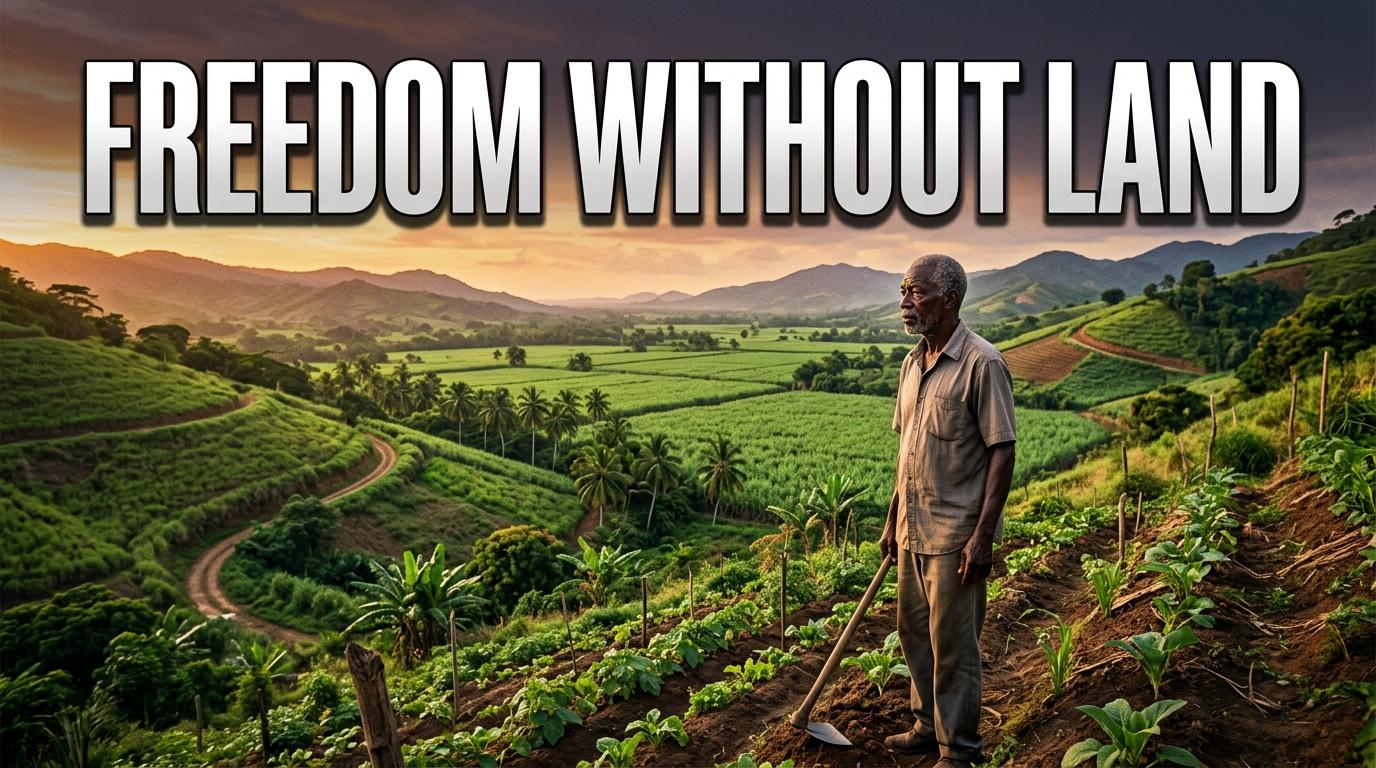
Following full emancipation in 1838, colonial legislatures enacted targeted measures to restrict access to land. Planters required a cheap, dependent labor force to maintain sugarcane yields. Consequently, colonial governments reserved the most fertile coastal and alluvial agricultural lands exclusively for sugar estates (jamaica-homes.com). Freed people seeking self-sufficiency were forced to purchase or squat on steep, rocky hillside plots commonly designated as ruinate land (jamaica-homes.com).
Colonial administrators also manipulated Crown land laws to block Black landownership. Land without formal European titles was declared property of the British Crown (jamaica-homes.com). Colonial authorities levied heavy taxes on smallholder farming trades while raising land rents. High taxes and landlessness triggered severe economic hardship, culminating in the Morant Bay Rebellion of 1865 in Jamaica (wikipedia.org). Led by Paul Bogle and George William Gordon, peaceful demonstrators petitioned Queen Victoria for fair land access (wikipedia.org). The colonial government refused their requests and suppressed the movement through brutal martial law (wikipedia.org).
Structural land barriers stemming from post-emancipation tenure systems
Family Land and Modern Property Roadblocks
To survive intense colonial land restriction, emancipated Afro-Caribbean communities created custom tenure structures known as family land. Family land represents property purchased collectively or settled by former enslaved workers and passed down to all blood descendants (jamaica-homes.com). No individual family member holds a separate paper deed, and the land cannot be sold to outsiders (jamaica-homes.com). This custom protected family lineage and prevented landlessness across generations (jamaica-homes.com).
However, this historical protection mechanism creates significant legal obstacles within modern financial systems. In Jamaica today, roughly 350,000 land parcels—representing about 40 percent of all occupied land—exist outside the formal property registration system (jamaica-homes.com). Because occupants lack individual legal titles, financial institutions do not accept family land as collateral for loans (jamaica-homes.com). Consequently, working families cannot leverage their land to build business equity, secure mortgages, or invest in agricultural technology. This systemic barrier limits Black economic agency across the region (jamaica-homes.com).
CARICOM and the Evolution of Regional Advocacy
Recognizing these historical disparities, Caribbean leaders organized collective political structures to pursue systemic repair. Established in 1973 by the Treaty of Chaguaramas, the Caribbean Community (CARICOM) functions as an intergovernmental organization representing 15 full member states (caricom.org, caricom.org). These states include Jamaica, Barbados, Guyana, Trinidad and Tobago, and Haiti (caricom.org). Governance authority sits with the Conference of Heads of Government, which directs regional policy and foreign diplomacy (caricom.org).
In 2013, CARICOM heads of government created the CARICOM Reparations Commission to lead claims against former European colonial powers (caricomreparations.org, caricomreparations.org). Chaired by academic Sir Hilary Beckles, the commission established the CARICOM 10-Point Plan for Reparatory Justice in 2014 (caricomreparations.org, caricomreparations.org). This initiative outlines crucial demands, including formal state apologies, debt cancellation, indigenous development programs, institutional funding, and technology transfer (caricomreparations.org, caricom.org). Through this unified platform, regional governments frame historical redress as an international development strategy rather than charitable aid (caricomreparations.org, caricomreparations.org). Joining global pursuit of reparations movements, CARICOM presents a legal case anchored in state responsibility (caricomreparations.org, jurist.org).
Quantifying the Damage: The Brattle Group Study
A landmark economic report published in June 2023 provided precise calculations regarding European financial liability for transatlantic chattel slavery (brattle.com). Titled Report on Reparations for Transatlantic Chattel Slavery in the Americas and the Caribbean, the study was conducted by the global economic firm The Brattle Group (brattle.com). The analysis was commissioned alongside The University of the West Indies and the American Society of International Law under the leadership of former International Court of Justice Judge Patrick Robinson (brattle.com).
The report calculates aggregate present-value economic harm caused by chattel slavery across 31 countries at between $100 trillion and $131 trillion (brattle.com). The quantification includes stolen labor, loss of life, personal injury, and mental suffering (brattle.com). According to the study, the United Kingdom carries an estimated reparations liability of $24 trillion to 14 Caribbean nations, with $9.5 trillion owed to Jamaica alone (brattle.com). Furthermore, the study determined that the United States owes $26 trillion, Spain owes $17 trillion, and France owes $9 trillion (brattle.com).
Estimated present-value financial damage by enslaving state (in Trillions USD)
Institutional Repair and European Responses
In response to academic research, some educational institutions have established independent reparatory programs. In 2019, the University of Glasgow signed a historical memorandum of understanding with The University of the West Indies (gla.ac.uk). The Scottish university acknowledged benefiting directly from nineteenth-century slave trade gifts and endowments (gla.ac.uk). To repair that historical benefit, Glasgow committed £20 million over 20 years to fund the Glasgow-Caribbean Centre for Development Research (gla.ac.uk). The partnership supports joint degree programs, medical research into chronic diseases, and environmental science (gla.ac.uk).
Conversely, European state governments continue to reject direct financial reparations claims. The British government repeatedly declines formal financial liability, preferring non-binding trade partnerships and climate development funds (theguardian.com, theguardian.com, theguardian.com). Official statements from European capitals express deep regret but avoid legal admissions of wrongdoing (theguardian.com, theguardian.com). Consequently, CARICOM states are considering international legal mechanisms. Caribbean leaders continue analyzing options to request an Advisory Opinion from the International Court of Justice regarding historic state liability (thewardpost.com, jurist.org).
Connecting Diasporic Struggles for Land and Justice
The Caribbean struggle for land reform mirrors historical and contemporary Black land loss in the United States. Following the American Civil War, Union General William T. Sherman issued Special Field Orders No. 15, promising 40 acres and a mule to newly freed families (msu.edu). President Andrew Johnson quickly revoked that mandate, returning confiscated southern lands to former Confederate slaveholders (msu.edu). This federal reversal stripped millions of Black Americans of wealth-generating land during Reconstruction (msu.edu).
Throughout the twentieth century, discriminatory lending practices by agricultural agencies and predatory legal mechanics caused Black farmers in the United States to lose over 90 percent of their farmland (modernfarmer.com). Similar to informal family land tenure in the Caribbean, heir property arrangements in the American South left Black families vulnerable to forced partition sales (modernfarmer.com). Today, advocacy bodies like the CARICOM Reparations Commission collaborate with international organizations and legislative commissions studying historical harms to push for global economic repair (caricomreparations.org, jurist.org).
The Path Forward for Economic Liberation
The message issued by the P.J. Patterson Institute emphasizes that celebratory observances cannot replace structural economic reform (jamaica-gleaner.com, uwi.edu). Real liberation requires active state intervention to resolve land title insecurity (jamaica-gleaner.com, uwi.edu). Regional legal scholars urge Caribbean governments to streamline land titling processes, establish public land banks, and convert informal family land into recognized economic capital (uwi.edu, jamaica-homes.com). These measures aim to provide working families with legal security and investment access (uwi.edu, jamaica-homes.com).
Furthermore, the Institute advocates for stronger diplomatic and economic ties between CARICOM and the African Union (uwi.edu, uwi.edu). By aligning policies, African and Caribbean nations aim to reform global trade structures and challenge unequal international debt arrangements (uwi.edu, uwi.edu). The movement for Caribbean reparatory rights demonstrates that true emancipation is an ongoing process. Converting political independence into property ownership, structural land rights, and economic self-determination remains the final frontier of regional freedom (jamaica-gleaner.com, uwi.edu).
About the Author
Darius Spearman is a professor of Black Studies at San Diego City College, where he has been teaching for over 20 years. He is the founder of African Elements, a media platform dedicated to providing educational resources on the history and culture of the African diaspora. Through his work, Spearman aims to empower and educate by bringing historical context to contemporary issues affecting the Black community.
