


Why Is the Global Reparations Movement Exploding Now?
By Darius Spearman (africanelements)
Support African Elements at patreon.com/africanelements and hear recent news in a single playlist. Additionally, you can gain early access to ad-free video content.
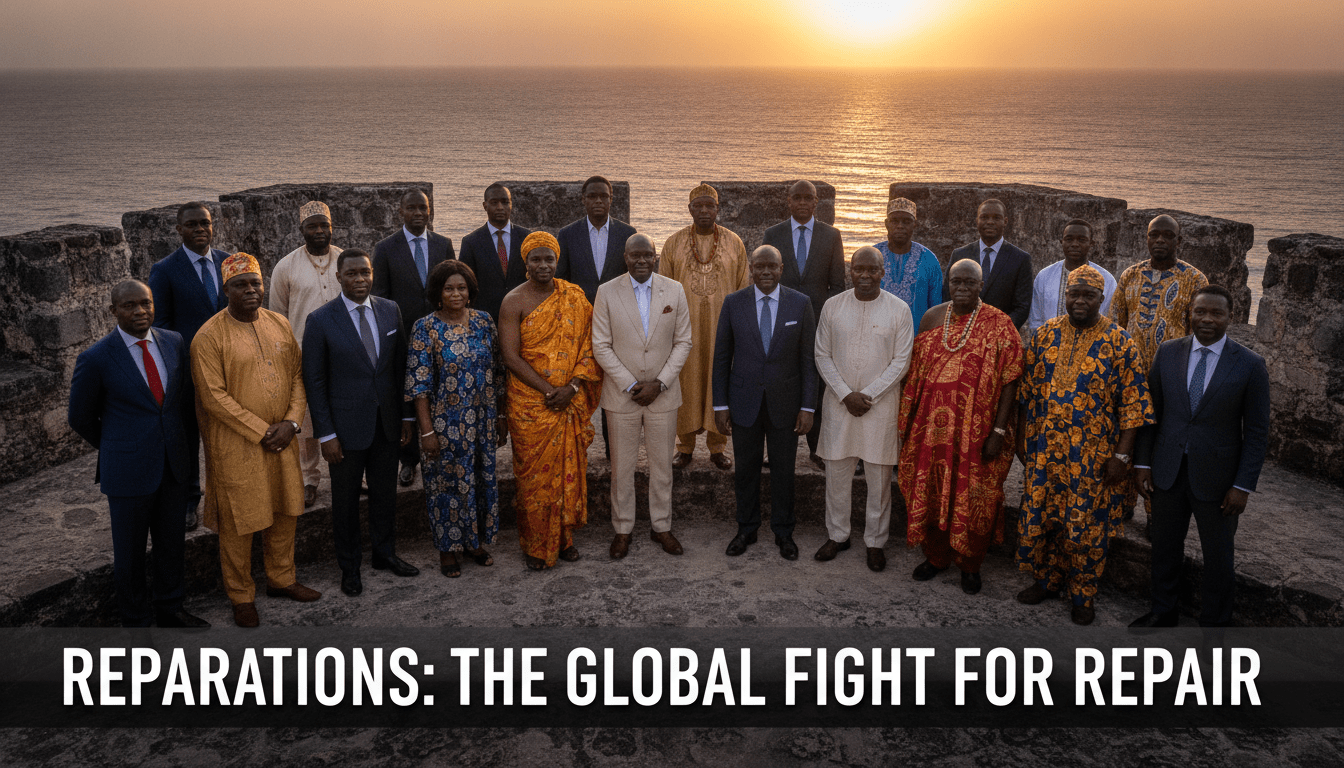
The world is witnessing a dramatic shift in the fight for historical accountability. In mid-June 2026, leaders, policymakers, and scholars from over eighty nations met in Accra, Ghana (mfa.gov.gh, news.cn). They gathered to address the lasting scars of the transatlantic slave trade (premiumtimesng.com). This landmark gathering followed a historic United Nations resolution (theguardian.com, premiumtimesng.com). The UN officially declared transatlantic chattel slavery as the gravest crime against humanity (theguardian.com, news.cn).
The meetings in Accra produced a unified framework for repair (mfa.gov.gh, news.cn). Under the leadership of Ghanaian President John Dramani Mahama, delegates signed a historic commitment (theguardian.com). This document outlines actionable steps for financial compensation, debt relief, and cultural restitution (theguardian.com, premiumtimesng.com). Yet, to understand this sudden momentum, one must look deep into the past. The conversation did not begin in Accra. It is the result of centuries of struggle.
Understanding Chattel Slavery and the Horrors of the Middle Passage
To appreciate the demands made in Ghana, one must understand the unique brutality of chattel slavery (wikipedia.org). Chattel slavery is a distinct legal and social system of enslavement (wikipedia.org). In this system, human beings are legally classified as personal property (wikipedia.org). They are treated, bought, sold, and inherited as commercial commodities (wikipedia.org, wikipedia.org). This system completely strips individuals of their civil, political, and basic human rights (wikipedia.org). It is absolute, multigenerational, and deeply racialized (wikipedia.org, britannica.com). The status of enslavement automatically passed to the offspring of enslaved women (britannica.com). This created a permanent, hereditary caste based entirely on race (wikipedia.org, britannica.com).
This system was fueled by the Middle Passage (wikipedia.org). The Middle Passage refers to the brutal maritime voyage across the Atlantic Ocean (wikipedia.org, slaveryandremembrance.org). It was the second leg of the triangular trade route connecting Europe, Africa, and the Americas (wikipedia.org, slaveryandremembrance.org). Approximately twelve million African people were forced onto overcrowded, disease-ridden vessels (wikipedia.org, slaveryandremembrance.org). Captives were chained closely together in suffocating ship holds (pbs.org, slaveryandremembrance.org). They had no bodily autonomy or physical agency (slaveryandremembrance.org). Nearly two million Africans died during this crossing (wikipedia.org). They succumbed to dehydration, dysentery, and extreme violence (slaveryandremembrance.org). This historical trauma laid the foundation for modern global inequality.
The Historical Paradox of Compensation for Slaveholders
When European nations abolished slavery, they did not compensate the victims (theguardian.com, aljazeera.com). Instead, they compensated the slaveholders (theguardian.com). This historical paradox is central to the modern debate (theguardian.com, aljazeera.com). In 1833, the British government passed the Slavery Abolition Act (theguardian.com). Under this act, Great Britain paid twenty million pounds to slave owners (theguardian.com). This massive payout compensated them for the loss of their human property (theguardian.com). The sum represented roughly forty percent of the national budget of the United Kingdom (theguardian.com). To finance this, the government took out a massive loan (theguardian.com). British taxpayers did not finish paying off this debt until the year 2015 (theguardian.com). The liberated African people received nothing for their lifetimes of stolen labor (theguardian.com, theguardian.com).
A similar injustice occurred in the Caribbean (theguardian.com). Following the successful Haitian Revolution, Haiti became the first independent Black republic (theguardian.com, wikipedia.org). However, French warships surrounded the island in 1825 (theguardian.com, aljazeera.com). Under duress, Haitian President Jean-Pierre Boyer agreed to pay France a massive indemnity (theguardian.com, aljazeera.com). The ransom of one hundred fifty million gold francs compensated former French slaveholders (theguardian.com, aljazeera.com). This sum is equivalent to twenty-one billion dollars in modern terms (theguardian.com). This debt crippled the economy of Haiti for over a century (theguardian.com, aljazeera.com). It remains the root cause of structural poverty in the country today (theguardian.com, aljazeera.com).
The Paradox of Historic Compensations
Source: Historical archives detailing post-abolition financial settlements.
From Abuja to Durban: The Modern Road to Reparations
The contemporary push for global repair began decades ago (guardian.ng, guardian.ng). In April 1993, the First Pan-African Conference on Reparations met in Abuja, Nigeria (guardian.ng). This meeting was sponsored by the Organisation of African Unity (guardian.ng, guardian.ng). The Organisation of African Unity was an intergovernmental body founded in May 1963 (wikipedia.org). It aimed to promote continental unity and eliminate colonization (wikipedia.org). In 2002, this organization was succeeded by the modern African Union (wikipedia.org). The transition shifted the focus from political decolonization to continental economic challenges and regional integration (au.int, wikipedia.org).
The Abuja conference was championed by Chief Moshood Kashimawo Olawale Abiola (guardian.ng, guardian.ng). Chief Abiola was a wealthy Nigerian philanthropist (guardian.ng, guardian.ng). He funded the Group of Eminent Persons to build a case for reparations (guardian.ng, guardian.ng). This group included prominent figures like Ali Mazrui and Miriam Makeba (guardian.ng). The resulting Abuja Proclamation declared that the damages of slavery were not a thing of the past (guardian.ng, guardian.ng). It called for the recognition of an unprecedented moral debt (guardian.ng, guardian.ng). However, the movement slowed after Chief Abiola was imprisoned in June 1993 (guardian.ng). He later died in prison in 1998 (guardian.ng). Later, in 2001, the UN World Conference against Racism in Durban renewed the fight (theguardian.com). Durban marked the first time the international community formally debated labeling the slave trade a crime against humanity (theguardian.com). Yet, the September 11 attacks quickly shifted global priorities away from the Durban declaration (theguardian.com).
The Caribbean Blueprint and the CARICOM Ten-Point Plan
The movement regained its structure in the Caribbean region (theguardian.com). In 2013, the Caribbean Community established the CARICOM Reparations Commission (theguardian.com, caricom.org). This commission was tasked with creating a formal path forward (theguardian.com, caricom.org). In March 2014, the commission published its landmark Ten-Point Action Plan for Reparatory Justice (caricom.org). This document serves as the primary template for modern demands (theguardian.com).
The plan demands a formal and unconditional apology from former colonial powers (caricom.org, caricom.org). It also calls for repatriation, cultural restitution, and public health funding (caricom.org, caricom.org). Advocates argue that the founding legal frameworks of many Western nations protected the wealth stolen during colonization. The CARICOM plan addresses these historical legal shields (caricom.org). It connects past exploitation to current development challenges (theguardian.com, caricom.org). The framework also demands the cancellation of national debts and technology transfers (caricom.org). This blueprint laid the groundwork for African nations to join the struggle (theguardian.com).
The Accra Next Steps Commitment and the Global Coalition
Ghana has established itself as the center of the global reparations movement (theguardian.com). This effort is known as the Accra Dynamic (theguardian.com). In August 2022, delegates signed the Accra Declaration on Reparations and Healing (accrasummit.com). This summit focused on the psychological recovery of the African diaspora (accrasummit.com). In November 2023, former Ghanaian President Nana Akufo-Addo hosted the second major summit (theguardian.com, news.cn). That meeting produced the Accra Proclamation (theguardian.com). It demanded the creation of a global reparations fund (theguardian.com).
This momentum culminated in the June 2026 “Next Steps” High-Level Consultative Conference (mfa.gov.gh). The meeting took place at Osu Castle in Accra (theguardian.com, youtube.com). This castle was a 17th-century Danish fortress where enslaved Africans were once held (theguardian.com, youtube.com). The 2026 conference shifted the focus from symbolic apologies to direct action (theguardian.com). Delegates adopted the Accra Next Steps Commitment on Reparatory Justice (theguardian.com, mfa.gov.gh). This framework established an Advisory Council on Reparatory Justice (mfa.gov.gh). It also created panels of legal and cultural experts to oversee restitution (mfa.gov.gh). The global diaspora and continental Africa are now acting as a single, united front (theguardian.com, news.cn).
The Roadmap: The Accra Dynamic
Signed the Accra Declaration focusing on healing and the psychological recovery of the diaspora.
Produced the Accra Proclamation, demanding the establishment of a global reparations fund.
The UN General Assembly declares transatlantic trafficking the “gravest crime against humanity.”
Adopted the Commitment framework and created dedicated legal, cultural, and advisory expert panels.
The Incalculable Bill: Economic Calculations of the Brattle Group
Calculating the financial value of centuries of stolen labor is a massive task (brattle.com, brattle.com). In 2023, the Brattle Group published a landmark economic study (brattle.com, brattle.com). This study was led by economic experts and former International Court of Justice Judge Patrick Robinson (brattle.com). The report analyzed the financial damages of transatlantic chattel slavery across thirty-one countries (brattle.com). It concluded that former slave-owning nations owe a combined total of one hundred seven point eight trillion dollars in reparations (brattle.com).
The study used an established economic methodology to calculate these figures (brattle.com, brattle.com). The researchers built upon a framework proposed by Professor Thomas Craemer (brattle.com). This model calculates the value of uncompensated labor (brattle.com). It measures the actual wages that enslaved people should have received (brattle.com). The economists estimated these historical wages at the time they were stolen (brattle.com). They then brought the financial value forward to modern dollars (brattle.com). They used a compounding interest rate of two point three to two point five percent (brattle.com). The calculations also account for specific legal heads of damages (brattle.com). These include loss of life, loss of liberty, personal injury, and mental anguish (brattle.com).
Estimated Reparations Liabilities (Brattle Group)
Source: 2023 Brattle Group economic assessment report.
Defining Heritage: Who Qualifies for Reparations in the United States?
A major question in the United States is who should receive reparations (blackwallstreet.org, calmatters.org). The California Reparations Task Force established a landmark model for this debate (calmatters.org). This state-level initiative chose a lineage-based framework rather than a race-based one (calmatters.org). To qualify, an individual must prove direct descent from an enslaved person (calmatters.org). Eligible individuals include descendants of antebellum chattel enslaved people (calmatters.org). It also includes descendants of free Black persons living in the United States before the end of the nineteenth century (calmatters.org).
Under this strict rule, Black immigrants who arrived in the twentieth or twenty-first centuries do not qualify (calmatters.org, adosfoundation.org). Verification relies on a process called reparative genealogy (precinctreporter.com). Applicants must trace their lineage using historical records (precinctreporter.com). These records include federal census data, state vital records, and military databases (precinctreporter.com). The Freedmen’s Bureau records are also highly critical for this research (nps.gov, precinctreporter.com). Furthermore, state legislatures have started to involve university systems (legiscan.com, ca.gov). They are tasked with researching and implementing secure genealogical verification processes (legiscan.com).
Geopolitical Resistance and the United States Government Response
The United States government maintains a strong stance against the global reparations movement (usmission.gov). On March 25, 2026, the United States voted against the historic UN General Assembly resolution on slavery (usmission.gov). Only Israel and Argentina joined the United States in opposing the measure (usmission.gov). The United States government officially stated that it does not recognize a legal right to reparations for historical wrongs (usmission.gov). The administration argued that these practices were not illegal under international law when they occurred (usmission.gov).
Furthermore, United States Representative Dan Negrea formally objected to the resolution (usmission.gov). He argued against ranking historical atrocities in a hierarchy (usmission.gov). The representative stated that labeling slavery as the gravest crime diminishes the suffering of other historical victims (usmission.gov). The United States also objects to using historical injustices to redistribute modern resources (usmission.gov). Government officials criticize what they call the cynical usage of history to allocate wealth to distant descendants (usmission.gov). This political opposition remains a major hurdle for advocates of reparatory justice (theguardian.com).
Beyond Cash: Alternative Paths to Reparative Justice
Direct cash payments are politically and economically complex (calmatters.org, calmatters.org). Because of this, advocates are proposing alternative forms of repair (acgov.org). These remedies aim to close the racial wealth gap through structural programs (acgov.org, ca.gov). Many of these issues trace back to the period of reconstruction and post-emancipation labor, when freed people were denied land and capital. Today, housing programs are a primary alternative (acgov.org). One example is the Homeownership Reparative Transfer program (acgov.org). This program offers direct grants for down payments and closing costs (acgov.org). It helps first-time Black homebuyers build generational wealth (acgov.org).
Educational models are also highly prominent (mindingthecampus.org, ca.gov). These proposals include tuition-free higher education for descendants of the enslaved (mindingthecampus.org, ca.gov). Some plans advocate for establishing satellite Historically Black College or University campuses in urban centers (ca.gov). Others demand the cancellation of student loan debt for eligible populations (ca.gov). Economic programs include business development grants and interest-free loans (acgov.org, ca.gov). Finally, policy reforms recommend creating dedicated state agencies, such as an Office of Freedmen Affairs, to oversee these initiatives (acgov.org, ca.gov).
Climate Reparations and Intersectional Justice for the Diaspora
The discussion in Accra also highlighted the modern issue of climate change (powershiftafrica.org). Climate reparations, or payments for loss and damage, are a key demand (powershiftafrica.org, globaljustice.org.uk). Highly industrialized nations are asked to compensate developing countries for ecological damages (powershiftafrica.org, globaljustice.org.uk). This concept directly links historical slavery to modern climate vulnerability (powershiftafrica.org, globaljustice.org.uk). Centuries of colonial resource extraction left these regions without the infrastructure to survive modern disasters (powershiftafrica.org).
The uncompensated labor of the enslavement era built the wealth of the Global North (powershiftafrica.org). This wealth fueled the industrialization that generated most global greenhouse gas emissions (powershiftafrica.org). Meanwhile, the colonized regions were systematically underdeveloped (powershiftafrica.org). The colonial powers dismantled natural local defense systems (powershiftafrica.org). Today, the descendants of the enslaved face the worst consequences of climate change (powershiftafrica.org). They experience rising sea levels, severe hurricanes, and food insecurity (powershiftafrica.org). They must face these disasters with very few resources (powershiftafrica.org). Therefore, climate justice is now seen as an essential part of reparatory justice (theguardian.com, powershiftafrica.org).
The 2026 Accra meetings mark a permanent shift in global politics (theguardian.com, mfa.gov.gh). The demand for reparatory justice is no longer just a marginal debate (theguardian.com). Instead, it has become a highly organized, state-backed international movement (theguardian.com, news.cn). With the support of key UN resolutions and robust economic studies like the Brattle Group report, advocates possess the tools to make their case on the world stage (theguardian.com, premiumtimesng.com, brattle.com).
While major powers like the United States continue to resist, the coalition between Africa and the diaspora grows stronger every day (theguardian.com, usmission.gov). The conversation has permanently moved from whether a debt is owed to how that debt will finally be paid (theguardian.com). The momentum of the Accra Next Steps Commitment shows that the global community is finally ready to confront the ghosts of its past (theguardian.com, mfa.gov.gh).
About the Author
Darius Spearman is a professor of Black Studies at San Diego City College, where he has been teaching for over 20 years. He is the founder of African Elements, a media platform dedicated to providing educational resources on the history and culture of the African diaspora. Through his work, Spearman aims to empower and educate by bringing historical context to contemporary issues affecting the Black community.
