



Why Is the U.S. Sending 1,200 Deportees to Liberia?
By Darius Spearman (africanelements)
Support African Elements at patreon.com/africanelements and hear recent news in a single playlist. Additionally, you can gain early access to ad-free video content.
A New Pipeline for Third-Country Deportations
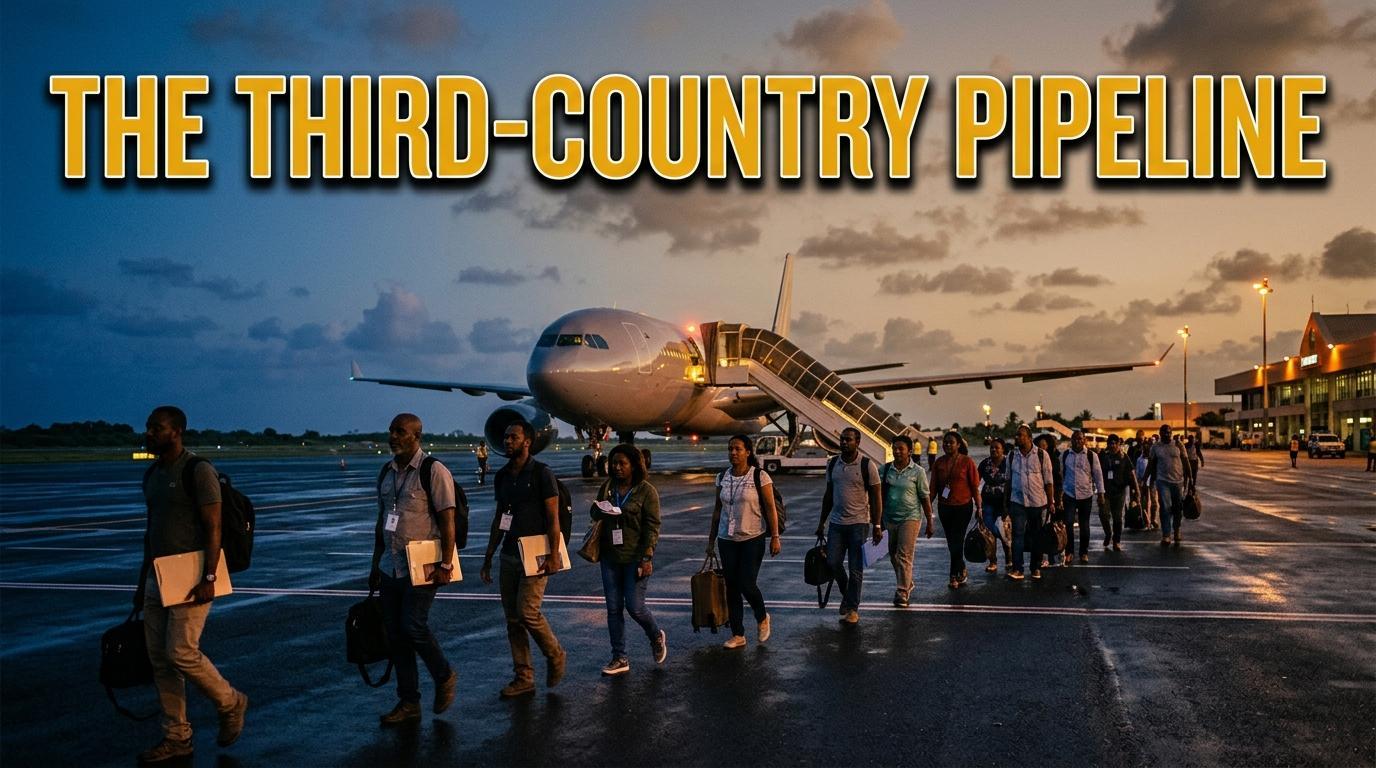
A diplomatic arrangement between Washington and Monrovia has opened a controversial new chapter in immigration policy. Under this bilateral framework, the United States plans to transfer up to 1,200 third-country deportees to the Republic of Liberia over twelve months. The initial flight transported a cohort of twenty individuals directly to Roberts International Airport (thevoiceofafrica.com, unn.ua).
The individuals selected for these flights are not Liberian citizens. Instead, they include foreign nationals originating from across Africa, the Caribbean, and the Americas who were detained in the American immigration system. This operation marks one of the most ambitious third-country removal efforts arranged by Washington in modern history (thirdcountrydeportationwatch.org, thirdcountrydeportationwatch.org).
The Roots of the American Colonization Society
The foundation of Liberia has always been tied to American racial politics. In 1816, white politicians and enslavers formed the American Colonization Society. Leaders like Henry Clay and Bushrod Washington asserted that free Black people could not exist harmoniously alongside white Americans. Consequently, the society arranged the first settlement of freed Black people in West Africa in 1822 (ucsb.edu).
Slaveholders supported this organization because free Black populations were seen as an ideological threat to chattel slavery. Removing free Black people was a calculated effort to preserve white authority in North America. Black abolitionists, including Frederick Douglass and James Forten, vehemently opposed colonization. They argued that Black Americans had earned rightful citizenship through their labor and blood, echoing the early battles where black workers fought against systemic exclusion (ucsb.edu).
Historical Entanglements and Societal Divides
When Americo-Liberian settlers established the independent Republic of Liberia in 1847, they adopted governance systems that mirrored the United States. The national flag, the constitution, and the capital city of Monrovia reflected deep American connections. However, the settlement also created severe social hierarchies between Americo-Liberian elites and indigenous ethnic groups (ucsb.edu).
These historical divides contributed to prolonged domestic instability in the late twentieth century. Two brutal civil wars erupted between 1989 and 2003, claiming more than 250,000 lives and uprooting over one million citizens. Tens of thousands of Liberians fled to the United States seeking sanctuary, establishing vibrant diaspora communities across Minnesota, New York, Pennsylvania, and New Jersey (ucsb.edu, uscis.gov).
Decades of Precarious Status for the Liberian Diaspora
For more than three decades, the Liberian diaspora in America navigated an unstable immigration system. In 1991, President George H.W. Bush designated Liberians for Temporary Protected Status due to armed conflict. When that designation lapsed, presidential directives granted Deferred Enforced Departure to suspend removals (ucsb.edu, uscis.gov).
Temporary Protected Status is a statutory relief program authorized by Congress, whereas Deferred Enforced Departure is an administrative relief granted directly by the executive branch. Successive administrations repeatedly extended these temporary shields. This protracted precarity forced thousands of families to live in legal limbo, demonstrating how African American families have continually maintained resilience against institutional disruptions (ucsb.edu, uscis.gov).
Relief finally arrived in December 2019 through the passage of the Liberian Refugee Immigration Fairness Act. This historic legislation established a pathway to lawful permanent resident status for qualifying Liberians. However, the legacy of conditional residency remains fresh in the collective memory of the diaspora, generating deep sensitivity toward modern deportation practices (uscis.gov).
Understanding Non-Refoulement and Protection Orders
Human rights monitors have raised urgent alarms regarding the international legal standards governing these transfers. Central to this controversy is the principle of non-refoulement, codified in Article 33 of the 1951 United Nations Refugee Convention and Article 3 of the Convention Against Torture. This non-derogable obligation forbids countries from expelling individuals to territories where they face torture or severe persecution (humanrightsfirst.org, amnesty.org).
In the United States, immigration judges grant Withholding of Removal and Convention Against Torture relief to protect vulnerable individuals. While political asylum requires demonstrating a well-founded fear of persecution, Withholding of Removal demands meeting a higher standard of clear probability. These protections are country-specific; they strictly prohibit removal to the native country, but they permit deportation to an alternate third country that agrees to receive the person (humanrightsfirst.org, amnesty.org).
The Threat of Chain-Refoulement and Stranded Migrants
Legal advocates emphasize that third-country removals create a significant risk of chain-refoulement. This occurs when a recipient third nation fails to maintain robust asylum safeguards and subsequently returns individuals to the dangerous territories from which they originally escaped. Human rights organizations argue that removing non-citizens to nations with fragile administrative capacity effectively undermines judicial protection orders (humanrightsfirst.org, amnesty.org).
The Liberian government has insisted that transferees arrive as guests of the republic rather than criminal detainees. Officials state that transferred persons may apply for domestic asylum or depart the country at will. Yet, practical barriers make spontaneous departure nearly impossible for most deportees (thevoiceofafrica.com, unn.ua).
Deported individuals routinely arrive without national passports, transit visas, or sufficient financial resources to book international travel. Furthermore, neighboring West African nations enforce strict border requirements for travelers who do not possess ECOWAS documentation. As a result, transferees who cannot secure formal legal status in Monrovia risk facing permanent destitution, severe linguistic barriers, and geographic confinement (thirdcountrydeportationwatch.org, thirdcountrydeportationwatch.org).
Diplomatic Leverage and Migration Externalization
The agreement between Washington and Monrovia is part of a broader international pattern called migration externalization. Wealthy Western nations increasingly outsource immigration enforcement, border management, and asylum processing to developing countries. Across Africa, multiple governments have engaged in similar third-country removal discussions or reception pacts (humanrightsfirst.org, thirdcountrydeportationwatch.org).
Diplomatic incentives and financial leverage play a central role in securing these bilateral accords. Shortly after Liberian officials agreed to accept third-country transferees, the United States extended the validity of business and tourism visas for Liberian citizens from twelve months to thirty-six months. In addition, Washington committed direct technical assistance for Liberian border systems and allocated $124 million to support domestic public health services (aljazeera.com, aljazeera.com).
Diaspora Pushback and Racial Justice Concerns
Civil rights organizations and Black immigrant justice coalitions have mounted fierce opposition to these transfer agreements. Groups such as the Black Alliance for Just Immigration point out that Western nations disproportionately pressure post-colonial African states into receiving deportees. They argue that this practice treats developing nations as holding facilities for domestic enforcement dilemmas (naacp.org, humanrightsfirst.org).
Advocates also highlight systemic racial disparities across the American immigration apparatus. Black and Brown non-citizens face higher rates of prolonged detention and expedited removals. In response, legal defense networks have filed federal lawsuits challenging the absence of due process and lack of prior notice given to individuals facing third-country transfer. Understanding how mass incarceration expanded across American institutions provides crucial context for how immigration enforcement operates today (americanimmigrationcouncil.org, humanrightsfirst.org).
Within Liberia, civil society leaders have expressed deep concern regarding the nation’s capacity to absorb international migrants. The Liberian Refugee Repatriation and Resettlement Commission continues to navigate domestic infrastructure deficits following years of post-conflict recovery. Critics argue that transferring non-English-speaking transferees into Monrovia strains social institutions while isolating individuals from legal representation and community networks (thirdcountrydeportationwatch.org, thirdcountrydeportationwatch.org).
Conclusion: An Evolving Struggle for Human Rights
The U.S.–Liberia deportation program highlights the tension between domestic immigration enforcement and international humanitarian protections. While the Liberian government frames the arrangement as a gesture of hospitality, human rights advocates view it as an erosion of core asylum protections. Transferring migrants to third countries challenges established refugee frameworks and complicates bilateral diplomacy across the Atlantic (thevoiceofafrica.com, humanrightsfirst.org).
As legal challenges continue in federal courts, the historical relationship between the United States and Liberia remains at the center of the debate. From the nineteenth-century colonial settlements of the American Colonization Society to modern deportation accords, Liberia has repeatedly intersected with American racial and legal policies. The outcome of this controversy will establish critical precedents for the future of global asylum law, migrant rights, and diaspora relations (ucsb.edu, thirdcountrydeportationwatch.org).
About the Author
Darius Spearman is a professor of Black Studies at San Diego City College, where he has been teaching for over 20 years. He is the founder of African Elements, a media platform dedicated to providing educational resources on the history and culture of the African diaspora. Through his work, Spearman aims to empower and educate by bringing historical context to contemporary issues affecting the Black community.
