



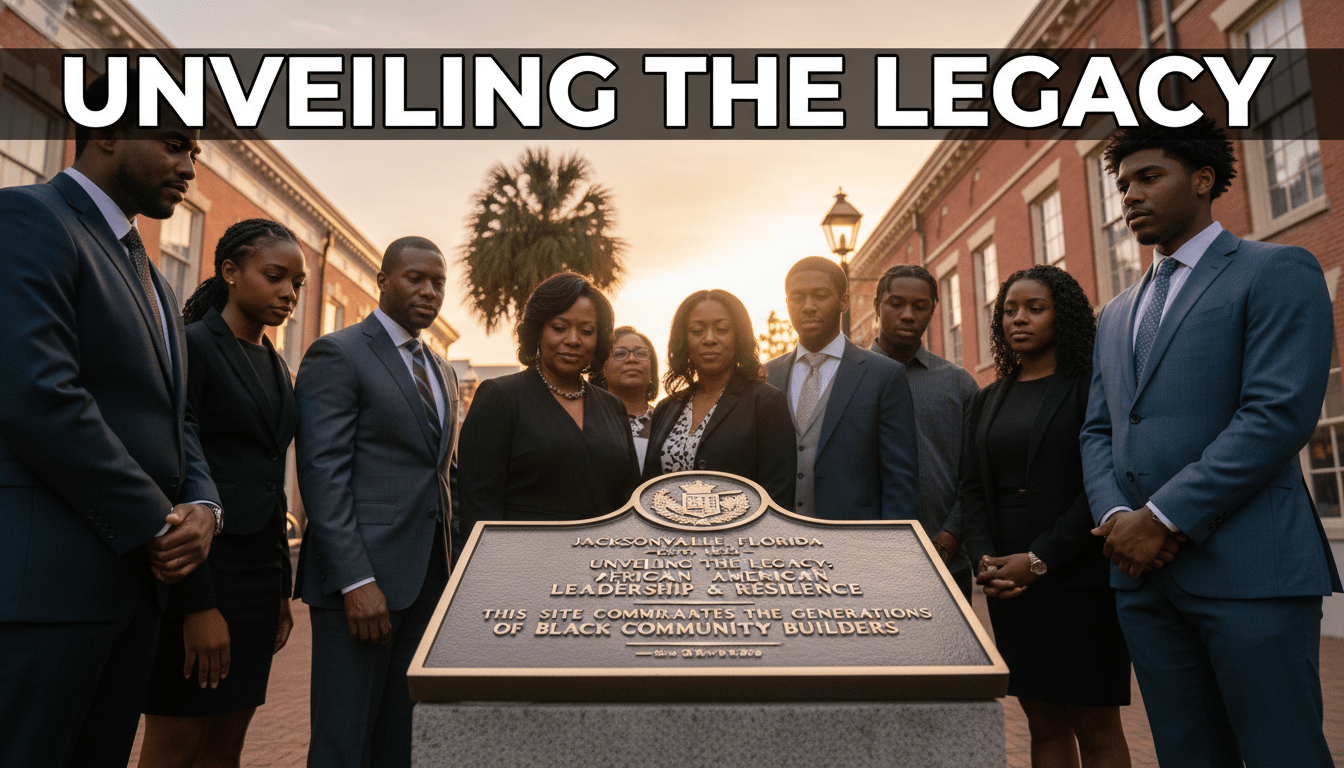
Why Jacksonville Civil Rights Trail Legacy Is Unveiled
By Darius Spearman (africanelements)
Support African Elements at patreon.com/africanelements and hear recent news in a single playlist. Additionally, you can gain early access to ad-free video content.
A New Trail in Florida
On May 26 and 27, 2026, three new historical markers were officially unveiled in Jacksonville, Florida (news4jax.com, news4jax.com). These bronze markers highlight the critical role of the city in the national civil rights movement (news4jax.com). They also honor the North Florida legacy of Dr. Martin Luther King Jr. (news4jax.com). Mayor Donna Deegan and local community leaders led the ceremonies to dedicate these important landmarks (news4jax.com). These markers expand the growing Jacksonville Civil Rights Trail (news4jax.com).
In February 2026, the U.S. Civil Rights Trail officially added the Jacksonville trail to its national heritage collection (news4jax.com, jaxtoday.org). The local trail will eventually include forty place-based markers across the city (news4jax.com). The very first marker was placed on February 25, 2026, at the historic Mount Ararat Missionary Baptist Church (news4jax.com). This marker commemorates March 19, 1961, when Dr. King delivered an inspiring sermon to the local community (news4jax.com). He spoke about nonviolent resistance in a sermon titled “This is a Great Time to Be Alive” (news4jax.com). The newly expanded trail makes the once-invisible history of Northeast Florida highly visible to the public (news4jax.com).
The System of Jim Crow Segregation
The struggle in Jacksonville occurred against the backdrop of Jim Crow segregation. Jim Crow was a systemic system of racial apartheid that dominated the American South (ferris.edu). It began in the late nineteenth century and lasted through the 1960s (khanacademy.org). The system combined state and local laws with deep-seated social codes (ferris.edu). These codes enforced physical separation and Black subservience to white supremacy (ferris.edu). Jim Crow legally segregated schools, transportation, restaurants, and hospitals (khanacademy.org, ferris.edu).
This system received constitutional backing from the United States Supreme Court in 1896 (khanacademy.org). In the Plessy versus Ferguson decision, the court established the separate but equal doctrine (khanacademy.org). Beyond legal codes, the system demanded that Black citizens show constant deference to white citizens (ferris.edu). Violations of these unwritten social rules often resulted in swift and severe violence (ferris.edu). Furthermore, the Southern states used poll taxes and literacy tests to disenfranchise Black voters (khanacademy.org). In many ways, these oppressive systems resembled how the civil war failed to end slavery by replacing it with involuntary servitude. The civil rights movement sought to dismantle these legal and social structures completely.
Timeline of the June 1964 Catalyst
Arrest in St. Augustine
Dr. King is arrested at the Monson Motor Lodge for attempting to dine in a segregated restaurant.
Courthouse Testimony
Dr. King testifies in Jacksonville federal court, seeking protection for peaceful protests.
Monson Lodge Swim-In
Activists integrate the motel pool, prompting the owner to pour acid into the water.
Civil Rights Act Passed
President Lyndon B. Johnson signs the landmark Civil Rights Act of 1964 into law.
The St. Augustine Catalyst and James Brock
In the summer of 1964, the fight against Jim Crow intensified in nearby St. Augustine, Florida (flagler.edu). The Southern Christian Leadership Conference, or SCLC, led intense local protests (stanford.edu). They targeted segregated businesses in the historic city (stanford.edu, flagler.edu). On June 11, 1964, police arrested Dr. King at the Monson Motor Lodge (civilrightstrail.com, flagler.edu). He had attempted to eat lunch in the segregated dining room (civilrightstrail.com).
Then, on June 18, 1964, a pivotal swim-in protest took place at the same motel (wikipedia.org). Black and white activists jumped into the whites-only swimming pool (wikipedia.org). The motel owner, James Brock, became extremely angry (wikipedia.org). In a desperate act, James Brock poured muriatic acid into the pool (wikipedia.org). He wanted to force the young protesters out of the water (wikipedia.org). Photographers captured dramatic images of Brock pouring the acid (wikipedia.org). The images also showed police officers dragging the swimsuit-clad teenagers from the pool (wikipedia.org). These shocking photographs quickly spread across the globe (wikipedia.org). They generated immense national outrage and shifted public opinion (wikipedia.org). The next day, the United States Senate voted to break an eighty-three-day filibuster against the Civil Rights Bill (wikipedia.org). This dramatic event served as a major moral catalyst for the passage of the historic Civil Rights Act of 1964 (wikipedia.org).
A Secret Flight to Duval County Jail
Following his arrest in St. Augustine, Dr. King faced extreme danger (civilrightstrail.com, flagler.edu). St. Augustine was a highly volatile and hostile environment during that summer (flagler.edu). Members of the Ku Klux Klan frequently attacked peaceful demonstrators (flagler.edu). Even worse, St. Johns County Sheriff L.O. Davis openly cooperated with white supremacists (flagler.edu). Davis and his deputies permitted local vigilantes to access jailed civil rights workers (crmvet.org, flagler.edu).
Because of these credible death threats, authorities decided to act. Deputies secretly transferred Dr. King to the Duval County Jail in Jacksonville (news4jax.com, news4jax.com). They processed him at the old Jacksonville courthouse, which has since been demolished (news4jax.com). The newly unveiled marker at 330 East Bay Street marks this historic transfer (news4jax.com, news4jax.com). This marker sits near the St. Johns River (news4jax.com). Jacksonville served as a much safer alternative for the civil rights leader (news4jax.com). The city was a larger urban center with an organized Black community (news4jax.com). Additionally, a professional federal court presence offered better security for Dr. King (news4jax.com). The Jacksonville network shielded national leaders from the unchecked violence of rural sheriffs.
A Rare Judicial Ally in Bryan Simpson
On Saturday, June 13, 1964, Dr. King appeared at the federal courthouse in Jacksonville (jaxfedbar.org). He testified in a crucial case before United States District Judge Bryan Simpson (jaxfedbar.org). The case was titled Andrew Young versus L.O. Davis (sao4th.com). Judge Simpson proved to be a rare ally of the civil rights movement (jaxfedbar.org). He courageously challenged the local segregationist power structures of North Florida (jaxfedbar.org). Judge Simpson ruled that St. Augustine officials could not block peaceful civil rights marches (sao4th.com).
He based his landmark decision on the United States Constitution (sao4th.com). First, he declared that banning night marches violated the First Amendment (sao4th.com). The demonstrators had a constitutional right to free speech, peaceful assembly, and petition (sao4th.com). Second, he ruled that local police failed to provide equal protection under the Fourteenth Amendment (sao4th.com). Sheriff Davis had allowed white segregationists to attack peaceful protesters without consequence (sao4th.com). Simpson issued a temporary injunction to stop this discriminatory policing (sao4th.com). The newly unveiled courthouse marker is located at 311 West Monroe Street (news4jax.com, news4jax.com). This site now houses the State Attorney’s Office (jaxfedbar.org). This ruling legally cleared the path for continued peaceful demonstrations (sao4th.com). It kept vital national pressure on federal lawmakers in Washington.
The Forces of Ax Handle Saturday
Comparing the peaceful teenage demonstrators to the armed mob on August 27, 1960
The Safe Haven of Ashley Street
During the segregation era, Black travelers faced extreme difficulties (ferris.edu). Jim Crow laws barred them from staying in white-owned hotels (ferris.edu). To survive, Black leaders relied on a network of safe havens. The Clara White Mission served as one of these vital sanctuaries (news4jax.com). The mission is located at 613 West Ashley Street in Jacksonville (news4jax.com). The third newly unveiled marker stands at this location (news4jax.com). Humanitarian Dr. Eartha Mary Magdalene White founded the mission in 1904 (news4jax.com).
She named the institution in honor of her mother, Clara White (news4jax.com). Dr. Eartha White was a former Broadway singer and a powerful civil rights activist (news4jax.com). She turned her mission into a safe house for the movement (news4jax.com). Dr. Eartha White provided Dr. King with shelter, hot food, and strategic counsel (news4jax.com). Activists preserved his original room and furniture on the third floor of the building (news4jax.com). The contributions of Black women like Eartha White were essential to the survival of the movement. Today, the mission has operated continuously for over one hundred and eleven years (news4jax.com). Under the leadership of Chief Executive Officer Ju’Coby Pittman, it still serves veterans and unhoused residents (news4jax.com).
The Legacy of LaVilla and A. Philip Randolph
The Clara White Mission sits in the historic LaVilla neighborhood (news4jax.com). During the early twentieth century, LaVilla was known as the Harlem of the South (news4jax.com, thejaxsonmag.com). It was a thriving, self-sustaining African American cultural and economic hub (thejaxsonmag.com). At its peak in the 1920s, LaVilla hosted over six hundred Black-owned businesses (thejaxsonmag.com). Many of these enterprises operated on Ashley Street (thejaxsonmag.com). Famous musicians like Duke Ellington, Ella Fitzgerald, and Ray Charles performed there regularly (thejaxsonmag.com).
Key landmarks like the Ritz Theatre anchored “The Great Black Way” (thejaxsonmag.com). This cultural renaissance also nurtured famous educators, artists, and national civil rights leaders (thejaxsonmag.com). For example, Jacksonville native James Weldon Johnson composed the Black national anthem here (thejaxsonmag.com). LaVilla also connected directly to the legendary labor organizer Asa Philip Randolph (news4jax.com, aflcio.org). In 1925, Randolph founded the Brotherhood of Sleeping Car Porters (aflcio.org). This organization became the first successful Black-led labor union to win a major contract (aflcio.org). He used labor organizing to fight for broader racial equality (aflcio.org). Randolph successfully pressured President Roosevelt to desegregate the defense industry in 1941 (aflcio.org). Later, he influenced President Truman to desegregate the United States Armed Forces (aflcio.org). His pioneering work helped lay the foundation for martin luther king sr. and the making of a movement that would sweep the nation.
The Brutality of Ax Handle Saturday
While legal battles raged, local youth took to the streets to protest (news4jax.com). Chief among these actions was the sit-in campaign in downtown Jacksonville (news4jax.com). On August 13, 1960, the NAACP Youth Council began peaceful demonstrations (news4jax.com). They protested segregated lunch counters at department stores like the Woolworth department store (news4jax.com). Activist and teacher Rutledge Pearson advised these young student protesters (news4jax.com). On August 27, 1960, the peaceful protest met with extreme violence (news4jax.com).
This dark day became known as Ax Handle Saturday (news4jax.com). A mob of approximately two hundred white men gathered downtown (news4jax.com). Many of these men had close ties to the local Ku Klux Klan (news4jax.com). They armed themselves with baseball bats and wooden ax handles (news4jax.com). The white mob brutally attacked the forty peaceful teenage demonstrators (news4jax.com). They also assaulted any Black bystander in their path (news4jax.com). Shockingly, the Jacksonville police force stood by and did not intervene (news4jax.com). When police finally acted, they arrested the Black youths who attempted to defend themselves (news4jax.com). They arrested members of a Black youth group called the Boomerangs (news4jax.com). There were no immediate prosecutions of the white attackers (news4jax.com). This selective enforcement of the law represents a precursor to the political shift from civil rights to mass incarceration that occurred in later decades. Young Nat Glover was caught in the riot that day (bollesbugleonline.com). He later became the first Black sheriff of Jacksonville in the twentieth century (bollesbugleonline.com).
Civil Rights Trail Scale and Preservation Impact
The Local Foot Soldiers of the Movement
The story of Jacksonville reminds observers that national change requires local action. National figures like Dr. King received essential support from local foot soldiers (news4jax.com, news4jax.com). Activists like Rutledge Pearson organized the youth when others hesitated (news4jax.com). The NAACP Youth Council demonstrated that teenagers could lead the charge against white supremacy (news4jax.com). Their brave sit-ins forced the city’s white business leadership to slowly desegregate (news4jax.com). This local victory occurred well before federal legislation forced their hand.
These local efforts were highly strategic. The Youth Councils shifted the strategy of the national organization (news4jax.com). They moved from slow courtroom litigation to immediate grassroots direct action (news4jax.com). They organized and executed some of the earliest lunch counter sit-ins (news4jax.com). These youth groups also raised critical funds and gathered volunteers for campaigns across the South (news4jax.com). Their courage inspired similar actions in other cities (news4jax.com). The historical markers along the new trail honor these lesser-known heroes (news4jax.com). They ensure that the names of local leaders remain in public memory (news4jax.com). These bronze markers remind visitors that everyday citizens built the civil rights movement.
Living History on Jacksonville’s Streets
Today, the city of Jacksonville continues to honor this complicated history (news4jax.com). The unveiling of these three new markers is not simply an exercise in looking backward (news4jax.com). Instead, it represents a deliberate effort to make once-invisible histories visible (news4jax.com). As Mayor Donna Deegan noted during the launch, the movement unfolded across local neighborhoods (news4jax.com). It took place in churches, schools, parks, and courtrooms (news4jax.com). History was lived on the very streets where residents walk today (news4jax.com).
By walking the Jacksonville Civil Rights Trail, citizens can connect with their past (news4jax.com). They can physically visit the places where history was made. The trail connects local landmarks directly to the national stage (news4jax.com). It shows that Northeast Florida was a critical battleground for justice (news4jax.com). The rights that citizens enjoy today were paid for on these very streets (news4jax.com). They were won courtroom by courtroom and sermon by sermon (news4jax.com). The bronze markers stand as permanent testaments to that struggle (news4jax.com). They challenge future generations to continue the fight for equality and justice.
About the Author
Darius Spearman is a professor of Black Studies at San Diego City College, where he has been teaching for over 20 years. He is the founder of African Elements, a media platform dedicated to providing educational resources on the history and culture of the African diaspora. Through his work, Spearman aims to empower and educate by bringing historical context to contemporary issues affecting the Black community.
