



Why South Florida Haitian TPS Protests Are Shaking the Nation
By Darius Spearman (africanelements)
Support African Elements at patreon.com/africanelements and hear recent news in a single playlist. Additionally, you can gain early access to ad-free video content.
Outcry in the Streets of South Florida
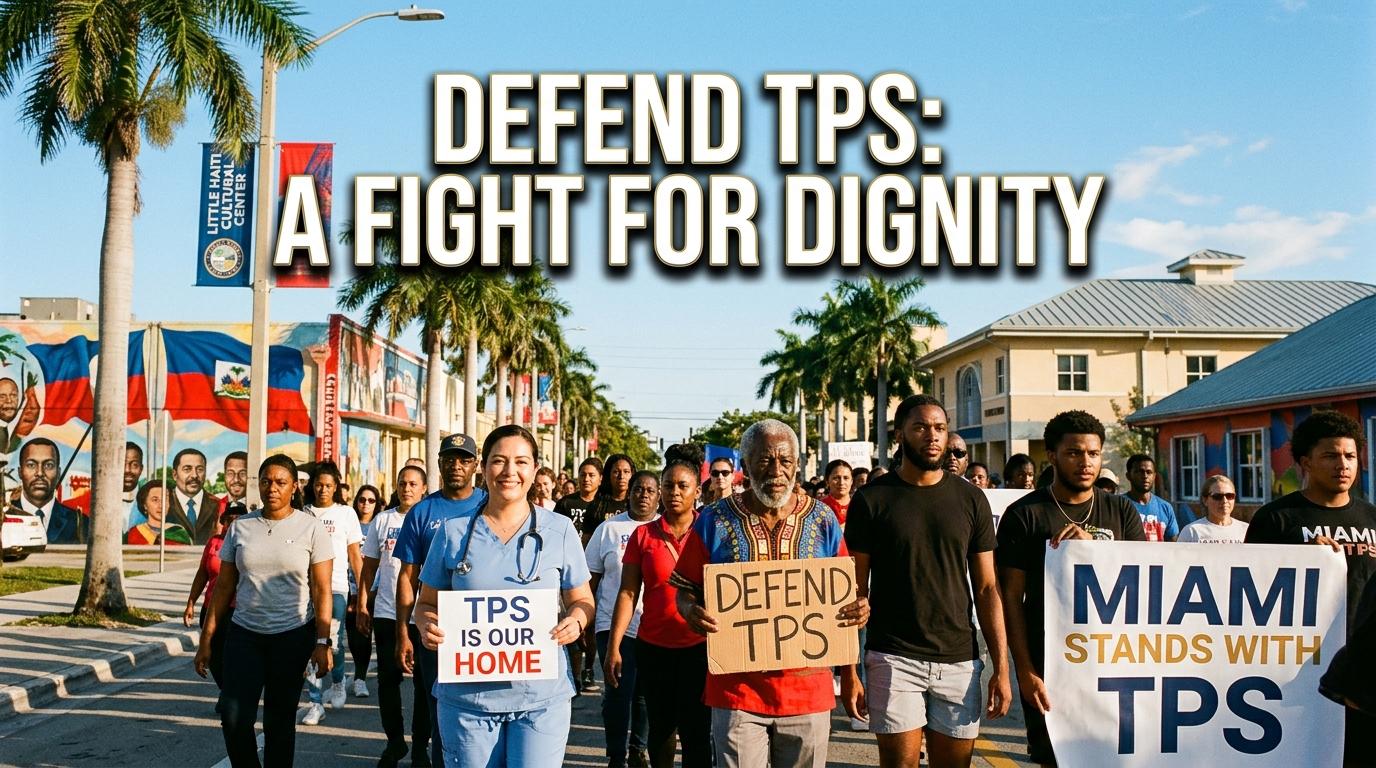
Protests have erupted across Miami-Dade and Broward counties with remarkable intensity (miaminewtimes.com). Demonstrators are filling the streets outside federal immigration facilities and local municipal offices (miaminewtimes.com, themilitant.com). Community members carry signs demanding an immediate halt to stepped-up deportations (themilitant.com). They are also protesting the termination of Temporary Protected Status, commonly known as TPS (cbsnews.com).
For thousands of Caribbean families, these demonstrations are a fight for survival (haitianbridgealliance.org). Little Haiti in Miami has become the vibrant center of this civil resistance (miaminewtimes.com). Organizers emphasize that the sudden loss of legal protections destabilizes entire neighborhoods (miaminewtimes.com, haitianbridgealliance.org). These recent headlines represent the latest chapter in a multi-decade struggle for Black immigrant dignity (upenn.edu, miami.edu).
A Double Standard: Cold War Politics and Exclusion
The roots of this crisis stretch back more than fifty years (upenn.edu). During the 1970s and 1980s, thousands of Haitians fled political terror under the Duvalier regime (upenn.edu, sandiego.edu). However, the federal government treated these Black refugees differently from other Caribbean arrivals (sandiego.edu). Cuban migrants received rapid legal status under the Cuban Adjustment Act of 1966 (sandiego.edu).
In contrast, federal officials classified Haitian asylum seekers as economic migrants (sandiego.edu). In 1981, the federal government launched the Haitian Interdiction Program (upenn.edu, sandiego.edu). The United States Coast Guard intercepted Haitian vessels on international waters (sandiego.edu). Thousands were returned without any formal asylum hearings (sandiego.edu). Many who reached land were placed in the Krome Detention Center in Miami (upenn.edu). This historical differential treatment laid the groundwork for modern resistance (miami.edu, sandiego.edu).
Historical Policy Comparison: Cuban vs. Haitian Migration
Fighting Back: The Legacy of Haitian Civil Rights Advocacy
Grassroots leaders in Miami refused to accept this discrimination quietly (miami.edu). Father Gérard Jean-Juste emerged as a legendary civil rights figure in the diaspora (upenn.edu, miami.edu). He led hunger strikes, rallies, and major legal challenges (upenn.edu, miami.edu). His efforts forced federal courts to examine systemic bias within the immigration system (miami.edu).
In the landmark 1980 case Haitian Refugee Center v. Civiletti, a federal judge ruled that the government used discriminatory methods against Haitian asylum seekers (miami.edu). This momentum sparked broad civil rights movements within South Florida. Later, organizations like the Family Action Network Movement fought for the Haitian Refugee Immigration Fairness Act of 1998 (miaminewtimes.com). That law provided permanent status to thousands of long-term residents (miaminewtimes.com).
The Fragile Lifeline: Temporary Protected Status
Congress created Temporary Protected Status inside the Immigration Act of 1990 (uscis.gov, americanimmigrationcouncil.org). The statutory framework allows the federal government to shield foreign nationals from deportation when extraordinary conditions make return dangerous (uscis.gov). Following the devastating 2010 earthquake, the federal government extended TPS to Haiti (cbsnews.com, haitianbridgealliance.org).
Critics frequently attempt to frame TPS as an unlawful permanent amnesty (uscis.gov, americanimmigrationcouncil.org). However, statutory law requires beneficiaries to undergo regular background checks, submit fingerprints, and pay administrative fees (uscis.gov, americanimmigrationcouncil.org). The status does not grant permanent residency or green cards (uscis.gov). Despite severe crises in Haiti, the recent push to terminate TPS leaves hundreds of thousands of people unprotected (newsweek.com, haitianbridgealliance.org).
Economic Fallout: Essential Workers on the Frontlines
The termination of TPS threatens the foundation of the South Florida economy (abicaction.org, abic.us). Over 158,000 Haitian TPS recipients live in the state of Florida alone (cmsny.org, abicaction.org). In fact, TPS beneficiaries maintain an impressive labor force participation rate above 80 percent (brookings.edu, migrationpolicy.org). They contribute billions of dollars annually to the regional gross domestic product (brookings.edu, abicaction.org).
Healthcare facilities face the most urgent disruption from these sudden policy changes (abicaction.org, abic.us). More than 113,000 Haitian workers in Florida provide care in nursing homes, hospitals, and assisted living centers (abicaction.org, abic.us). Losing these dedicated healthcare providers threatens patient care across the state (abicaction.org, abic.us). Labor unions and municipal leaders continue to urge federal authorities to protect this essential workforce (miaminewtimes.com, abicaction.org).
Haitian TPS Demographic & Economic Profile
Police Collaboration and Section 287(g)
Public anger in South Florida has also targeted municipal cooperation with federal immigration agents (miaminewtimes.com, aclu.org). Section 287(g) of the Immigration and Nationality Act permits local law enforcement to perform federal immigration duties (americanimmigrationcouncil.org, aclu.org). Deputized local officers can interrogate detainees and issue immigration detainers inside county jails (americanimmigrationcouncil.org, ilrc.org).
Civil rights organizations argue that 287(g) agreements lead directly to racial profiling against Black and Latino residents (acluofnorthcarolina.org, aclu.org). Furthermore, these programs mirror broader mass incarceration policies that target marginalized communities. Immigrant crime victims often avoid calling the police because they fear deportation (civilrights.org, aclu.org). Consequently, local public safety and community trust suffer deep harm across the region (acluofnorthcarolina.org, aclu.org).
Workplace Raids and Reverification Traps
When the federal government ends TPS designations, beneficiaries lose their legal right to work (guidepostsolutions.com, i-9intelligence.com). Federal regulations require employers to reverify work authorization on Form I-9 immediately (ahluwalialaw.com, i-9intelligence.com). Automated systems such as E-Verify notify human resource departments when documents expire (guidepostsolutions.com, i-9intelligence.com).
Consequently, thousands of long-term employees face abrupt termination from their jobs (guidepostsolutions.com, i-9intelligence.com). At the same time, workplace audits by federal authorities have increased substantially (guidepostsolutions.com, duanemorris.com). Immigrant defense groups document growing panic as workers are forced into informal labor markets (miaminewtimes.com, i-9intelligence.com). This dynamic echoes historic patterns of systemic racial exploitation where Black labor is utilized without legal protection.
The Crisis Facing Mixed-Status Families
The human cost of immigration enforcement falls heavily on mixed-status households (urban.org, americanimmigrationcouncil.org). In these homes, temporary-status parents raise children who are United States citizens by birth (urban.org, americanimmigrationcouncil.org). Nationally, more than four million citizen children live with an unauthorized or temporary-status parent (urban.org, americanimmigrationcouncil.org).
Deportation forces parents to make harrowing custody choices (casey.org, legalhealth.org). Leaving citizen children behind can risk their placement into state foster care systems (casey.org, fosterlove.com). Alternatively, taking citizen children back to Haiti exposes them to dangerous armed conflict (haitianbridgealliance.org, refugeerights.org). This impossible dilemma causes profound developmental trauma for young children (urban.org, casey.org).
Human and Economic Dimensions of TPS Expiration
Black Civil Rights Coalitions Build Power
National civil rights organizations have joined South Florida organizers on the frontlines (civilrights.org, house.gov). Groups such as the Black Alliance for Just Immigration and the NAACP connect local deportations to national racial justice campaigns (civilrights.org). They emphasize that Black immigrants face disproportionate arrest and deportation rates (civilrights.org). These struggles form an important part of wider global Black struggles for economic and social justice.
Meanwhile, the Congressional Black Caucus continues to push for permanent legislative protections (house.gov, house.gov). Lawmakers have proposed updates to the American Dream and Promise Act and the 1998 HRIFA framework (house.gov, house.gov). Activists insist that temporary status is not enough (miaminewtimes.com, themilitant.com). They demand a clear pathway to permanent residency for every immigrant who helps build and sustain South Florida (miaminewtimes.com, house.gov).
About the Author
Darius Spearman is a professor of Black Studies at San Diego City College, where he has been teaching for over 20 years. He is the founder of African Elements, a media platform dedicated to providing educational resources on the history and culture of the African diaspora. Through his work, Spearman aims to empower and educate by bringing historical context to contemporary issues affecting the Black community.
