


Why This Landmark ICC Libya Trial Exposes Systemic Cruelty
By Darius Spearman (africanelements)
Support African Elements at patreon.com/africanelements and hear recent news in a single playlist. Additionally, you can gain early access to ad-free video content.
The Historic Break in the Culture of Impunity
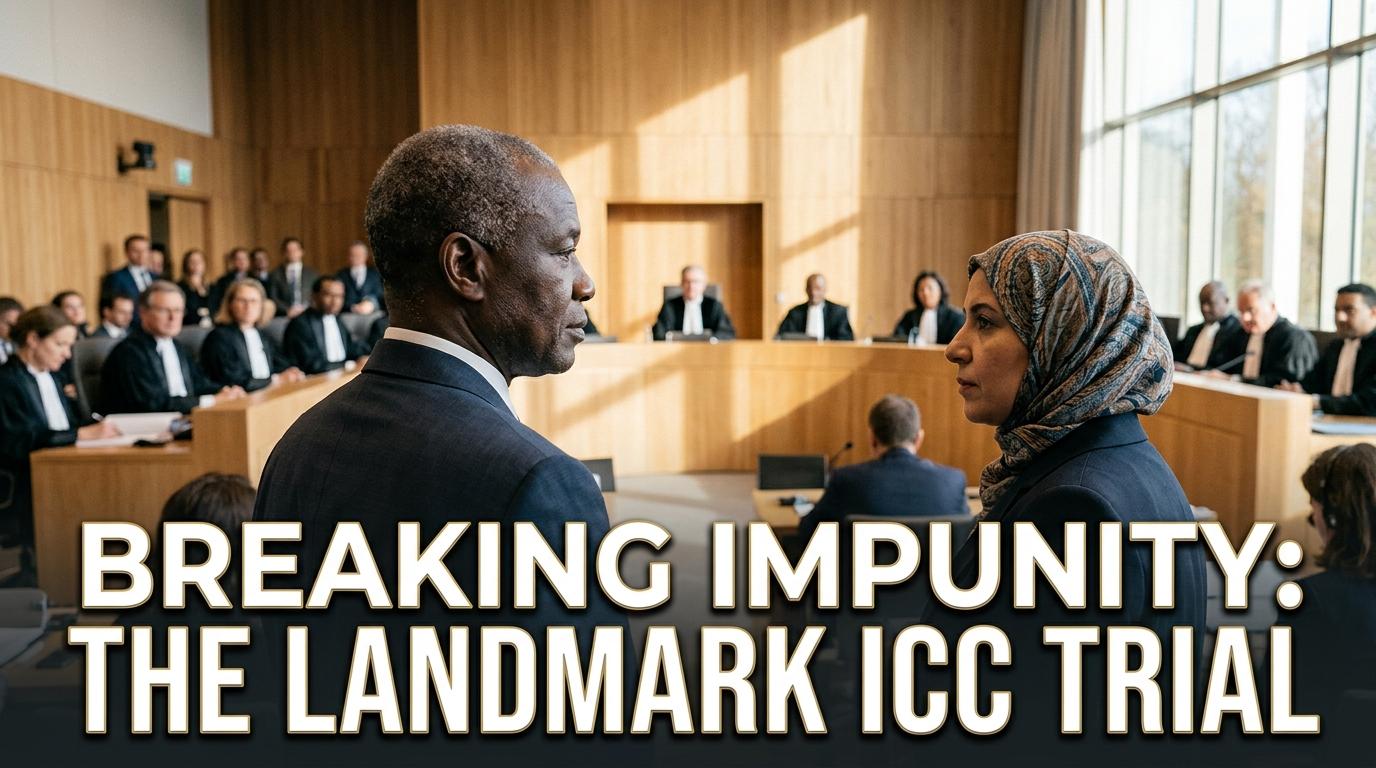
On July 16, 2026, the International Criminal Court took a monumental step toward justice in North Africa (hrw.org). Pre-Trial Chamber I unanimously confirmed 17 counts of war crimes and crimes against humanity against Khaled Mohamed Ali El Hishri (hrw.org). He is a senior commander of the notorious Special Deterrence Force, which is commonly known as RADA (hrw.org). This decisive ruling officially pushes the first-ever case from the court’s Libya investigation forward to a full trial (hrw.org).
For more than a decade, powerful actors in Libya operated with complete disregard for international law. The confirmation of charges against El Hishri breaks this long cycle of impunity (hrw.org). This judicial breakthrough offers a long-overdue path to justice for survivors of systemic torture and persecution (hrw.org). The looming trial promises to expose the horrific internal operations of illegal detention facilities to the entire world (hrw.org).
The Sparks of Revolt and the Road to The Hague
In February 2011, popular protests erupted across Libya against the dictatorial regime of Muammar Gaddafi (hrw.org). The government responded to the demonstrations with brutal and systematic violence against civilian protesters (hrw.org). In response to these atrocities, the United Nations Security Council adopted Resolution 1970 on February 26, 2011 (hrw.org). This historic resolution condemned the actions of the state and officially referred the entire situation to the International Criminal Court (hrw.org, globalr2p.org). This action marked the first time in global history that the Security Council unanimously referred a country to the court (hrw.org).
However, international justice soon faced major delays. Although the court issued early arrest warrants for Muammar Gaddafi and his close associates, deep political instability stalled the process (hrw.org). Gaddafi was killed in October 2011, and other high-profile suspects remained completely out of reach (hrw.org, wikipedia.org). The post-revolutionary period quickly devolved into severe civil conflict, creating a lawless environment that resembled a system of unregulated mass incarceration where accountability was non-existent.
The Security Vacuum and the Rise of Sovereign Militias
Following the collapse of the Gaddafi regime, Libya fractured into competing governments based in the East and the West (hrw.org, arabcenterdc.org). A severe security vacuum emerged in the capital city of Tripoli (hrw.org). Various armed groups scrambled to control strategic local infrastructure, including sea ports, border crossings, and airports (hrw.org). Out of this immense chaos rose the Special Deterrence Force, which is widely known as RADA (hrw.org).
Established in 2013, RADA is a heavily armed militia with a highly conservative Madkhali Salafist religious orientation (hrw.org, dcaf.ch, chathamhouse.org). This religious movement emphasizes absolute obedience to whoever holds de facto power (dcaf.ch, chathamhouse.org). Successive recognized governments integrated RADA into the official state security apparatus to project a false image of stability (hrw.org, arabcenterdc.org). The state paid their salaries and provided equipment, but exercised no actual control over their activities (hrw.org, arabcenterdc.org). Consequently, the militia operated with total autonomy and seized control of Tripoli’s Mitiga International Airport and the adjacent military compound (hrw.org).
Inside the Horror of Tripoli’s Mitiga Prison
From 2014 onward, RADA used the Mitiga compound to run a sprawling, informal, and illegal detention center (hrw.org). Mitiga Prison quickly became one of the most feared and dangerous places in the entire country (hrw.org). Thousands of individuals were swept up in arbitrary arrests, including political opponents, journalists, and religious minorities (hrw.org, hrw.org). Inside the facility, detainees faced a horrific system specifically designed to inflict severe physical and mental pain (hrw.org, amnesty.org).
Detainees were subjected to forced labor, severe starvation, constant beatings, and sexual violence (hrw.org, amnesty.org, hrw.org). Within this prison hierarchy, Khaled Mohamed Ali El Hishri exercised absolute authority over the daily operations (hrw.org). He was nicknamed the “Angel of Death” by terrorized prisoners who survived his custody (hrw.org). El Hishri maintained direct control over the women’s and children’s wing of the prison, where systemic abuses occurred daily (hrw.org). The survival of these individuals shows the incredible strength and resilience that human beings can muster in the face of absolute terror.
The Tragic Plight of Sub-Saharan Migrants
Sub-Saharan migrants are primarily transit migrants trying to cross the Mediterranean Sea to reach Europe (migrationpolicy.org). They represent approximately 60 percent of the total migrant population residing in Libya (migrationpolicy.org). Following the 2011 collapse of the state, these vulnerable individuals became highly commodified (hrw.org). In this lawless vacuum, human trafficking, abductions, and forced labor thrived completely unchecked (hrw.org).
Furthermore, rampant racism and xenophobia left Black sub-Saharan Africans uniquely vulnerable to systematic, ethnically targeted abuse by militias, employers, and criminal gangs (hrw.org, amnesty.org). Smuggling and trafficking became major sources of revenue, generating hundreds of millions of dollars annually (hrw.org, gchumanrights.org). This lucrative conflict economy turned human detention into a commercial enterprise (hrw.org). In late 2017, international media exposed migrants being sold at public slave auctions near Tripoli, triggering global outrage (internazionale.it, time.com). Mitiga Prison operated as a central hub in this broader, horrific system of exploitation (hrw.org).
Understanding Intersectionality in International Law
Intersectionality is a legal framework coined by Black feminist theorist Kimberlé Crenshaw (humanrightsresearch.org). It analyzes how overlapping identities, such as race, gender, and migration status, interact to create unique systems of oppression and discrimination (humanrightsresearch.org). In the trial of El Hishri, the Pre-Trial Chamber of the ICC applied this intersectional approach (hrw.org). The court recognized that detainees in Mitiga Prison experienced crimes differently based on their multi-layered identities (hrw.org).
Specifically, the judges ruled that Black sub-Saharan migrants were targeted for enslavement and persecution because of the combined effects of their race, ethnicity, nationality, and undocumented status (hrw.org). This framework also applied to gender and age (hrw.org). Women and children faced gendered forms of sexual slavery in isolated sections, while young boys were enslaved based on age (hrw.org). This systematic oppression mirrors the history of economic exploitation where vulnerable groups are stripped of their humanity for financial gain.
The Shadows of European Complicity
Extensive evidence reveals that European Union funding has indirectly financed the forces running Mitiga Prison (hrw.org, amnesty.org, hrw.org). Under the guise of migration management and border control, the European Union and Italy have provided millions of euros to Libyan maritime forces (amnesty.org, hrw.org, mediterranearescue.org). This controversial cooperation was formalized under the 2017 Italy-Libya Memorandum (internazionale.it, amnesty.org).
These European-funded forces intercept migrants at sea and return them to Libyan shores (hrw.org, amnesty.org, hrw.org). Once on land, the migrants are transferred directly into the custody of local militias (hrw.org, amnesty.org, hrw.org). This practice directly feeds the highly profitable prison and torture industry (hrw.org). Human rights defenders argue that European funding has empowered torturers (hrw.org, amnesty.org). Activists have called for legal accountability for the European actors who finance this abusive infrastructure (hrw.org).
The Legal Breakthroughs Leading to the Docks
The path to prosecuting El Hishri was paved by key legal developments (hrw.org). In May 2025, Libya’s Government of National Unity filed a formal declaration under Article 12(3) of the Rome Statute (hrw.org, verfassungsblog.de). This declaration formally accepted the jurisdiction of the ICC over international crimes committed on Libyan territory from 2011 until the end of 2027 (hrw.org, verfassungsblog.de).
Consequently, German police arrested El Hishri in July 2025 on a sealed ICC warrant (hrw.org). He was transferred to custody in The Hague on December 1, 2025 (hrw.org, courthousenews.com). In July 2026, the Pre-Trial Chamber rejected his defense counsel’s challenge to the court’s jurisdiction (hrw.org, courthousenews.com). Finally, on July 16, 2026, the court confirmed 17 counts of war crimes and crimes against humanity, clearing the way for a historic trial (hrw.org).
The Long Path to Reparations and Restorative Justice
Many surviving victims of the Mitiga Prison atrocities have fled Libya to find safety in Europe (hrw.org, ecchr.eu). Some of these survivors are now cooperating with international legal organizations to seek justice (ecchr.eu). Under Article 75 of the Rome Statute, the ICC Trial Chamber can order direct reparations upon a conviction (ecchr.eu, trustfundforvictims.org). These reparations can include restitution, compensation, and rehabilitation (trustfundforvictims.org).
The ICC’s Trust Fund for Victims is the independent body mandated to implement these awards (trustfundforvictims.org). When a convicted perpetrator is indigent, the fund can use its own resources to support the victims (trustfundforvictims.org). However, locating and safely compensating transient, undocumented sub-Saharan migrant victims remains a massive logistical challenge (hrw.org). This ongoing effort highlights the critical need for global initiatives like the struggle for racial justice to address the long-term harms of systemic violence.
About the Author
Darius Spearman is a professor of Black Studies at San Diego City College, where he has been teaching for over 20 years. He is the founder of African Elements, a media platform dedicated to providing educational resources on the history and culture of the African diaspora. Through his work, Spearman aims to empower and educate by bringing historical context to contemporary issues affecting the Black community.
