


Why US Lawmakers Join the Fight for Global Reparations
By Darius Spearman (africanelements)
Support African Elements at patreon.com/africanelements and hear recent news in a single playlist. Additionally, you can gain early access to ad-free video content.
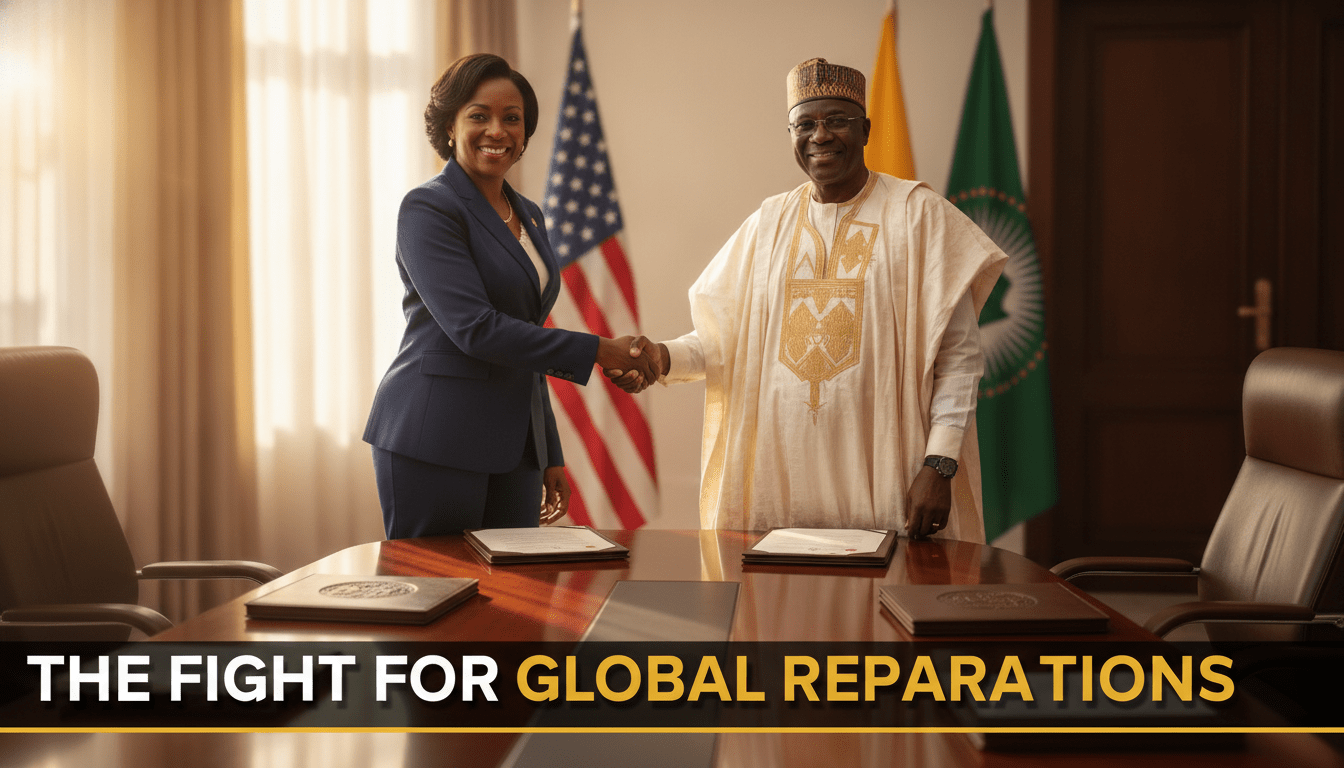
A powerful shift is occurring in the global struggle for justice. On July 2, 2026, Illinois State Representative Carol Ammons traveled to Bolgatanga, Ghana (citinewsroom.com). She publicly supported the efforts of West African nations to demand international reparations for slavery and colonialism (modernghana.com). This moment represents a growing connection between African American lawmakers and continental African leaders. Representative Ammons stood alongside Ghanaian President John Dramani Mahama to back his “Accra Reset” initiative (citinewsroom.com). This policy frames reparative justice as a key part of modern economic development (modernghana.com).
This transatlantic alliance is the result of years of advocacy and diplomatic organizing. For instance, the United Nations General Assembly passed a historic resolution on March 25, 2026 (youtube.com). The resolution declared the transatlantic slave trade to be the gravest crime against humanity (un.org). The vote showed a widening division between the Global South and Western nations (youtube.com). Understanding this modern headline requires a deep dive into the history of the reparations movement.
UN General Assembly Vote (Resolution A/80/L.48)
A historic vote declaring the slave trade as the gravest crime against humanity.
Connecting Local Struggle to Global Movements
Historically, local civil rights struggles in the United States and the global fight against colonialism have operated on separate tracks. However, modern activists are bridging this gap. The visit of Representative Ammons to Ghana highlights this emerging unity (modernghana.com). Lawmakers now recognize that local racial wealth gaps and global African economic struggles share a common origin. They are both rooted in the exploitation of African labor and resources (citinewsroom.com).
The “Accra Reset” initiative provides a blueprint for this unified struggle. President Mahama designed the initiative to restructure international development (presidency.gov.gh). It aims to move countries in the Global South away from donor dependence and toward true economic sovereignty (who.int). This matches the goals of Black lawmakers in the United States who seek to address systemic poverty. By joining forces, African and African American leaders are building a powerful global coalition (modernghana.com).
The Roots of the Reparations Movement
The demand for reparations is not a modern legal invention. It began centuries ago with individual efforts by formerly enslaved people. In 1783, an emancipated woman named Belinda Royall petitioned the Massachusetts legislature (eji.org). She had survived forty years of enslavement (abhmuseum.org). She requested a pension from the confiscated estate of her former owner (eji.org). The legislature granted her request, which established one of the first successful reparations claims in North America (abhmuseum.org).
In the nineteenth century, the movement grew from individual petitions to collective demands. During the American Civil War, Union General William Tecumseh Sherman issued Special Field Orders No. 15 in January 1865 (nps.gov). This order promised to distribute 400,000 acres of confiscated land to newly freed Black families (nps.gov). Each family was to receive forty acres of land (bluefield.edu). Some families also received surplus army mules (nps.gov). This promise raised hopes for economic independence across the South (nps.gov).
The Betrayal of Reconstruction
The hope of “forty acres and a mule” was short-lived. Following the assassination of President Abraham Lincoln, President Andrew Johnson assumed office (bluefield.edu). He immediately reversed the field orders and returned the confiscated land to former Confederate owners (nps.gov). This decision stripped newly emancipated people of the economic foundation they needed to build wealth (abhmuseum.org). The reversal locked in structural economic inequalities that persist today (eji.org).
This betrayal marked the beginning of a broader retreat from justice. The post-Civil War Reconstruction era was a brief period of democratic expansion (wikipedia.org). During this time, the federal government attempted to protect the rights of Black Americans (britannica.com). However, federal support collapsed in 1877 due to white supremacist opposition (wikipedia.org). The failure of this era left Black Americans vulnerable to racial terror and Jim Crow segregation. Many historians point to this period to show how post-Civil War Reconstruction failed to secure long-term racial equality.
The Human Toll of the Middle Passage
Forced migration and loss of life between 1501 and 1867.
The Modern Pan-African Awakening
As the twentieth century progressed, the reparations movement expanded internationally. Activists realized that local civil rights battles could not fully solve global systemic inequalities. The philosophy of Pan-Africanism became central to this expansion (au.int). Pan-Africanism is a movement that seeks to unite people of African descent worldwide (au.int). It emphasizes a shared history and a common destiny (au.int).
The modern structure of the international reparations debate emerged in April 1993. The Organisation of African Unity sponsored the First Pan-African Conference on Reparations in Abuja, Nigeria (issafrica.org). Championed by Chief M.K.O. Abiola, delegates from Africa and the diaspora gathered to discuss historical crimes (issafrica.org). The resulting Abuja Proclamation argued that the damage of the slave trade was painfully visible in modern African lives (reparationscomm.org). It was the first formal document to demand Western debt annulment and capital transfers as reparations (issafrica.org).
Quantifying the Massive Debt of Slavery
A major challenge for the reparations movement has been determining the financial cost of historical atrocities. Modern economists have begun to calculate these figures with precision. Between 1501 and 1867, approximately 13 million African people were kidnapped and forced into chattel slavery (un.org). About 2 million of those captives died during the brutal Middle Passage (eji.org). This massive theft of human life created immense wealth for Western empires (un.org).
In 2023, a landmark study by the Brattle Group analyzed the economic damages of the transatlantic slave trade (brattle.com). The report estimated that global liabilities for unpaid labor and historical harms reach into the trillions of dollars (brattle.com). Some estimates place the total liability at upward of 24 trillion dollars (brattle.com). At the same time, African nations struggle with over 640 billion dollars in external debt (issafrica.org). Advocates argue that this debt is a form of neocolonial extraction that traces directly back to colonial exploitation (issafrica.org).
The Massive Scale of Historical Debt
Comparing calculated slavery reparations liabilities to current African external debt.
African external debt is only 2.6% of the calculated global historical liability.
The United Nations Vote of 2026
The global pressure for reparations led to a historic confrontation at the United Nations in 2026. On March 25, 2026, the UN General Assembly voted on Resolution A/80/L.48 (youtube.com). Tabled by Ghana and backed by the African Union, the resolution declared the transatlantic slave trade the gravest crime against humanity (youtube.com). It demanded formal apologies and good-faith dialogues about reparative justice (youtube.com).
The vote revealed deep geopolitical divisions. A total of 123 nations voted in favor of the resolution, while 52 nations abstained (youtube.com). Only three nations voted against the resolution: the United States, Israel, and Argentina (youtube.com). U.S. representatives argued against the retroactive application of international law to historical acts (usmission.gov). They asserted that modern resources should not be reallocated based on historical wrongs (usmission.gov). This vote highlighted the ongoing resistance of Western powers to formal financial liability (youtube.com).
The Rise of Micro-Reparations
Because federal reparations bills remain stalled in the United States, advocates are turning to local solutions. Legislation such as H.R. 40, which proposes a commission to study reparations, faces partisan gridlock in Congress (house.gov). In response, state and local governments are pursuing micro-reparations. These are localized, small-scale initiatives designed to address historical injuries through municipal budgets and local programs (chicagoreparations.org).
Several states have taken bold steps to address these issues. For instance, California established a pioneering task force to study the issue (americanbar.org). Supporters of this work emphasize that understanding reparations in California is essential because even non-slave states benefited from racial exploitation (americanbar.org). Similarly, New York lawmakers have established their own commission to investigate racial disparities (amsterdamnews.com). This state-level momentum shows that local governments are unwilling to wait for federal action. Advocates of New York’s reparations commission view it as a crucial step toward systemic healing (amsterdamnews.com).
DNA Testing as Ancestral Redress
Representative Carol Ammons of Illinois has modeled this local approach. In August 2025, she secured 500,000 dollars in state funding to launch the Illinois Family Roots Pilot Program (citinewsroom.com). The program provides free DNA testing and genomic analysis to help Black residents trace their ancestry (citinewsroom.com). The initiative collaborates with the African Kinship Reunion research project at the University of Illinois (citinewsroom.com).
This program serves as a practical form of cultural reparations. The transatlantic slave trade intentionally erased the family histories and cultural identities of millions of people (eji.org). By offering genetic testing, the state of Illinois helps descendants of enslaved people bypass the lack of historical records (citinewsroom.com). The program partners with local bodies like the Evanston Reparations Committee to distribute these DNA kits (citinewsroom.com). It allows participants to reconnect with ancestral homelands and build cultural bridges to West Africa (citinewsroom.com).
The meeting between Representative Carol Ammons and West African leaders in Bolgatanga represents a powerful convergence of history and modern policy (citinewsroom.com). It connects grassroots genealogical programs in Illinois to the macroeconomic goals of the African Union (citinewsroom.com). From the early petition of Belinda Royall to the landmark UN vote of 2026, the demand for justice has evolved into a global movement (eji.org, youtube.com).
The conversation is no longer about whether historical crimes occurred. Instead, it is about how the international community will address the economic legacy of those crimes. As more local lawmakers align with global leaders, the pressure on Western nations will continue to grow. The journey toward reparative justice is long, but the global alliance to achieve it is stronger than ever.
About the Author
Darius Spearman is a professor of Black Studies at San Diego City College, where he has been teaching for over 20 years. He is the founder of African Elements, a media platform dedicated to providing educational resources on the history and culture of the African diaspora. Through his work, Spearman aims to empower and educate by bringing historical context to contemporary issues affecting the Black community.
