



How African Diaspora Leaders Fight Human Trafficking
By Darius Spearman (africanelements)
Support African Elements at patreon.com/africanelements and hear recent news in a single playlist. Additionally, you can gain early access to ad-free video content.
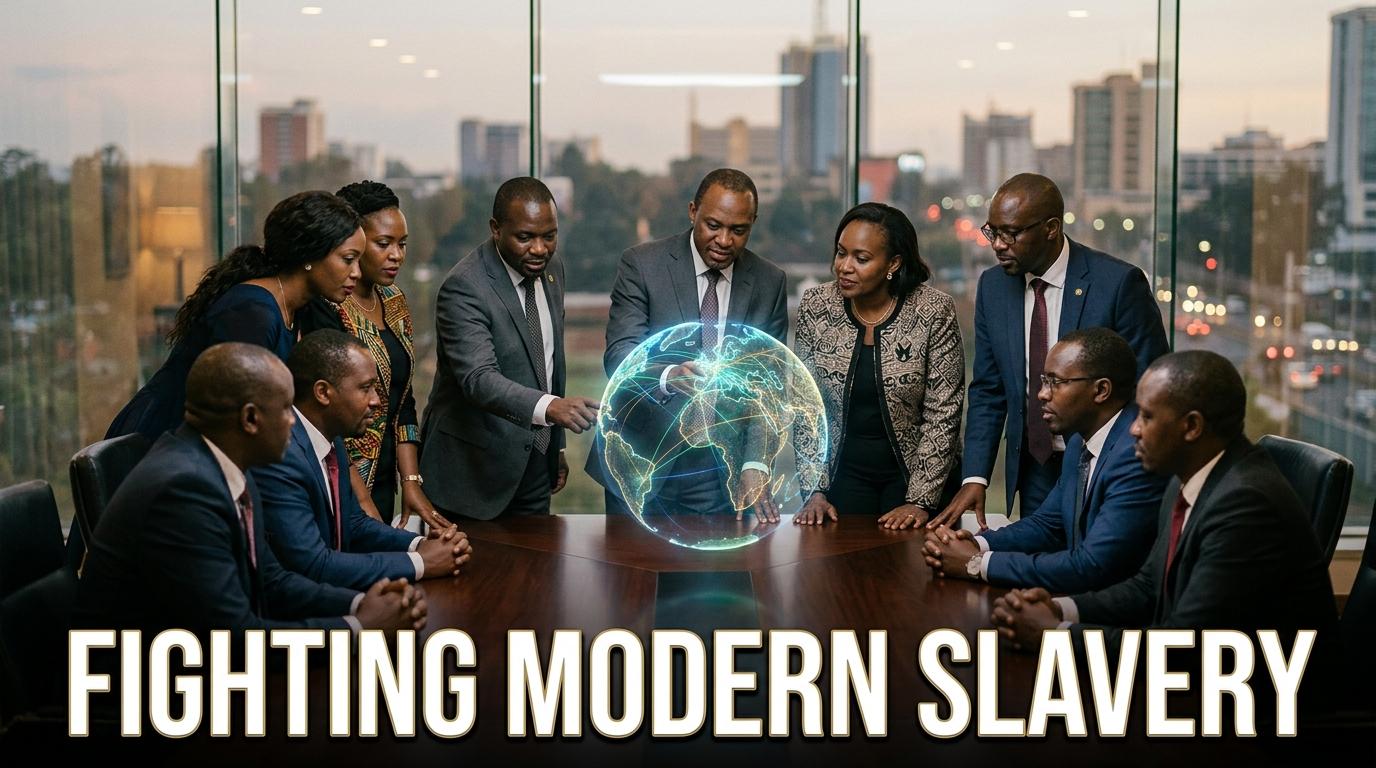
At an international conference held at Tangaza University in Nairobi, Kenya, government officials and diaspora representatives gathered for a landmark summit (tangaza.ac.ke). The Fourth International Conference on Human Trafficking brought together key leaders, including Roseline Kathure Njogu, Kenya’s Principal Secretary for Diaspora Affairs (diaspora.go.ke, diaspora.go.ke). They gathered to confront the growing crisis of migrant exploitation across the globe (iom.int).
For decades, global displacement and labor migration have shaped the lives of millions of African families. Today, modern trafficking networks rely heavily on digital coercion, deceptive job postings, and regional instability (state.gov, state.gov). To combat these evolving threats, delegates outlined coordinated strategies that move far beyond simple physical rescues (diaspora.go.ke). The new frameworks prioritize long-term survivor rehabilitation, economic empowerment, and international intelligence sharing (iom.int, idiaspora.org).
Defining the Diaspora: From Slavery to the Sixth Region
To understand this united effort, one must examine how the global African community defines itself in international policy. The African Union officially defines the African diaspora as people of native or partial African origin living outside the continent (au6rg.org). This definition includes individuals regardless of their current citizenship, provided they wish to contribute to the development of Africa (panafricancouncil.org, au6rg.org). Significantly, the African Union formally designated this global population as the “Sixth Region” of the continent (au6rg.org).
This official framework creates a unified coalition that spans generations and geography. The definition encompasses the “continental diaspora,” which consists of recent emigrants moving abroad for labor or education (au6rg.org). It also incorporates the “historical diaspora,” comprising descendants of enslaved Africans forcibly dispersed across the Americas (au6rg.org). Historically, how families survived oppression provided a blueprint for resilience, survival, and community preservation (wikipedia.org). Today, African Americans and global Black communities partner with continental leaders to defend vulnerable migrants against modern forced labor (panafricancouncil.org, au6rg.org).
The Kafala Legacy and Domestic Exploitation in the Gulf
For many years, low-wage labor migration from East Africa flowed primarily toward Middle Eastern nations. Member countries of the Gulf Cooperation Council, including Saudi Arabia, the United Arab Emirates, Qatar, Kuwait, Oman, and Bahrain, recruited heavily from East Africa (pomeps.org). Migrant domestic workers from Kenya, Uganda, and Ethiopia traveled to these states under a sponsorship framework known as the Kafala system (pomeps.org).
Originating in the mid-twentieth century, the Kafala system legally binds a worker’s visa and residency status directly to an individual employer (pomeps.org). This framework grants employers extreme authority over foreign workers (pomeps.org, ohchr.org). Consequently, domestic workers frequently face severe abuses, including passport confiscation, physical confinement, wage theft, and excessive work hours (ohchr.org, kudheiha.org).
Despite these documented dangers, millions of workers accept overseas positions because remittances remain a crucial economic lifeline. In 2023, Kenya received $4.2 billion in foreign remittances, making it one of the largest financial recipients in Sub-Saharan Africa (iom.int). The urgent pressure to support families at home leaves job seekers vulnerable to deceptive recruitment agencies and debt bondage (kudheiha.org). The history of survival strategies during enslavement demonstrates how economic necessity has long compelled vulnerable populations to navigate dangerous labor systems to protect their loved ones.
Legal Protections: Palermo Protocol to Kenya’s 2010 Act
International legal frameworks have continuously evolved to address transnational human rights abuses. The United Nations Palermo Protocol, adopted in 2000, established the first universally accepted definition of human trafficking (unodc.org, un.org). It outlines three core elements: the act of recruitment, the means of coercion or fraud, and the purpose of exploitation (unodc.org). Crucially, the protocol introduced the non-punishment principle, ensuring that victims are not prosecuted for unlawful acts forced upon them by traffickers (ohchr.org, unodc.org).
Building upon the Palermo Protocol, Kenya enacted the Counter-Trafficking in Persons Act in 2010 (parliament.go.ke, unodc.org). This legislation defined human trafficking clearly in national law and established severe criminal penalties ranging from thirty years to life imprisonment for offenders (parliament.go.ke). It marked a significant shift away from treating forced labor as a simple administrative immigration issue (parliament.go.ke).
However, enforcing these legal protections across international borders presented persistent challenges. For years, domestic oversight agencies struggled with budget constraints and limited investigative capacity (state.gov). These enforcement gaps allowed rogue recruitment agencies to operate freely, targeting vulnerable workers in major urban centers (kudheiha.org).
Due Diligence Litigation: Holding Governments Accountable
When regulatory failures allowed systemic abuses to persist, survivors and civil society groups turned to the judiciary for remedies. A major legal battle unfolded when survivors filed a landmark public-interest lawsuit in domestic courts (the-isla.org). The case, known as Kituo Cha Sheria and Others v. Cabinet Secretary for Labour, directly challenged the state’s failure to regulate private employment agencies (the-isla.org, the-isla.org).
The legal team relied heavily on the international law standard known as the Due Diligence Principle (yalelawandpolicy.org). Under this principle, sovereign states carry a positive legal obligation to prevent, investigate, and remedy human rights abuses committed by private entities (yalelawandpolicy.org). While a government might not directly commit the private abuse, systemic failure to oversee recruitment channels creates binding state liability under international law (yalelawandpolicy.org).
On June 19, 2026, the Employment and Labour Relations Court in Nairobi delivered a historic judgment (the-isla.org). The court ruled that the government breached its constitutional duty by failing to protect domestic workers from trafficking and abuse overseas (the-isla.org). This ruling established a vital judicial precedent. It compels state institutions to enforce strict recruitment oversight and guarantee consular protection for citizens abroad (the-isla.org). Just as post-Civil War Reconstruction failed to secure equal protection under the law, modern African workers have turned to legal battles to demand state protection against systemic exploitation.
Modern Fraud Compounds: Cyber Slavery in Southeast Asia
In recent years, human trafficking networks have shifted beyond traditional domestic labor markets. Following global economic shifts, organized crime syndicates expanded operations into Southeast Asia, setting up bases in Myanmar, Laos, and Cambodia (time.com, globalinitiative.net). Within these border regions, transnational syndicates established heavily guarded cyber-scam compounds (time.com, globalinitiative.net).
These criminal operations target educated, English-speaking African youth through deceptive digital marketing (eastleighvoice.co.ke, africauncensored.online). Fake job advertisements post attractive offers for roles in customer support, hotel management, or digital marketing (eastleighvoice.co.ke, africauncensored.online). Traffickers utilize social media platforms and compromised recruitment agencies in international travel hubs to lure unsuspecting candidates (eastleighvoice.co.ke, africauncensored.online).
Upon arrival in transit countries, victims have their passports confiscated and are smuggled across guarded borders into forced labor facilities (time.com, africauncensored.online). Inside these compounds, captives are forced to execute complex online financial fraud schemes, commonly called “pig-butchering” scams, targeting global victims (time.com, globalinitiative.net). Captives face severe physical violence, forced starvation, and torture if they fail to meet strict scam quotas (time.com, africauncensored.online).
The operational scope of these cyber compounds is immense. Official parliamentary reports revealed that between 2022 and May 2026, authorities rescued 751 Kenyan citizens from compounds in Myanmar (parliament.go.ke, eastleighvoice.co.ke). Additionally, government officials assisted 406 Kenyan nationals trapped in Cambodian compounds within a single four-month period in early 2026 (parliament.go.ke, eastleighvoice.co.ke). This rapid evolution demonstrates how modern forced labor has adapted to digital platforms.
Global Security Alliances and Diaspora Governance
Confronting these sophisticated criminal networks requires multi-layered international partnerships. The Dublin Declaration of 2022 established an international blueprint to institutionalize diaspora involvement in migration governance (gfmd.org, idiaspora.org). To operationalize this vision, international partners established the Global Diaspora Policy Alliance in September 2024 (iom.int, iom.int). This framework elevates diaspora organizations from simple financial senders into active policy advisors and frontline responders (diasporafordevelopment.eu, idiaspora.org).
Simultaneously, international security partnerships have aligned to disrupt transnational crime rings. In June 2024, the United States formally designated Kenya as a Major Non-NATO Ally (trade.gov, kenyanforeignpolicy.com). This security designation expanded bilateral defense funding, technical training, and intelligence sharing (trade.gov, kenyanforeignpolicy.com). These structural upgrades assist civil law enforcement agencies in tracking digital financial flows and dismantling organized trafficking networks across borders (trade.gov, kenyanforeignpolicy.com).
Furthermore, in June 2026, Kenya joined G7 nations in signing a global declaration targeting organized migrant smuggling and modern slavery (panafricanvisions.com, kenyanforeignpolicy.com). These diplomatic steps integrate African nations into international counter-trafficking intelligence networks, providing powerful tools to disrupt organized syndicates.
Rebuilding Lives: Beyond Rescue to Restoration
Delegates at the Nairobi conference emphasized that physical rescue operations represent only the initial phase of recovery (diaspora.go.ke, tangaza.ac.ke). Survivors returning from cyber compounds and forced labor facilities face severe physical trauma, psychological distress, and heavy financial debts (freetheslaves.net, helenbamber.org). Without comprehensive support structures, returned migrants remain vulnerable to secondary trafficking (freetheslaves.net, lastradainternational.org).
The strategy adopted in Nairobi prioritizes holistic, survivor-centered reintegration (diaspora.go.ke). Academic centers, such as the Tangaza Centre for Ethical Leadership, collaborate with survivor-led organizations to deliver trauma-informed care, vocational training, and economic support (tangaza.ac.ke). These initiatives ensure survivors re-enter local economies securely and regain financial independence (diaspora.go.ke, tangaza.ac.ke).
By uniting legal protections, strategic intelligence, and diaspora advocacy, global Black leaders are building sustainable responses to modern exploitation (iom.int, panafricancouncil.org). Connecting historical context with contemporary action enables the global African diaspora to protect vulnerable workers and defend human dignity worldwide (panafricancouncil.org, au6rg.org).
About the Author
Darius Spearman is a professor of Black Studies at San Diego City College, where he has been teaching for over 20 years. He is the founder of African Elements, a media platform dedicated to providing educational resources on the history and culture of the African diaspora. Through his work, Spearman aims to empower and educate by bringing historical context to contemporary issues affecting the Black community.
