
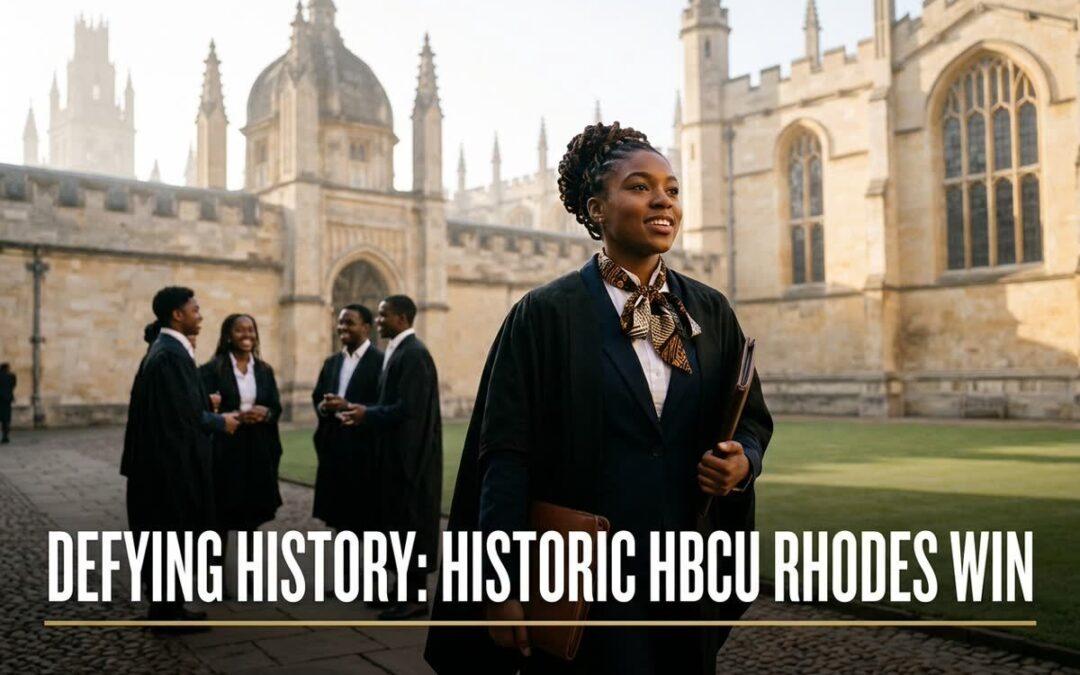

U.S. Rhodes Scholars: Historic HBCU Win Defies Oxford’s Past
By Darius Spearman (africanelements)
Support African Elements at patreon.com/africanelements and hear recent news in a single playlist. Additionally, you can gain early access to ad-free video content.
The annual announcement of the American class of Rhodes Scholars represents one of the most visible milestones in global academia (forbes.com). On November 18, the Rhodes Trust selected 32 American undergraduates and recent graduates to pursue fully funded postgraduate study at the University of Oxford (9news.com, ox.ac.uk). Within this cohort, five African American scholars earned appointments across a diverse spectrum of academic fields, including biomedical sciences, comparative social policy, international economics, and legal history (jbhe.com, indianewengland.com). These selections draw attention to the intersection of contemporary intellectual achievement and historical memory (jbhe.com, columbia.edu).
The 2026 class includes Kailynn M. Weaver of Prairie View A&M University, Arianna G. Doss of the Massachusetts Institute of Technology, Richard O. George of Yale University, Bryson A. Handy of The George Washington University, and Mya M. Koffie of Princeton University (jbhe.com). The presence of these African American Rhodes Scholars at Oxford reflects profound institutional shifts (jbhe.com, rhodesproject.com). The scholarship was originally established using wealth extracted through colonial mining enterprises in Southern Africa (historiana.eu, encyclopedia.com). The scholars who now claim these awards are actively confronting public policy dilemmas, legal structural barriers, and systemic health disparities that disproportionately impact marginalized populations (jbhe.com, pvamu.edu).
The 2026 U.S. Rhodes Selection Funnel
Kailynn Weaver and the Prairie View A&M Rhodes Scholar Breakthrough
The appointment of Kailynn M. Weaver as a Prairie View A&M Rhodes Scholar represents an institutional milestone for the state of Texas and historically Black higher education (pvamu.edu, houstonchronicle.com). Prairie View A&M University (PVAMU) was founded in 1876 during the Reconstruction era and operates as Texas’s second-oldest public institution of higher learning (pvamu.edu, pvamu.edu). In its nearly 150-year operating history, the university had never produced a Rhodes Scholar until Weaver’s election in the 2026 cycle (pvamu.edu, blackenterprise.com).
Weaver, a senior biology major from Greenwood, Louisiana, completed extensive laboratory investigations into cardiovascular pathology, concentrating specifically on endothelial dysfunction and congenital cardiac anomalies (pvamu.edu, texasmetronews.com). Her scientific inquiries extend into the structural mechanics of community wellness, evaluating how socioeconomic inequality and regional healthcare disinvestment drive disparate clinical outcomes for Black Americans (jbhe.com, pvamu.edu). At Oxford, Weaver plans to read for two consecutive degrees: a Master of Science in Translational Health Sciences and a Master of Science in Evidence-Based Social Intervention and Policy Evaluation (jbhe.com, pvamu.edu).
Weaver’s achievement was accompanied by unprecedented institutional breadth for PVAMU (houstonchronicle.com, pvamu.edu). The university produced two national finalists in the 2026 competition, with political science major Raniyah Edwards also advancing to the final interview stage within District 8 (pvamu.edu, pvamu.edu). This institutional showing highlights deliberate investments made by the university honors program to prepare candidates for rigorous international fellowship screenings (houstonchronicle.com, texasmetronews.com). Weaver joins a selective national contingent of 32 scholars who were vetted across 16 regional committees from an initial pool of over 3,000 applicants (9news.com, forbes.com).
| Scholar | Undergraduate Institution | Oxford Degree Objective |
|---|---|---|
| Kailynn M. Weaver | Prairie View A&M University | M.Sc. Translational Health Sciences |
| Arianna G. Doss | Mass. Institute of Technology | M.Sc. Comparative Social Policy |
| Richard O. George | Yale University | M.Sc. Politics |
| Bryson A. Handy | George Washington University | M.Sc. Economics |
| Mya M. Koffie | Princeton University | M.Sc. Socio-Legal Research |
The academic interests of the remaining Black scholars in the 2026 cohort parallel Weaver’s commitment to social equity (jbhe.com, indianewengland.com). Arianna G. Doss, a Houston native and MIT graduate in biological engineering and political science, analyzed maternal health disparities while serving as a policy intern in the United States House of Representatives (jbhe.com, blackenterprise.com). Richard O. George of Yale conducted ethnographic research into public political discourse while organizing local labor unions (jbhe.com, jbhe.com). Bryson A. Handy, a Truman Scholar at George Washington University, examined sovereign debt markets alongside civil rights philosophy (jbhe.com, jbhe.com). Mya M. Koffie, a world-champion collegiate debater at Princeton, conducted research into civil legal remedies for survivors of domestic violence (jbhe.com, jbhe.com). Each scholar will use University of Oxford scholarships to address structural governance failures across international borders (jbhe.com, ox.ac.uk).
Cecil Rhodes Imperial Legacy and the Architecture of Exclusion
To grasp the significance of five Black scholars entering Oxford through this trust, one must examine the Cecil Rhodes imperial legacy (ox.ac.uk, historiana.eu). Cecil John Rhodes (1853–1902) was a British colonial businessman and politician who amassed extreme private wealth through diamond and gold extraction in Southern Africa (wikipedia.org, historiana.eu). Through the De Beers diamond syndicate and the British South Africa Company, Rhodes established commercial monopolies backed by state violence and administrative dispossession (historiana.eu, encyclopedia.com). As Prime Minister of the Cape Colony, he introduced the Glen Grey Act of 1894, which dispossessed Indigenous Africans of ancestral lands and created labor taxes designed to push African men into corporate mine shafts (historiana.eu).
Rhodes viewed higher education as a strategic vehicle for British imperial supremacy (ox.ac.uk, historiana.eu). In early versions of his will, Rhodes outlined ambitions to finance a global society tasked with expanding British dominion across the planet (historiana.eu, encyclopedia.com). By his sixth and final will, executed prior to his death in 1902, this ideological project manifested as an international educational trust at the University of Oxford (ox.ac.uk, wikipedia.org). Rhodes envisioned gathering male scholars from the British Empire, the United States, and Germany to forge an enduring ruling class grounded in Anglo-Saxon racial unity (wikipedia.org, historiana.eu).
“No student shall be qualified or disqualified for election to a Scholarship on account of his race or religious opinions.”
— Cecil John Rhodes, Sixth Will and Testament (1902)
Rhodes defined four criteria for election: academic distinction, athletic vigor, moral force of character, and instincts to lead (ox.ac.uk, wikipedia.org). He included language stipulating that candidates should not face disqualification on religious or racial grounds (wikipedia.org, historiana.eu). However, the operational reality of the trust remained deeply tied to early-twentieth-century colonial frameworks (ox.ac.uk, historiana.eu). Selection committees within the United States were immediately turned over to local academic gatekeepers who implemented policies of racial exclusion that contradicted the literal text of the founder’s will (aaregistry.org, columbia.edu).
The Isolation of Alain Locke Rhodes Scholar and the 56-Year Color Line
The racial barriers of the scholarship were tested within the first four years of American selections (aaregistry.org, columbia.edu). In 1907, Philadelphia native Alain LeRoy Locke gained election from Pennsylvania, becoming the first Alain Locke Rhodes Scholar in history (aaregistry.org, upenn.edu). Locke had graduated from Harvard University in just three years with highest academic honors (harvard.edu, columbia.edu). The Pennsylvania selection committee conducted its evaluations entirely through written dossiers, discovering that Locke was an African American only after his selection had been certified and publicized (aaregistry.org, upenn.edu).
Locke’s appointment triggered immediate resistance among white American scholars (aaregistry.org, columbia.edu). Southern Rhodes Scholars published formal protests and threatened to surrender their appointments rather than board transatlantic vessels alongside a Black peer (columbia.edu, upenn.edu). Upon Locke’s arrival in England, several Oxford colleges refused his matriculation requests exclusively due to racial prejudice (aaregistry.org, upenn.edu). Only Hertford College accepted Locke, with its administrative leadership rejecting petitions from white American students who demanded Locke’s immediate removal or social segregation (aaregistry.org, columbia.edu).
The 56-Year Exclusionary Color Line
Locke completed his education at Oxford and Harvard, eventually serving as chair of the Department of Philosophy at Howard University (aaregistry.org, legacyprojectchicago.org). In 1925, he edited The New Negro, an anthology that codified the creative output of the Harlem Renaissance and redefined modern Black intellectual identity (legacyprojectchicago.org, wikipedia.org). Yet the backlash surrounding his Oxford election proved destructive to subsequent generations (aaregistry.org, columbia.edu). American selection committees adopted an informal color line that barred Black candidates from receiving endorsements (columbia.edu, upenn.edu). For 56 continuous years, no African American applicant secured appointment to the Rhodes Trust (aaregistry.org, wikipedia.org).
Desegregating the Rhodes Trust During the Civil Rights Era
The prolonged era of exclusion ended in December 1962 with the selection of the 1963 class, marking the start of Desegregating the Rhodes Trust (jbhe.com, wikipedia.org). Two African American men broke the barrier simultaneously: John Edgar Wideman of the University of Pennsylvania and Joseph Stanley Sanders of Whittier College (jbhe.com, wikipedia.org). Wideman was a Phi Beta Kappa literature major and captain of the Penn basketball team (jbhe.com, wikipedia.org). Sanders was Whittier’s student body president and an All-American football athlete (jbhe.com, wikipedia.org). Both scholars matched the traditional criteria established by the Rhodes Trust, making subjective exclusion difficult for committee members (jbhe.com, wikipedia.org).
This breakthrough unfolded against the backdrop of federal interventions in the American South, including the violent integration crises that surrounded the enrollment of James Meredith at the University of Mississippi (jbhe.com). Selection leadership under American Secretary Courtney Smith worked to professionalize national screening panels, reducing the ability of regional committees to apply Jim Crow standards (jbhe.com). Wideman went on to become a celebrated author and MacArthur Fellow, while Sanders pursued a career in municipal law and civic organizing in Southern California (jbhe.com, wikipedia.org).
Gender barriers remained codified within the Rhodes Trust until the mid-1970s (unc.edu, rhodesproject.com). The terms of Cecil Rhodes’s will specifically restricted awards to men, a mandate that endured until the British Parliament passed the Sex Discrimination Act of 1975 (rhodesproject.com). The following year, the trust modified its founding statutes to invite applications from women (unc.edu, rhodesproject.com). In 1978, Karen Stevenson of the University of North Carolina at Chapel Hill made history as the first African American woman selected for a Rhodes Scholarship (unc.edu, rhodesproject.com). Stevenson, a record-setting sprinter and Morehead-Cain Scholar, later built a distinguished career as a United States Magistrate Judge (unc.edu, rhodesproject.com).
The appointment of Karen Stevenson in 1978 dismantled seven decades of compounded racial and gender restrictions at Oxford.
Throughout the final decades of the twentieth century, Black Rhodes Scholars moved steadily into executive leadership across civil society (wikipedia.org, jbhe.com). Kurt Schmoke and Franklin Raines gained election in 1971, eventually serving as Mayor of Baltimore and Director of the White House Office of Management and Budget, respectively (wikipedia.org, jbhe.com). Legal scholar Randall Kennedy earned appointment in 1977, Susan Rice won selection in 1986 prior to serving as United States Ambassador to the United Nations, and Cory Booker secured election in 1992 before entering the United States Senate (washingtonpost.com, wikipedia.org). These scholars demonstrated that democratic governance and higher education reform were directly enriched by dismantling exclusionary fellowship conventions (wikipedia.org, columbia.edu).
Overcoming Decades of Systemic HBCU Funding Disparities
While Black scholars from predominantly white universities broke into the Rhodes community after 1963, historically Black colleges faced systemic structural obstacles that created steep HBCU funding disparities (thehundred-seven.org, morehouse.edu). Most HBCUs were founded following the Civil War when Black Americans were barred from public colleges throughout the South (pvamu.edu, pvamu.edu). The passage of the Second Morrill Land-Grant Act of 1890 required segregated states to establish separate agricultural and mechanical institutions for Black students, bringing schools like Prairie View A&M into the land-grant network during the post-Reconstruction era (pvamu.edu, pvamu.edu).
State legislatures consistently deprived Black land-grant institutions of statutory matching funds mandated under federal law (thehundred-seven.org). In September 2023, the United States Department of Education and the Department of Agriculture issued formal notifications to 16 state governors detailing a documented shortfall of more than twelve billion dollars in state matching funds for HBCUs between 1993 and 2023 alone (pvamu.edu, thehundred-seven.org). Prairie View A&M University was subjected to decades of inequitable resource distribution by the Texas state legislature when compared directly to Texas A&M University in College Station (pvamu.edu, houstonchronicle.com). This funding divide limited the campus infrastructure, graduate research laboratories, and dedicated fellowship advising offices required to mount elite global scholarship candidacies (pvamu.edu, thehundred-seven.org).
HBCU Rhodes Scholars Produced
Despite persistent underfunding, select HBCUs successfully established international fellowship pipelines (morehouse.edu, jbhe.com). In 1994, Morehouse College senior Nima Warfield earned election as the first African American Rhodes Scholar from an HBCU (morehouse.edu, thehundred-seven.org). Morehouse went on to develop an exceptional institutional record, producing subsequent Rhodes Scholars including Christopher Elders in 2002, Topé Folarin in 2004, Prince Abudu in 2016, Franck Nijimbere in 2018, and Aniaba Jean-Baptist N’guessan in 2025 (morehouse.edu, thehundred-seven.org). Howard University similarly produced a series of scholars, including Mark Alleyne in 1986, Carla Peterman in 1999, Marianna Ofosu in 2003, and Cameron Clarke in 2016 (thehundred-seven.org, jbhe.com). Weaver’s election adds Prairie View A&M to this historic list, demonstrating that top-tier intellectual leadership thrives within public land-grant institutions despite documented educational inequities (pvamu.edu, blackenterprise.com).
How the Rhodes Must Fall Movement Reshaped Oxford Scholarships
The contemporary expansion of access to Oxford cannot be separated from modern student activism, most notably the Rhodes Must Fall movement (ox.ac.uk, time.com). In March 2015, students at the University of Cape Town in South Africa launched protests demanding the removal of a campus statue honoring Cecil Rhodes, condemning his legacy of colonial exploitation (ox.ac.uk, time.com). The movement spread directly to Oxford later that year, where the Rhodes Must Fall Oxford campaign pressured the university to confront colonial iconography and Eurocentric curricula (ox.ac.uk, time.com). Activists concentrated on the prominent statue of Rhodes overlooking the High Street from the façade of Oriel College, bringing global attention to the institutional links connecting Oxford’s modern endowments with colonial violence (ox.ac.uk, ox.ac.uk).
The protests prompted structural self-examination within the Rhodes Trust (ox.ac.uk, ox.ac.uk). Rather than dismissing the student demonstrations, executive leadership—directed by Warden Elizabeth Kiss—initiated dialogues concerning the imperial history of the endowment (ox.ac.uk, ox.ac.uk). The Trust openly acknowledged that its founding wealth originated in African resource extraction and organized forums addressing historical equity (ox.ac.uk, ox.ac.uk). To address geographic imbalances, the Trust expanded constituencies into West Africa, East Africa, and other developing regions, alongside creating global at-large appointments for students from nations lacking domestic committees (ox.ac.uk, ox.ac.uk).
Within the United States, administrative outreach shifted deliberately toward state universities, regional campuses, and minority-serving institutions (forbes.com, ox.ac.uk). Ivy League universities historically captured more than a third of all American appointments, establishing a concentration of educational capital that reinforced elite privileges (forbes.com, columbia.edu). The deliberate inclusion of regional land-grant universities reflects an operational shift toward broader democratic representation (forbes.com, pvamu.edu). The 32 scholars selected for the 2026 class represent 22 unique higher education institutions across the nation, highlighting an expanding geographic footprint (9news.com, forbes.com).
The selection of five African American scholars in 2026 marks an important historical transition (jbhe.com, indianewengland.com). A trust established by an imperial magnate to extend Anglo-Saxon global control now finances graduate study for scholars of African descent who examine post-colonial development, maternal healthcare accessibility, and structural racism (jbhe.com, historiana.eu). From Alain Locke’s isolated matriculation in 1907 to Kailynn Weaver’s upcoming arrival from Prairie View A&M, these selections demonstrate how persistent community activism and academic dedication can transform exclusionary institutions into engines of global equity (pvamu.edu, aaregistry.org).
About the Author
Darius Spearman is a professor of Black Studies at San Diego City College, where he has been teaching for over 20 years. He is the founder of African Elements, a media platform dedicated to providing educational resources on the history and culture of the African diaspora. Through his work, Spearman aims to empower and educate by bringing historical context to contemporary issues affecting the Black community.
