


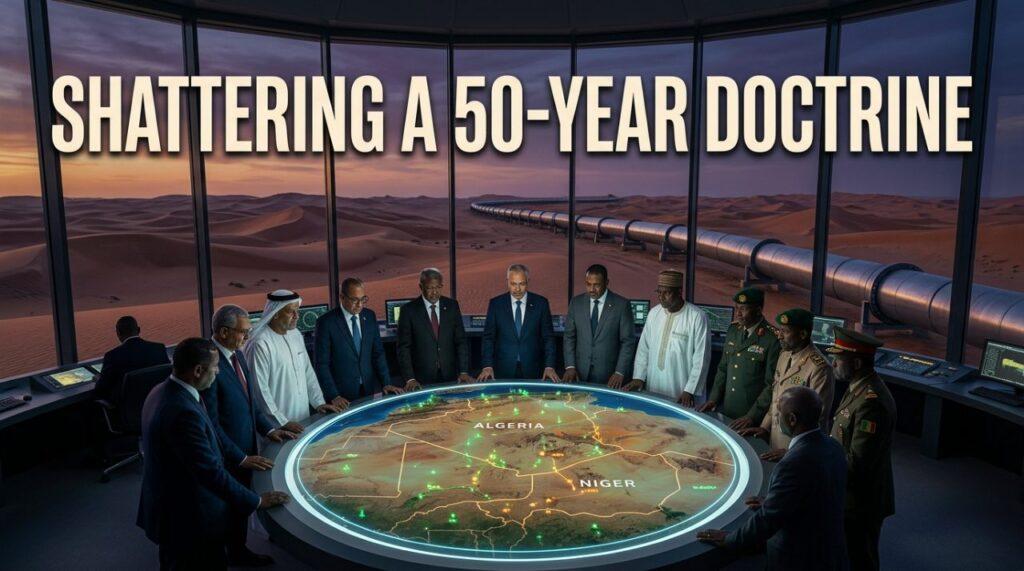
Why Algeria Broke Its 50-Year Military Rule in Niger
By Darius Spearman (africanelements)
Support African Elements at patreon.com/africanelements and hear recent news in a single playlist. Additionally, you can gain early access to ad-free video content.
Breaking a Fifty-Year Military Precedent
In a historic parliamentary vote, the Algerian government authorized the deployment of armed forces into neighboring Niger (aljazeera.com, aljazeera.com). The decision marks the first time in over half a century that Algerian ground troops have been cleared to operate beyond their sovereign borders (thearabweekly.com). The emergency legislative sessions took place in the Council of the Nation and the People’s National Assembly under constitutional provisions established in 2020 (carnegieendowment.org). Lawmakers voted to support the transitional military administration in Niamey, creating an immediate ripple effect across regional defense circles (aljazeera.com, kelo.com).
The mission assigns the People’s National Army, known as the ANP, to guard vulnerable border zones and critical energy infrastructure (aljazeera.com, businessinsider.com). Algerian units are preparing to enter northern Niger, with particular operational focus on the remote fortress of Madama and oil installations within the Kafra basin (aljazeera.com, thearabweekly.com). For decades, Algeria maintained a strict policy against foreign military deployments, choosing static border defense over cross-border maneuvers (carnegieendowment.org, nesa-center.org). This historic vote fundamentally reshapes North African security, demonstrating how rapidly shifting realities across the Sahel are pushing regional states toward new defense doctrines (arabnews.com, bisa.ac.uk).
Anticolonial Roots and the Doctrine of Non-Intervention
To grasp why crossing into Niger represents such a profound transformation, one must examine Algeria’s modern revolutionary lineage. Modern Algerian strategic thought was born in the furnace of the War of Independence against French colonial rule between 1954 and 1962 (carnegieendowment.org). The National Liberation Front and its armed wing, the National Liberation Army, viewed the presence of foreign troops on sovereign soil as the ultimate expression of imperial domination (nesa-center.org, researchgate.net). Under foundational leaders Ahmed Ben Bella and Houari Boumediene, the new state positioned anti-imperialism and sovereign integrity at the absolute center of its national defense architecture (carnegieendowment.org, researchgate.net). This anticolonial ethos closely mirrored the political theories of postcolonial liberation that took root across Africa during the mid-twentieth century (bisa.ac.uk).
Following independence, Algiers championed the inviolability of inherited borders, a principle later adopted by the Organization of African Unity to prevent territorial warfare (au.int, researchgate.net). Algeria emerged as an influential champion of the Non-Aligned Movement, giving safe harbor to liberation movements from South Africa to the Americas while avoiding foreign military alliances (carnegieendowment.org, nesa-center.org). The historical posture rested on three firm tenets: strict non-interference in other nations, respect for sovereign borders, and the total refusal to deploy national soldiers on foreign soil (nesa-center.org, politique-etrangere.com). This defensive stance was preserved across successive constitutional iterations, enshrining the military as an instrument designed solely to protect sovereign territory against outside aggression (carnegieendowment.org, jmss.org).
The 1973 Precedent and Decades of Self-Imposed Restraint
Algerian combat units ventured outside national borders on only a handful of occasions during the early post-independence era. In 1963, the military fought a brief frontier engagement known as the Sand War against Morocco (nesa-center.org). Later, in 1967 and 1973, Algeria dispatched armored brigades, infantry battalions, and fighter squadrons to Egypt during the Arab-Israeli conflicts (nesa-center.org, researchgate.net). Following the 1973 October War, Algerian authorities closed the door to expeditionary warfare entirely (nesa-center.org). For fifty-three years, no Algerian president ordered combat soldiers to cross an international frontier, solidifying a doctrine of extreme self-restraint (thearabweekly.com, carnegieendowment.org).
During the 1990s, Algeria fought a brutal domestic insurgency known as the Black Decade, in which state forces battled violent domestic extremist groups (carnegieendowment.org, icct.nl). As armed factions were pushed into the deep Sahara, surviving elements formed the Salafist Group for Preaching and Combat, which rebranded in 2007 as Al-Qaeda in the Islamic Maghreb (carnegieendowment.org, icct.nl). Despite violent cross-border raids striking Algerian border outposts, Algiers refused to send soldiers into neighboring Sahelian territory (carnegieendowment.org). Instead, Algeria promoted regional intelligence bodies such as the Joint Operational Military Committee in Tamanrasset, maintaining its refusal to permit hot pursuit across national lines (carnegieendowment.org, icct.nl). The legal wall remained unbroken until November 2020, when voters approved constitutional revisions under President Abdelmadjid Tebboune (carnegieendowment.org). Article 31 permitted international peacekeeping missions, while Article 91 empowered the president to deploy troops abroad following a two-thirds parliamentary vote (carnegieendowment.org).
Legislative Support for Niger Deployment
The Sahelian Security Vacuum and Western Exit
The immediate catalyst for Algeria’s policy shift lies in the rapid unraveling of the Western security apparatus across the Sahel (icct.nl, criticalthreats.org). Between 2020 and 2023, consecutive military coups toppled civilian administrations in Mali, Burkina Faso, and Niger (icct.nl, criticalthreats.org). The military authorities formed the Alliance of Sahel States, terminating longstanding defense partnerships with European and American powers (icct.nl, criticalthreats.org). Popular protests erupted in Niamey and surrounding cities, voicing deep anger over a decade of French military operations under Operation Barkhane that failed to halt rising civilian casualties (icct.nl, criticalthreats.org). Local communities had grown frustrated with foreign bases operating alongside ongoing violence, interpreting the presence of external powers as an infringement on sovereignty (icct.nl, washingtonpost.com).
Public resentment focused squarely on historic mechanisms of French economic dominance, often referred to as Françafrique (politique-etrangere.com, icct.nl). For decades, French state-controlled entities extracted high-grade uranium from Nigerien mines in Arlit, supplying nuclear reactors in Europe while most Nigerien households lived without domestic electrical grids (icct.nl, washingtonpost.com). Washington also suffered a complete diplomatic reversal, receiving formal eviction notices that shuttered its $110 million drone complex at Air Base 201 near Agadez (washingtonpost.com). Seeking alternatives, the junta established complex foreign alliances with Russian defense networks such as the Africa Corps, formerly known as the Wagner Group (icct.nl, criticalthreats.org). However, Russian personnel struggled to contain growing rebel factions, creating a regional power vacuum that directly threatened Algeria’s southern perimeter (icct.nl, criticalthreats.org).
Pipelines, Oil Reserves, and Trans-Saharan Infrastructure
Economic survival and infrastructure protection represent central drivers behind Algeria’s troop authorization (aljazeera.com, businessinsider.com). Algiers is committing significant resources to secure massive cross-border energy projects (businessinsider.com, pipeline-journal.net). The Algerian state-owned hydrocarbon enterprise, Sonatrach, holds substantial exploration concessions within northern Niger, centered on the Kafra oil basin (businessinsider.com, thearabweekly.com). Geological surveys indicate the block holds more than 260 million barrels of crude oil (businessinsider.com). Operating drill sites in this isolated desert zone requires constant physical protection against roving bandit networks and militant units traversing the borderlands (businessinsider.com, thearabweekly.com).
Even larger strategic interests surround the Trans-Saharan Gas Pipeline, an ambitious continental project valued at $13 billion (pipeline-journal.net, premiumtimesng.com). The planned pipeline spans 4,128 kilometers, originating in the Niger Delta fields of Nigeria, cutting across 841 kilometers of Nigerien territory, and terminating at the Algerian export hub of Hassi R’Mel (pipeline-journal.net, gem.wiki). Designed to pump 30 billion cubic meters of natural gas annually to European energy consumers, the line cannot operate safely through an unsecured corridor (pipeline-journal.net, premiumtimesng.com). By stationing military personnel at the fortified base of Madama near the Libyan frontier, the Algerian army secures key transit arteries, protecting long-term continental investments from sabotage (aljazeera.com, thearabweekly.com).
Trans-Saharan Gas Pipeline Distribution
Local Grievances Behind Regional Insurgency
The military deployment occurs against a backdrop of deep local instability driven by economic neglect and environmental degradation (icct.nl, criticalthreats.org). Extremist organizations such as Jama’at Nusrat al-Islam wal-Muslimin and the Islamic State in the Greater Sahara have gained ground by exploiting rural grievances (icct.nl, criticalthreats.org). Severe droughts and expanding desertification have sharpened competition between semi-nomadic pastoralists and sedentary agricultural communities (icct.nl, criticalthreats.org). Marginalized Fulani herders frequently face exclusion under customary land-tenure frameworks, leaving their herds without legal grazing corridors or reliable water points (icct.nl). Militant factions step into this breach, providing cattle protection, retrieving stolen livestock, and securing grazing rights to build rural alliances (icct.nl, criticalthreats.org).
State absence compounds these communal fractures (icct.nl, criticalthreats.org). For generations, remote villages across northern and western Niger have lacked public health clinics, schools, clean drinking water, and functioning courts (icct.nl, criticalthreats.org). Local populations have regularly endured predatory behavior by government officials, such as arbitrary grazing fines levied by forestry rangers and abusive counter-insurgency operations by national armies (icct.nl, criticalthreats.org). When regular justice systems are corrupt or non-existent, local residents turn to parallel sharia arbitration courts run by insurgents for rapid conflict resolution (icct.nl). In regions stripped of formal jobs, extremist groups offer disaffected youth weapons, cash payments, and physical safety (icct.nl). They control and tax artisanal gold mining sites and informal fuel smuggling networks, providing economic structure where the modern state provides none (icct.nl, criticalthreats.org).
The Humanitarian Crisis Along Northern Transit Routes
While officials frame the deployment around counter-terrorism and economic security, human rights organizations highlight severe humanitarian costs for vulnerable travelers (aljazeera.com, nook.africa). The militarization of the southern frontier exacerbates an ongoing migration crisis that directly impacts sub-Saharan Africans seeking transit toward North Africa (aljazeera.com, nook.africa). In these desert corridors, black migrants confront harsh state practices that test international legal protections and grassroots demands for self-determination (aljazeera.com, nook.africa).
Independent monitors from Human Rights Watch and Doctors Without Borders have repeatedly documented summary expulsions carried out by Algerian security forces (nook.africa). Thousands of sub-Saharan migrants are rounded up in urban centers, loaded onto buses, and driven south into the desert (nook.africa). Security personnel deposit these groups at an isolated border marker known as Point Zero, fifteen kilometers north of the Nigerien settlement of Assamaka (nook.africa). Migrants are stripped of cash, cell phones, and travel documents, then forced to walk across barren desert terrain in scorching temperatures toward Niger (nook.africa). Vulnerable individuals, including pregnant women and young children, arrive dehydrated, injured, and deeply traumatized (nook.africa).
Increased military surveillance does not eliminate human movement; it pushes travel networks into far deadlier conditions (nook.africa). Smugglers actively avoid fortified outposts like Madama, steering transport trucks into unmapped, waterless Saharan corridors (nook.africa). When vehicles break down in these remote zones, passengers face catastrophic dehydration before humanitarian rescue teams from Alarm Phone Sahara or the United Nations can locate them (nook.africa). Furthermore, tiny border communities like Assamaka and Arlit lack the clean water, medical centers, and food stores required to sustain thousands of expellees (nook.africa). The resulting logistical strain has generated sharp diplomatic anger in Niamey, where leaders view summary expulsions as an unfair export of humanitarian misery directly into Nigerien territory (aljazeera.com, nook.africa).
African Defense Budgets (2025)
Power Projection and the Future of Sovereign Security
The strategic deployment into Niger demonstrates Algeria’s emergence as an assertive expeditionary power (carnegieendowment.org, sipri.org). With an annual defense budget surpassing $25.4 billion—accounting for nearly forty-four percent of all military spending across the African continent—Algeria possesses material resources that eclipse its Sahelian neighbors (sipri.org, defensebudget.org). By providing direct military assistance, including Sukhoi fighter jet cover during recent mutiny attempts in Niamey, Algiers has transformed itself into an essential security partner for the isolated Nigerien leadership (aljazeera.com, thearabweekly.com). This active intervention safeguards Algeria’s massive energy corridor while blocking regional competitors such as Morocco and the United Arab Emirates from expanding their own security influence into the central Sahara (thearabweekly.com, moroccoworldnews.com).
Ultimately, this historic deployment reflects the contradictions facing post-colonial African states (nesa-center.org, bisa.ac.uk). As foreign western armies withdraw from the Sahel, African nations face the dual challenge of protecting their own borders while avoiding the trap of becoming regional military enforcers themselves (icct.nl, criticalthreats.org). Algeria’s shift from strict non-interventionism to active cross-border power projection represents a pragmatic adjustment to a chaotic regional landscape (carnegieendowment.org, nesa-center.org). How Algiers balances its military power against human rights standards and sovereign integrity will define stability across North and West Africa for decades to come (aljazeera.com, carnegieendowment.org).
About the Author
Darius Spearman is a professor of Black Studies at San Diego City College, where he has been teaching for over 20 years. He is the founder of African Elements, a media platform dedicated to providing educational resources on the history and culture of the African diaspora. Through his work, Spearman aims to empower and educate by bringing historical context to contemporary issues affecting the Black community.
