



Can Angie Nixon Become Florida’s First Black U.S. Senator?
By Darius Spearman (africanelements)
Support African Elements at patreon.com/africanelements and hear recent news in a single playlist. Additionally, you can gain early access to ad-free video content.
A Political Earthquake in the Sunshine State
Florida politics experienced a historic tremor when State Representative Angie Nixon captured the Democratic nomination for the United States Senate (news4jax.com). Running on a platform of unapologetic economic populism and working-class advocacy, Nixon defeated former national security official Alex Vindman (prospect.org). The victory astonished political observers across the nation because she was outspent by a staggering margin of nearly seventeen to one (ballotpedia.org, prospect.org).
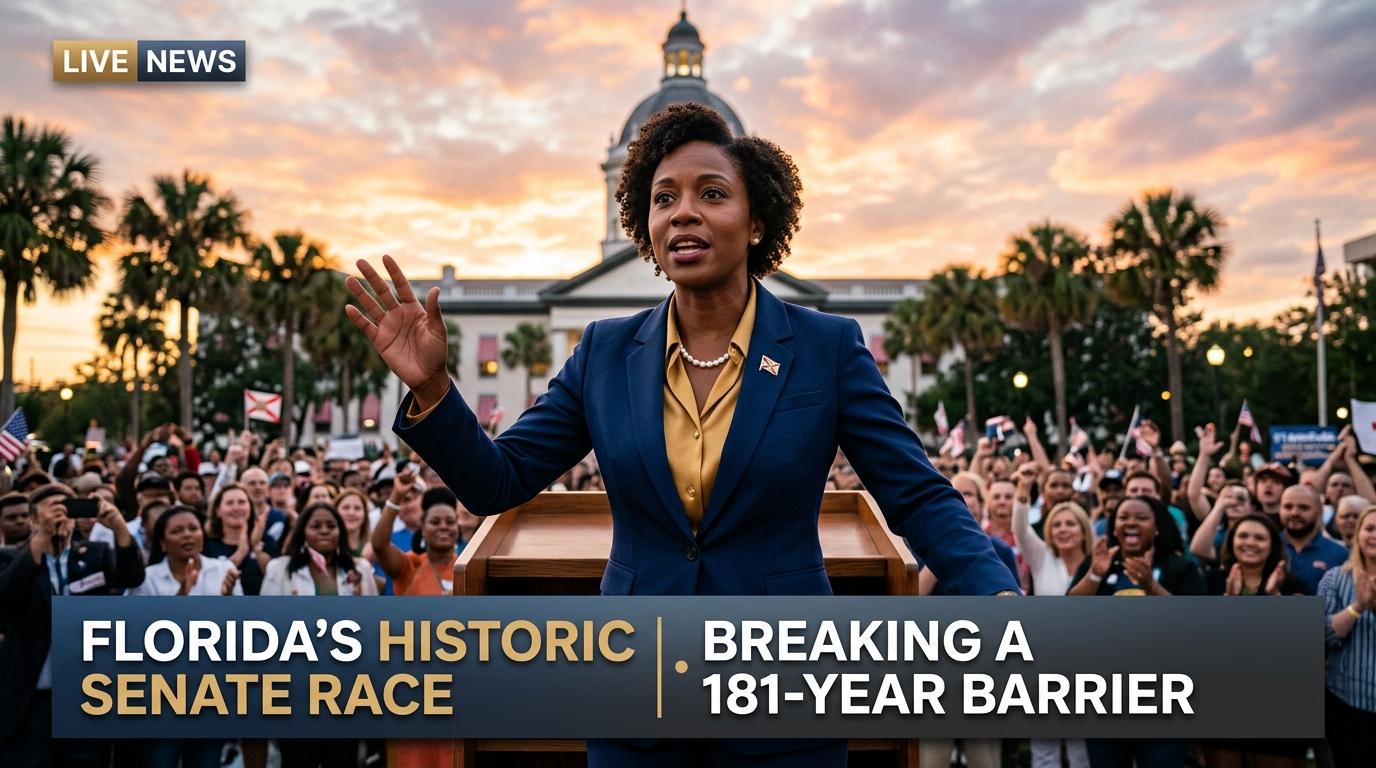
The nomination carries profound historical weight. If Nixon wins the general election, she will become the first Black individual to represent Florida in the United States Senate (news4jax.com, senate.gov). Her campaign directly confronts centuries of structural exclusion in the American South. This moment highlights how modern organizers continue the generational fight for Black political power across the region.
The Reconstruction Era and the Stolen Promise
To understand the magnitude of this candidacy, one must examine the Reconstruction era in Florida. During the immediate after the Civil War period, newly freed African Americans organized rapidly (wikipedia.org). They established schools, built churches, and participated directly in representative democracy (wikipedia.org, floridamemory.com).
Black leaders quickly achieved major legislative milestones across the state. Josiah Thomas Walls, a formerly enslaved veteran of the United States Colored Troops, won election to the Florida House and Senate before becoming Florida’s first Black member of the U.S. House of Representatives in 1870 (wikipedia.org, rootsweb.com). Simultaneously, Jonathan Clarkson Gibbs served as Florida Secretary of State and Superintendent of Public Instruction, establishing the foundation for the state’s public education system (wikipedia.org, floridamemory.com). These leaders proved that biracial democracy could govern effectively.
The Jim Crow Rollback and Decades of Silence
This period of democratic progress was swiftly crushed by white conservative Redeemers (rootsweb.com). Following the Compromise of 1877, federal troops withdrew from the South, leaving Black citizens vulnerable to coordinated violence and legal disenfranchisement (theguardian.com, rootsweb.com). White officials unseated Josiah Walls through contested election challenges in 1876, expelling Black leadership from Capitol Hill (wikipedia.org).
The state then instituted ruthless voter suppression mechanisms, such as the white primary and poll taxes (rootsweb.com, floridamemory.com). The white primary declared political parties to be private clubs, excluding Black citizens from the only meaningful elections in a one-party state (rootsweb.com). These discriminatory laws established a political blackout. Following the removal of Walls in 1876, Florida did not send another Black representative to Congress for 117 years (broward.edu). Furthermore, no Black Floridian has ever entered the United States Senate (senate.gov).
Breaking Through the Modern Glass Ceiling
The long journey toward rebuilding Black political representation in Florida accelerated in the late twentieth century. In 1968, Joe Lang Kershaw gained election to the Florida House of Representatives, becoming the first Black state lawmaker since 1889 (floridamemory.com, broward.edu). Two years later, Gwendolyn Sawyer Cherry became the first Black woman elected to the Florida House (broward.edu). These pioneers opened legislative doors that had been locked for generations.
In 1982, Carrie P. Meek made history by winning a seat in the Florida State Senate (broward.edu). A decade later, court-ordered redistricting enforcing the Voting Rights Act enabled Meek to enter the United States House of Representatives in 1992 (broward.edu). Meek, alongside Corrine Brown and Alcee Hastings, broke the century-long absence of Black Floridians in Congress (broward.edu). While leaders like Kendrick Meek in 2010 and Val Demings in 2022 later mounted historic statewide Senate campaigns, the United States Senate seat remained stubbornly out of reach (ballotpedia.org, senate.gov).
From Grassroots Organizer to the Florida State House
Angie Nixon developed her political philosophy in the neighborhoods of Jacksonville rather than corporate boardrooms (news4jax.com, thejaxsonmag.com). She worked as an organizer and higher education director with the Service Employees International Union (prospect.org). In that role, she represented healthcare workers, university employees, and public servants (prospect.org). This organizing background rooted her career in working-class labor solidarity.
Nixon also recognized that economic empowerment requires local community investment (thejaxsonmag.com). In 2017, she co-founded the Jax Melanin Market along historic A. Philip Randolph Boulevard (thejaxsonmag.com). The initiative serves as a cultural incubator for minority-owned small businesses (thejaxsonmag.com). When Nixon won election to the Florida House of Representatives in 2020, she brought this community-first philosophy directly to Tallahassee (news4jax.com, ballotpedia.org).
Standing on the House Floor: Fighting Voter Suppression
In Tallahassee, Nixon became a visible opponent of policy decisions that weakened minority voting power (firstcoastnews.com). In April 2022, Governor Ron DeSantis pushed a redistricting map that dismantled Florida’s 5th Congressional District (axios.com, news4jax.com). That district had allowed Black communities from Tallahassee to Jacksonville to elect candidates of their choice (axios.com, news4jax.com). Nixon and her colleagues staged a peaceful sit-in on the House floor, singing and demanding fair representation (firstcoastnews.com, news4jax.com).
Her legislative career has consistently addressed modern voting restrictions (theguardian.com). Following the voter-approved Amendment 4 in 2018, state legislation required returning citizens to pay all legal fees before regaining voting rights (theguardian.com). Subsequent laws, including Senate Bill 90 and Senate Bill 7050, placed heavy penalties on third-party voter registration groups (tampabay.com, wlrn.org). These legislative battles illuminate the ongoing conflict between state and national power over civil rights.
The National Picture: Black Women in the U.S. Senate
The scarcity of Black representation in the United States Senate extends far beyond Florida. Out of more than two thousand individuals who have served in the chamber since 1789, only fourteen have been African American (senate.gov). The numbers for Black women remain even smaller (senate.gov, washingtoninformer.com). Only five Black women have ever held a seat in the United States Senate (senate.gov, washingtoninformer.com).
Carol Moseley Braun broke the initial barrier in 1992 when Illinois elected her to the chamber (senate.gov). Decades passed before Kamala Harris became the second Black woman senator in 2016 (senate.gov). Laphonza Butler briefly served after her appointment in 2023 (senate.gov). In 2024, Angela Alsobrooks and Lisa Blunt Rochester made history by winning concurrent Senate elections (washingtoninformer.com, whyy.org). If Nixon prevails, she will become only the sixth Black woman to enter the upper chamber (senate.gov).
The Long Road Ahead to November
The general election presents significant structural hurdles for the Democratic nominee (theguardian.com). Florida has shifted increasingly conservative in recent statewide elections (theguardian.com). Nixon faces Republican incumbent Ashley Moody, the former Florida Attorney General who was appointed by Governor Ron DeSantis to fill Marco Rubio’s vacated Senate seat (news4jax.com, ballotpedia.org). Moody commands substantial party backing and deep financial resources across the state.
To overcome these odds, Nixon is building an expansive coalition of working-class families, young voters, and communities of color (prospect.org). Her strategy bypasses traditional political playbooks by addressing core economic issues like housing affordability, childcare costs, and wage growth (prospect.org). By confronting entrenched anti-Black political strategies, her campaign seeks to transform Florida’s electoral landscape.
Regardless of the November outcome, Angie Nixon has reshaped political assumptions across the state (news4jax.com, prospect.org). Her victory demonstrates the strength of grassroots organizing against immense financial advantages (prospect.org). More importantly, her campaign carries the unfinished work of Reconstruction into the twenty-first century (wikipedia.org, rootsweb.com). The nation now watches Florida to see if voters will finally break a 181-year barrier.
About the Author
Darius Spearman is a professor of Black Studies at San Diego City College, where he has been teaching for over 20 years. He is the founder of African Elements, a media platform dedicated to providing educational resources on the history and culture of the African diaspora. Through his work, Spearman aims to empower and educate by bringing historical context to contemporary issues affecting the Black community.
