


Can the DRC Peace Roadmap End 30 Years of War?
By Darius Spearman (africanelements)
Support African Elements at patreon.com/africanelements and hear recent news in a single playlist. Additionally, you can gain early access to ad-free video content.
A Fragile Breakthrough in Doha and Switzerland
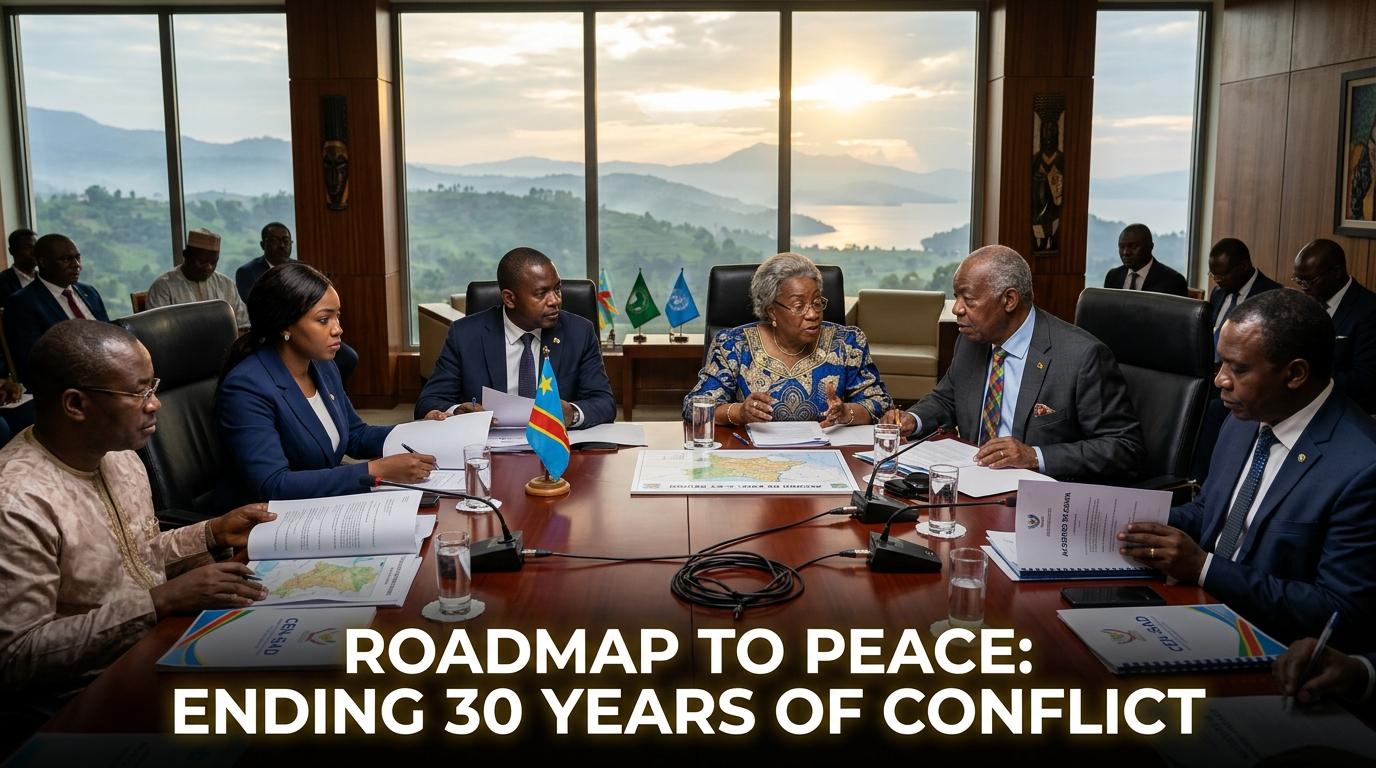
Delegates from the Democratic Republic of the Congo and the March 23 Movement have reached a milestone agreement. Following intensive mediation in Doha and Switzerland, both parties finalized a structured peace roadmap (africanews.com, dohanews.co). The plan establishes formal timelines for troop disengagement, dialogue, and a permanent ceasefire (dohanews.co, state.gov).
Diplomatic talks in Switzerland built upon the earlier Doha Framework Agreement (dohanews.co). Mediators introduced standardized incident reporting to manage localized fighting before political talks collapse (africanews.com). Furthermore, regional monitors will deploy directly to flashpoints to inspect compliance on the ground (dohanews.co). While regional leaders praise the pact, lasting peace requires addressing decades of unresolved structural grievances (cfr.org, fpri.org).
Doha Declaration of Principles
Establishes bilateral commitments between Kinshasa and rebel leadership for a permanent cessation of hostilities.
Framework Agreement Protocols
Outlines eight distinct negotiation tracks, prisoner exchanges, and regional humanitarian access guidelines.
Swiss Follow-Up Roadmap
Defines sequenced operational schedules, political talks, and standardized reporting for frontline incidents.
MCVE+ Verification Deployment
Authorizes multinational regional observers to investigate violations directly in vulnerable eastern territories.
The Echoes of 1994 and the Spillover of War
The roots of modern eastern Congolese warfare trace directly to the 1994 Rwandan Genocide (cfr.org). When the Rwandan Patriotic Front took power, over one million Rwandan Hutus fled into eastern Zaire (wikipedia.org). This massive exodus included soldiers of the former Rwandan armed forces and Interahamwe militias (wikipedia.org, wikipedia.org).
These armed groups established military bases in North and South Kivu (wikipedia.org). They reorganized into the Democratic Forces for the Liberation of Rwanda, known as the FDLR (wikipedia.org). Consequently, cross-border attacks into Rwanda triggered the First and Second Congo Wars (cfr.org, wikipedia.org). Regional armies invaded, domestic militias multiplied, and millions of Congolese civilians perished from direct violence, disease, and starvation (cfr.org, wikipedia.org).
From the 2009 Accords to the M23 Rebellion
To defend local Congolese Tutsi interests against the FDLR, Laurent Nkunda founded the National Congress for the Defence of the People in 2006 (wikipedia.org). On March 23, 2009, the Congolese government signed a peace agreement with the CNDP (wikipedia.org, wikipedia.org). The accord aimed to integrate rebel fighters into the national military, known as the FARDC (wikipedia.org).
However, the agreement quickly collapsed due to broken promises regarding ranks and minority protection (wikipedia.org). In April 2012, former rebels mutinied and formed the March 23 Movement, taking their name from the 2009 pact (wikipedia.org). M23 captured Goma in late 2012 before suffering defeat by United Nations peacekeepers in 2013 (theowp.org, wikipedia.org). The movement reconstituted in late 2021, claiming Kinshasa failed to honor past disarmament commitments (cfr.org, wikipedia.org).
The Banyamulenge and the Crisis of Belonging
The Banyamulenge are a pastoralist Tutsi community living in the high plateaus of South Kivu (nyu.edu, ebuteli.org). Their ancestors migrated to the region during the eighteenth and nineteenth centuries, long before colonial borders were established (nyu.edu). Despite their long presence, Belgian colonial authorities never granted the community a customary administrative territory (nyu.edu). Consequently, neighboring ethnic groups frequently label them as outsiders (nyu.edu, ebuteli.org).
National politics deepened this exclusion through shifting citizenship laws (nyu.edu). A 1971 law granted citizenship to residents who arrived before 1950 (nyu.edu). However, a 1981 law revoked this status, demanding proof of ancestral lineage before 1885 (nyu.edu). This legal change rendered many Banyamulenge stateless (nyu.edu). Today, self-defense groups such as Twirwaneho battle rival ethnic militias in defense of their villages (nyu.edu, ebuteli.org).
Self-Defense Militias and the Wazalendo Trap
Eastern Congo is home to dozens of community self-defense militias known historically as Mai-Mai (theowp.org, ebuteli.org). These fighters originally organized around traditional customs and sacred rituals to defend ancestral lands (theowp.org, ebuteli.org). Recently, the Congolese government organized many of these local militias under the banner of the Wazalendo (ebuteli.org, adf-magazine.com). Kinshasa enlisted these groups as auxiliary forces to halt M23 advancements across North Kivu (ebuteli.org, adf-magazine.com).
However, relying on informal militias creates severe hazards for civilian safety (ebuteli.org). Lacking military salaries and institutional discipline, many Wazalendo factions turn to predatory behavior (ebuteli.org). They erect illegal roadblocks, levy arbitrary taxes on farmers, and seize artisanal mining pits (ebuteli.org). Consequently, forces formed for protection often evolve into extortion networks that terrorize local communities (ebuteli.org, adf-magazine.com).
Peacekeeping Dilemmas: MONUSCO and the MCVE+
The United Nations has maintained a massive peacekeeping force in the country for decades (undp.org, wikipedia.org). Originally called MONUC, the mission became MONUSCO in 2010 (wikipedia.org). In 2013, the UN Security Council created the Force Intervention Brigade with an offensive combat mandate (wikipedia.org). Despite substantial spending, peacekeepers struggled to protect civilians from rebel massacres (theowp.org, wikipedia.org). Discontent sparked deadly public demonstrations across major eastern cities, accelerating the mission withdrawal (wikipedia.org).
To fill verification gaps, regional diplomats rely on the Expanded Joint Verification Mechanism, known as the MCVE+ (africanews.com, icglr.org). Operating under the International Conference on the Great Lakes Region, the MCVE+ investigates border clashes and ceasefire breaches (icglr.org). The team contains military experts from twelve member states (icglr.org). However, the body lacks independent enforcement authority and relies entirely on political cooperation to implement its recommendations (icglr.org).
Blood in the Battery: Minerals and Global Complicity
The soil of eastern Congo holds exceptional mineral wealth vital to the global economy (cfr.org, fpri.org). The nation produces over seventy percent of the world cobalt supply (fpri.org). In addition, it holds massive deposits of coltan, which yields tantalum powder for electronic capacitors (cfr.org, altairasesores.es). These materials power consumer laptops, smartphones, and electric vehicle batteries across the globe (fpri.org, altairasesores.es).
Unfortunately, global supply chains remain linked to extreme human suffering in artisanal mines (fpri.org). Thousands of children dig deep into unstable pits without basic protective equipment (fpri.org). Armed groups and rogue commanders tax mining sites to purchase weapons (cfr.org, fpri.org). Smugglers transport raw ores into neighboring countries, laundering illicit metals into global markets before export to international smelters (fpri.org, altairasesores.es).
Artisanal Pits (Creuseurs)
Unregulated extraction of cobalt and coltan by hand, characterized by child labor and hazardous pit collapses.
Militia Taxation & Smuggling
Armed factions levy illegal checkpoints and traffic raw minerals across borders to obscure conflict origins.
International Smelting Centers
Foreign refining facilities melt ores into homogeneous metal ingots, removing geographic traceability.
Multinational Technology & EVs
Refined tantalum and cobalt become essential components in commercial smartphones, electronics, and batteries.
Colonial Ghosts and State Fragility in Kinshasa
The structural weakness of the Congolese military stems from a long history of imperial extraction (fpri.org, wikipedia.org). Under King Leopold II and subsequent Belgian rule, authorities treated the territory solely as an extractive business (fpri.org, wikipedia.org). The colonial administration barred Africans from higher education and senior civil service posts (fpri.org). At independence in 1960, the country possessed fewer than thirty university graduates (fpri.org).
Later, dictator Mobutu Sese Seko ruled the country for thirty-two years through institutionalized theft (fpri.org, wikipedia.org). Mobutu deliberately underfunded the national military to prevent potential coups (fpri.org). Consequently, soldiers were expected to survive by extorting civilians (fpri.org). Post-war programs repeatedly integrated former rebels into the army without proper vetting (wikipedia.org, afrikarabia.com). This practice created divided loyalties and systemic corruption throughout the armed forces (afrikarabia.com).
Corneille Nangaa and the Alliance Fleuve Congo
In December 2023, former electoral commission chief Corneille Nangaa announced a political alliance with M23 (facebook.com, afrikarabia.com). Nangaa oversaw the disputed 2018 presidential election that brought Félix Tshisekedi to power (afrikarabia.com). After falling out with the president, Nangaa formed the Alliance Fleuve Congo in Nairobi (facebook.com, afrikarabia.com).
The AFC provides a broader political front for the M23 insurgency (facebook.com, afrikarabia.com). By placing a non-Tutsi figure at the head of the coalition, the movement attempts to present itself as a national resistance (facebook.com, afrikarabia.com). Nangaa argued that armed struggle was necessary to restore democratic governance in Kinshasa (facebook.com, youtube.com). In response, Congolese military courts sentenced Nangaa to death in absentia for high treason (afrikarabia.com).
Global Black Solidarity and the Congolese Struggle
For the African diaspora, the ongoing crisis in the Congo reflects the unfinished work of continental liberation. Activists draw direct connections between Congolese exploitation and wider anti-imperialist campaigns (fpri.org). The fight connects deeply to past historic anti-apartheid campaigns and shared international struggles against racial and economic subjugation. The resource extraction that financed Western industrial growth continues to destabilize the heart of Africa today (fpri.org).
Furthermore, human rights organizers emphasize that the global transition to clean energy must remain just (fpri.org). Modern green technologies should never rely on the exploitation of Congolese children (fpri.org). Much like earlier revolutionary movements for self-determination and broader initiatives for decolonizing African institutions, international accountability remains essential. The peace roadmap agreed upon in Doha offers a vital diplomatic step (africanews.com, dohanews.co). However, permanent peace will only arrive when the Congolese people secure full sovereignty over their land, governance, and resources (cfr.org, fpri.org).
About the Author
Darius Spearman is a professor of Black Studies at San Diego City College, where he has been teaching for over 20 years. He is the founder of African Elements, a media platform dedicated to providing educational resources on the history and culture of the African diaspora. Through his work, Spearman aims to empower and educate by bringing historical context to contemporary issues affecting the Black community.
