


Healthcare Attacks in Ethiopia: Why Are Clinics Targeted?
By Darius Spearman (africanelements)
Support African Elements at patreon.com/africanelements and hear recent news in a single playlist. Additionally, you can gain early access to ad-free video content.
The Weaponization of Medicine in the Horn of Africa
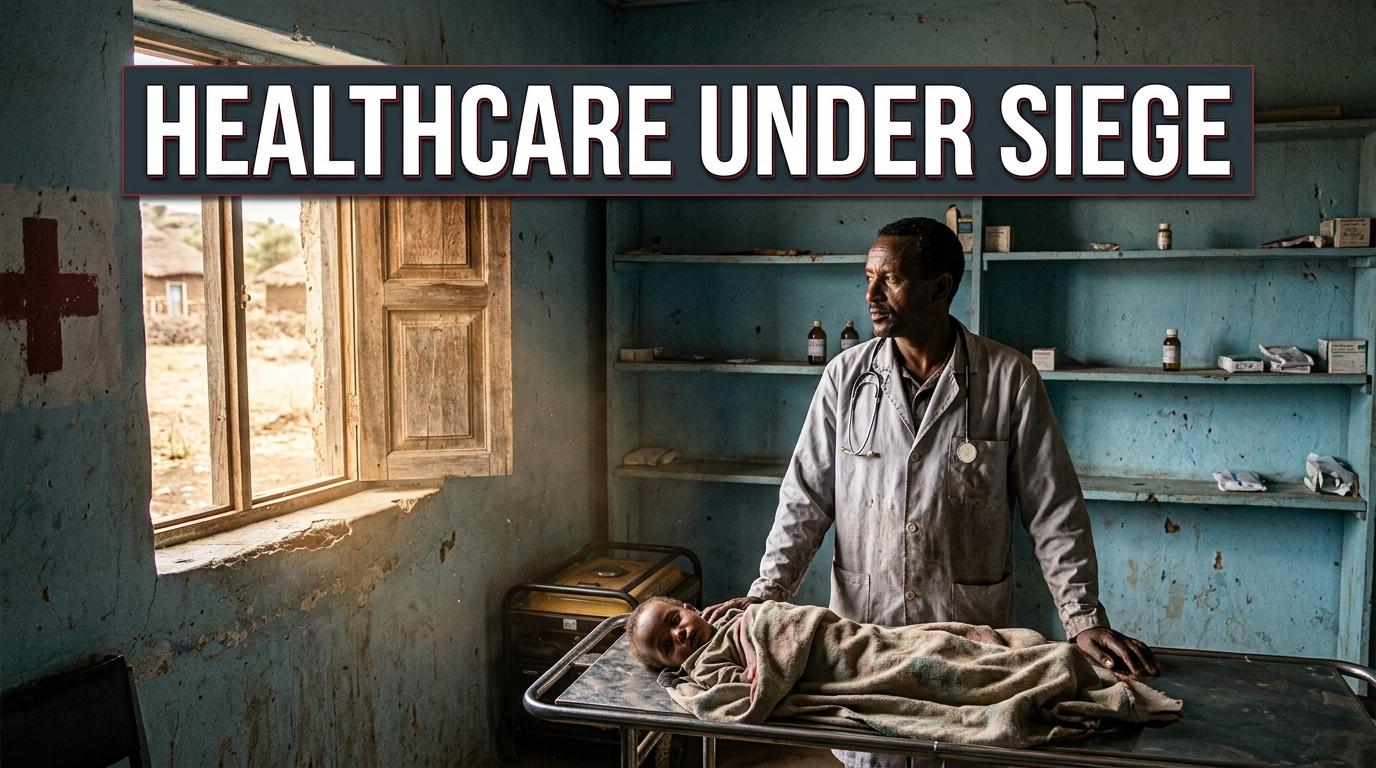
Hospitals are meant to serve as safe havens during armed conflict. Across northern Ethiopia, however, healthcare centers have become central battlegrounds. A joint investigation by Physicians for Human Rights and the Organization for Justice and Accountability in the Horn of Africa has documented widespread attacks on medical systems (phr.org, phr.org). The findings reveal that regional clinics, ambulances, and doctors were systematically targeted across Tigray, Amhara, and Afar (phr.org).
For observers throughout the African diaspora, this crisis illustrates how public health infrastructure can be dismantled during wartime. The deliberate targeting of medical care strips vulnerable civilians of their fundamental right to survival. Historically, systems of domination have often relied on abuses within medicine to subjugate communities. In modern Ethiopia, the destruction of clinics has evolved into a calculated military tactic (phr.org, phr.org).
Roots of Conflict: Power Struggles and Ethnic Federalism
The roots of this healthcare catastrophe trace back to shifting political dynamics in Addis Ababa. For nearly three decades following the fall of the Derg regime in 1991, the Tigray People’s Liberation Front served as the dominant force within the ruling coalition (wikipedia.org, wikipedia.org). The coalition established a system of ethnic federalism that granted regional autonomy to major linguistic groups (wikipedia.org). However, this structure concentrated immense federal power and security control among a small elite (wikipedia.org, accord.org.za).
Mass popular protests between 2015 and 2018 altered the national landscape, bringing Prime Minister Abiy Ahmed to office (wikipedia.org, wikipedia.org). His administration pursued centralized authority and merged regional parties into the unified Prosperity Party (wikipedia.org, wikipedia.org). The leadership of the Tigray People’s Liberation Front rejected this consolidation, demanding regional autonomy and political self-determination (merip.org, wikipedia.org). When national elections were postponed in 2020, Tigray conducted unauthorized regional elections, leading to a breakdown in relations and armed conflict (wikipedia.org, accord.org.za).
The Siege of Tigray and the Collapse of Medical Care
When fighting erupted in November 2020, federal forces, allied Eritrean troops, and regional militias quickly surrounded Tigray (wikipedia.org, eritrea-focus.org). The federal government instituted a severe blockade that cut off electricity, banking, telecommunications, and fuel supplies (bmj.com, starvationaccountability.org). Medical supply chains collapsed almost immediately as life-saving pharmaceuticals were blocked at regional borders (nih.gov, starvationaccountability.org).
Major referral facilities, including Ayder Comprehensive Specialized Hospital in Mekelle, ran out of basic surgical gloves, intravenous fluids, and antibiotics (nih.gov, bmj.com). Without electricity, staff could not power oxygen concentrators or maintain cold-chain storage for childhood vaccines (bmj.com, nih.gov). Doctors were forced to reuse single-use medical equipment and watch patients die from treatable conditions (nih.gov, nih.gov). Invading troops ransacked pharmacies, intentionally wrecked diagnostic equipment, and converted health wards into military barracks (phr.org, doctorswithoutborders.ca).
Tigray Healthcare System Destruction
Impact of the Northern Ethiopia Conflict (2020–2022)
Spillover into Amhara and Afar: The Cycle of Retaliation
As the conflict expanded in mid-2021, Tigrayan forces advanced south and east into the Amhara and Afar regions (wikipedia.org, accord.org.za). This expansion replicated the devastation of public health systems in new territories (phr.org, phr.org). Rather than sparing civic facilities, retreating and advancing forces routinely targeted regional clinics (phr.org, phr.org).
Tigrayan forces engaged in widespread looting across North Wollo, South Wollo, and Wag Hemra zones in Amhara (phr.org, reliefweb.int). Rural health posts in Afar were ransacked, destroying cold-storage equipment and emergency delivery rooms (phr.org, phr.org). More than half of the health facilities in conflict-hit zones of Amhara sustained significant physical damage (nih.gov, projecthope.org). The pattern demonstrated that healthcare infrastructure was treated as an instrument of war across all factions (phr.org, phr.org).
The Amhara Insurgency and Broken Alliances
Although the November 2022 Pretoria Agreement officially ended open combat between federal forces and the TPLF, stability did not return to northern Ethiopia (wikipedia.org, accord.org.za). Regional Amhara militias, known as Fano, had fought alongside federal troops during the northern campaign (riftvalley.net, accord.org.za). However, Fano leaders felt excluded from the Pretoria peace framework and feared the loss of disputed border territories like Welkait (riftvalley.net, acleddata.com).
Tensions escalated dramatically in April 2023 when Prime Minister Abiy moved to dismantle and integrate all regional paramilitary forces (acleddata.com, acleddata.com). Amhara communities viewed this directive as an effort to leave their region vulnerable to external attacks (acleddata.com, wikipedia.org). Fano militias mobilized an armed insurgency, taking control of major towns across Amhara (acleddata.com, acleddata.com). The federal military responded with drone strikes, hospital raids, and arrests of medical workers accused of treating wounded militia fighters (phr.org, acleddata.com).
PHR-OJAH Investigation: Health Worker Violations
Gendered Violence and Systematic Harm
The assault on healthcare systems directly worsened the severity of conflict-related sexual violence (hrw.org, omnatigray.org). Human rights documentation revealed that armed actors systematically used sexual violence as a weapon of warfare across Tigray and neighboring regions (hrw.org, amnesty.org). Women and girls were subjected to brutal attacks designed to cause physical trauma and terrorize local populations (hrw.org, state.gov).
At the same time, the destruction of medical centers eliminated access to emergency clinical care (phr.org, phr.org). Survivors were unable to receive post-exposure prophylaxis for HIV, emergency contraception, or surgical repair for catastrophic injuries (nih.gov, hrw.org). By vandalizing maternal wards and blocking medical shipments, armed forces magnified the trauma inflicted upon civilian communities (phr.org, phr.org).
Medical Neutrality and International Law in Crisis
Under the Geneva Conventions and United Nations Security Council Resolution 2286, medical neutrality is an absolute legal principle (wma.net, un.org). Healthcare workers must be permitted to treat all wounded persons impartially, regardless of political or military affiliation (wma.net). Warring factions are explicitly prohibited from occupying hospitals, targeting ambulances, or punishing physicians for upholding professional ethics (icrc.org, wma.net).
In Ethiopia, these international legal standards were repeatedly discarded by combatants on all sides (phr.org, phr.org). Doctors faced severe harassment, arbitrary detention, and violent reprisals simply for providing care to injured civilians and opposing fighters (phr.org, acleddata.com). Ambulances were commandeered for military logistics or attacked along transit corridors (phr.org, phr.org). The failure to enforce global protections has created an environment of unchecked impunity across the region (phr.org, un.org).
Post-Conflict Health Reconstruction Toll
Grassroots Survival and Diaspora Solidarity
When public systems collapsed entirely, ordinary citizens turned to traditional mutual aid to stay alive (nih.gov). Local healthcare professionals volunteered in makeshift clinics, rationing expired medicines and using household items to sterilize surgical tools (nih.gov, nih.gov). Communities established underground food networks and shared minimal rations to survive the blockade (starvationaccountability.org).
Abroad, Ethiopian diaspora groups mobilized critical funding, organized digital awareness campaigns, and lobbied international institutions (omnatigray.org). Like historical African American movements that relied on grassroots community networks, local organizers formed essential safety nets during institutional failure. Despite facing severe economic strain, these mutual-aid initiatives prevented far greater loss of life across isolated regions (omnatigray.org, nih.gov).
The Struggle for Accountability and Global Justice
Meaningful recovery remains impossible without criminal accountability for attacks on medical infrastructure (phr.org, phr.org). The Ethiopian federal government has promoted a domestic transitional justice framework to handle wartime offenses (justiceinfo.net, ajcr.pub). However, international observers point out that state-run mechanisms often lack independence and fail to hold high-ranking military commanders responsible (hrw.org, justiceinfo.net).
Furthermore, international oversight has steadily diminished (justiceinfo.net, un.org). The United Nations Human Rights Council allowed the mandate of its independent investigation commission on Ethiopia to expire in late 2023 (justiceinfo.net, un.org). Because Ethiopia has not ratified the Rome Statute, the International Criminal Court cannot easily exercise jurisdiction over these crimes without a Security Council referral (justiceinfo.net). The joint probe by Physicians for Human Rights makes clear that unless attacks on healthcare carry legal consequences, medical facilities will remain vulnerable in conflicts across the globe (phr.org, phr.org).
About the Author
Darius Spearman is a professor of Black Studies at San Diego City College, where he has been teaching for over 20 years. He is the founder of African Elements, a media platform dedicated to providing educational resources on the history and culture of the African diaspora. Through his work, Spearman aims to empower and educate by bringing historical context to contemporary issues affecting the Black community.
