



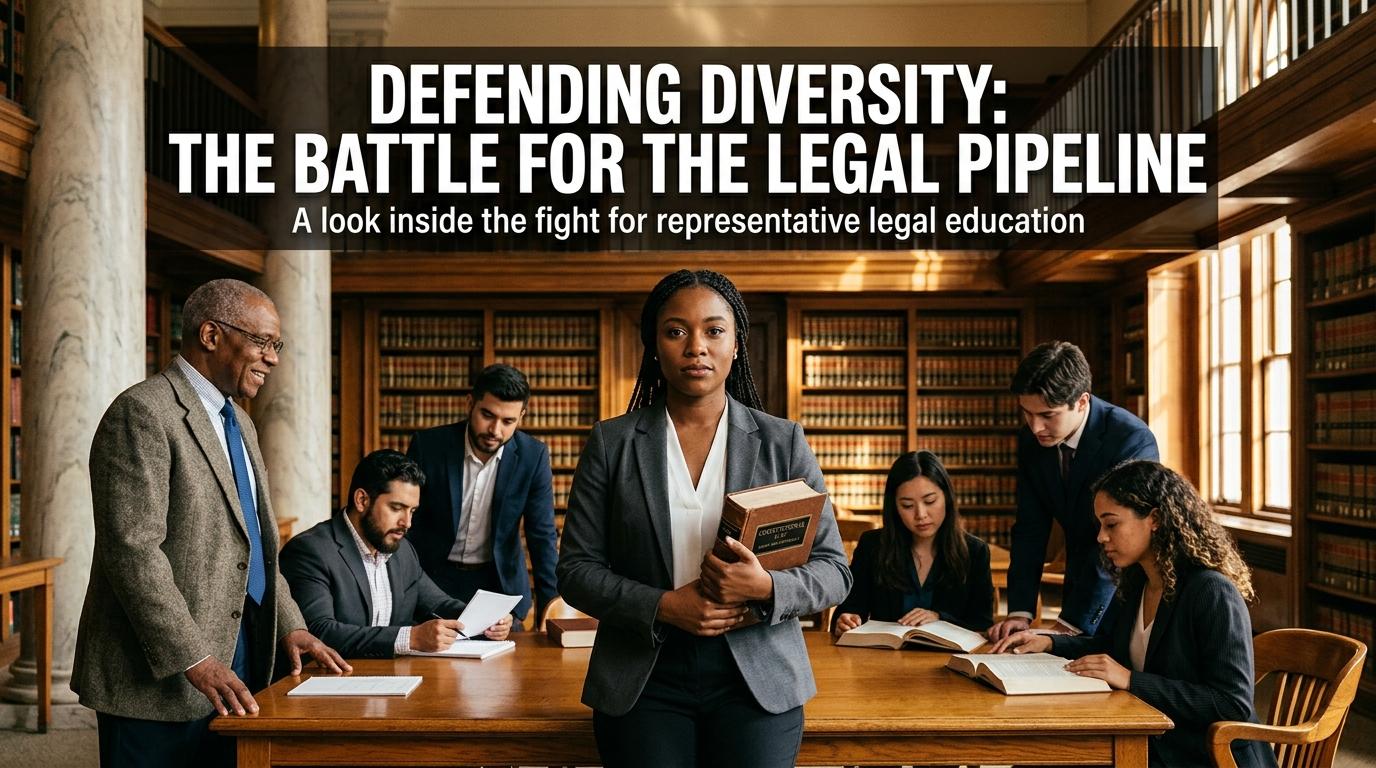
Law School Diversity Rules Face a Critical Battle
By Darius Spearman (africanelements)
Support African Elements at patreon.com/africanelements and hear recent news in a single playlist. Additionally, you can gain early access to ad-free video content.
A New Crisis in Legal Education
A major confrontation has erupted over the future of the legal profession. In August 2026, the NAACP Legal Defense and Educational Fund joined fifteen allied civil rights organizations to issue an urgent warning to the American Bar Association (davisvanguard.org). The coalition demanded that the association reject a proposal to eliminate Standard 206 (lawyerscommittee.org). Standard 206 requires law schools to demonstrate an active commitment to diversity and inclusion for students, faculty, and staff (americanbar.org).
The push to remove this rule follows intense political pressure from conservative state attorneys general and debates surrounding affirmative action (nebraska.gov). Civil rights advocates argue that repealing the mandate would reverse decades of hard-won progress. The legal arena shapes American democracy, civil liberties, and criminal justice policy. Consequently, the struggle over who gains entry to law school touches the core of community empowerment and systemic equality (davisvanguard.org).
The Long History of Gatekeeping in the Law
The fight over diversity requirements in law schools is rooted in a long history of institutional exclusion. When the American Bar Association formed in 1878, it operated as a selective club for elite attorneys (uclalawreview.org). During the early twentieth century, leaders of the organized bar created restrictive accreditation requirements (uclalawreview.org). They intentionally targeted proprietary and evening law schools (uclalawreview.org).
Working-class students, European immigrants, and African Americans relied heavily on part-time and evening programs. These institutions offered flexible hours and affordable tuition. When the accrediting bodies introduced strict rules requiring full-time day programs and massive libraries, dozens of accessible institutions closed their doors (uclalawreview.org). This deliberate gatekeeping preserved the legal profession as an exclusive enclave for wealthy white men. African Americans who sought to challenge post-emancipation struggles found their path to the courtroom systematically blocked.
Key Milestones in Law School Access
The Supreme Court rules that segregated legal education is inherently unequal, ordering the desegregation of the University of Texas School of Law.
The ABA creates its first mandatory accreditation standard requiring law schools to provide concrete opportunities for minority students.
The diversity requirement is expanded to include concrete commitments to diverse faculty, administrators, and staff alongside student bodies.
A coalition of sixteen civil rights organizations petitions the ABA to defend Standard 206 against administrative repeal.
The Breakthrough of Sweatt v. Painter
The historical breakthrough for Black legal education arrived through a coordinated campaign by civil rights visionaries. In 1946, an African American postal carrier named Heman Marion Sweatt applied to the University of Texas School of Law (tshaonline.org). State officials rejected Sweatt solely because of his race. To avoid integration, Texas created a separate, underfunded law school in a basement (oyez.org, oyezoyezohyay.org).
Thurgood Marshall and the NAACP Legal Defense Fund took up Sweatt’s case (tshaonline.org, oyezoyezohyay.org). They argued that legal training could not exist in isolation. In the landmark 1950 decision Sweatt v. Painter, the Supreme Court agreed (oyez.org). Chief Justice Fred Vinson highlighted that intangible elements, such as peer interaction and faculty prestige, made the segregated school grossly unequal (tshaonline.org, oyez.org). This case set the legal foundation for the historic ruling in Brown v. Board of Education four years later (oyez.org, oyezoyezohyay.org). It firmly established that true legal education requires an open, integrated environment (tshaonline.org).
The Creation and Expansion of Standard 206
Despite constitutional victories, law schools remained overwhelmingly white for several decades. Activists and legal educators continued to demand structural change from the American Bar Association (davisvanguard.org). In 1991, the association adopted Standard 212, which required law schools to take active measures to recruit and retain underrepresented minority students (davisvanguard.org).
In 2006, the association strengthened this requirement by transforming it into Standard 206 (davisvanguard.org, davisvanguard.org). The revised standard instructed accredited law schools to demonstrate concrete commitments to diversity across all institutional levels (americanbar.org). This included student bodies, teaching faculties, and administrative staffs (americanbar.org). For twenty years, Standard 206 served as the principal national mechanism ensuring that legal institutions could not ignore systemic inequities (davisvanguard.org, davisvanguard.org).
The Backlash After the Harvard Decision
The legal landscape shifted dramatically in June 2023 when the Supreme Court decided Students for Fair Admissions v. Harvard (crowell.com, k-12legalinsights.com). The Court eliminated race-conscious admissions policies at colleges and universities across the country (k-12legalinsights.com). Opponents of diversity programs immediately declared that all institutional inclusion efforts were unlawful (crowell.com).
However, civil rights scholars pointed out that the Supreme Court decision was far narrower than critics claimed (davisvanguard.org). The Court prohibited mechanical racial classifications in admissions. It did not prohibit institutions from valuing diversity or evaluating how race shaped an applicant’s lived experience (crowell.com, k-12legalinsights.com). Despite this critical distinction, conservative activists quickly targeted Standard 206 (davisvanguard.org, nebraska.gov).
U.S. Population Share vs. Lawyer Demographics
Comparing demographic share of the general public (Dark Green) to active practicing attorneys (Bronze).
The Threat of State Lawsuits and Title VII Claims
In mid-2024, a coalition of twenty-one state attorneys general sent a threatening letter to the American Bar Association (nebraska.gov). They argued that Standard 206 forced law schools to engage in unlawful employment discrimination (nebraska.gov). The officials asserted that mandating diverse faculty and staff violated Title VII of the Civil Rights Act of 1964 (nebraska.gov). They threatened to challenge the association’s federal accreditation powers in court (nebraska.gov).
Conversely, nineteen state attorneys general defended the standard (davisvanguard.org). They explained that Title VII permits employers to remove barriers and conduct broad recruitment. Ensuring fair opportunities does not equal setting illegal racial quotas (davisvanguard.org). Even so, regulatory pressure continued to build. In 2025, the association suspended enforcement of Standard 206, setting the stage for a proposed total repeal (campusreform.org).
Stagnation in the Legal Profession
The statistical reality of the American legal profession reveals why Standard 206 remains essential. According to demographic data from the American Bar Association, law remains one of the least racially diverse professions in the nation (2civility.org, abajournal.com). While Black Americans make up nearly fourteen percent of the national population, they represent only five percent of practicing attorneys (americanbar.org, 2civility.org).
Furthermore, this percentage has remained stagnant for well over a decade (2civility.org, abajournal.com). While women have made significant gains and now account for over forty-one percent of lawyers, racial progress has lagged behind (americanbar.org, abajournal.com). Hispanic lawyers make up under six percent of the bar despite representing nineteen percent of the general population (americanbar.org, 2civility.org). Without intentional standards, the pipeline of minority talent into the legal system risks shrinking even further.
Why Black Representation Remains Trapped at Five Percent
Several institutional barriers explain why Black legal representation has not grown over the past ten years. A major factor is heavy reliance on the Law School Admission Test (accesslex.org, accesslex.org). Commercial test preparation programs are expensive, creating an unfair advantage for wealthy applicants (accesslex.org). In addition, law schools increasingly distribute financial aid based on standardized test scores rather than financial need (accesslex.org, accesslex.org).
This merit-scholarship dynamic deprives low-income applicants of essential financial support (accesslex.org, accesslex.org). As law school tuition climbs, Black students face disproportionate debt burdens upon graduation (accesslex.org, accesslex.org). These financial hurdles, paired with traditional hiring networks that favor elite social circles, keep qualified candidates from advancing. Standard 206 helped counter these barriers by holding institutions accountable for providing real access (davisvanguard.org).
The Realities of Legal Diversity
The Civil Rights Coalition Mobilizes
Recognizing the danger of rolling back accreditation rules, national civil rights groups stepped forward. The NAACP Legal Defense Fund spearheaded a major advocacy campaign (davisvanguard.org). They united with fifteen other prominent organizations, including the Lawyers’ Committee for Civil Rights Under Law, Asian Americans Advancing Justice, LatinoJustice PRLDEF, and the National Women’s Law Center (lawyerscommittee.org, lawyerscommittee.org).
The coalition submitted detailed comments to the American Bar Association Council (davisvanguard.org). They reminded the council that accreditation standards exist to protect the public interest (davisvanguard.org, lawyerscommittee.org). The Howard University School of Law Civil Rights Clinic joined the coalition, ensuring that historically Black academic institutions had a direct voice. These groups made it clear that eliminating Standard 206 would be an unnecessary retreat in the face of political intimidation (davisvanguard.org).
HBCU Law Schools on the Frontline
Historically Black College and University law schools carry a massive responsibility in training minority lawyers (cuny.edu, nccu.edu). Institutions such as Howard University, Southern University Law Center, Florida A&M University, Texas Southern University, North Carolina Central University, and the University of the District of Columbia produce a high share of Black attorneys (cuny.edu, nccu.edu). These schools stepped up when other institutions refused to open their doors (cuny.edu).
If the association repeals Standard 206, predominantly white institutions may reduce their recruitment efforts (cuny.edu, nccu.edu). Consequently, the responsibility for integrating the profession will fall even more heavily upon underfunded institutions (cuny.edu). At the same time, strict accreditation bar-passage rules create intense pressures for schools serving first-generation students (cuny.edu, nccu.edu). Weakening diversity requirements across the board threatens to isolate and overburden these historic training grounds (cuny.edu).
The Voice of the Critical Legal Collective
Law professors and legal scholars across the country have also entered the debate. The Critical Legal Collective organized faculty members to resist the rollback of diversity standards (truthout.org, uclalawreview.org). Scholars such as Athena Mutua emphasized that law schools must prepare students to serve an increasingly diverse society (truthout.org). They argued that public confidence in the judicial branch depends on having a bench and bar that reflect the population (truthout.org, uclalawreview.org).
The collective demonstrated that the Supreme Court never outlawed broad diversity efforts (truthout.org). Institutions can still use holistic admissions, expand outreach, and address economic hardship (crowell.com). Repealing Standard 206 sends a damaging message that racial equity is no longer a core value of legal education (davisvanguard.org, truthout.org). The organization called on law school deans to speak out forcefully against political interference in academic governance (truthout.org).
Lawful Pathways for Diversity Post-SFFA
Legal experts emphasize that law schools possess numerous lawful strategies to maintain diversity after the Harvard ruling (crowell.com). Admissions committees may review personal statements that describe how racial background or adversity shaped an applicant’s character (crowell.com, k-12legalinsights.com). Schools can also prioritize applicants from low-income families or first-generation college students (crowell.com).
Furthermore, institutions can establish partnerships with community colleges and minority-serving institutions (crowell.com). Law schools can implement test-optional policies and offer need-based financial aid (accesslex.org, accesslex.org). Standard 206 does not force schools to violate federal law. Instead, it holds them accountable for using these lawful tools to build an inclusive learning environment (davisvanguard.org, crowell.com). Eliminating the rule removes any incentive for institutions to maintain these important programs (davisvanguard.org).
The Path Forward for Equal Justice
The battle over Standard 206 is fundamentally a fight for the soul of the American legal system. From the founding of foundational constitutional law to modern courtrooms, legal rules determine who holds institutional power. When the bar remains segregated, the administration of justice suffers (davisvanguard.org, truthout.org).
Civil rights groups, civil rights organizers, and legal scholars have made their stance clear. They demand that the American Bar Association stand firm against political threats (davisvanguard.org, lawyerscommittee.org). The legacy of Heman Sweatt and Thurgood Marshall proved that separate is never equal (tshaonline.org, oyez.org). Preserving mandatory diversity standards is essential to ensuring that the legal profession belongs to everyone (davisvanguard.org).
About the Author
Darius Spearman is a professor of Black Studies at San Diego City College, where he has been teaching for over 20 years. He is the founder of African Elements, a media platform dedicated to providing educational resources on the history and culture of the African diaspora. Through his work, Spearman aims to empower and educate by bringing historical context to contemporary issues affecting the Black community.
