


Sudan Civil Conflict Displacement: The Hidden Roots
By Darius Spearman (africanelements)
Support African Elements at patreon.com/africanelements and hear recent news in a single playlist. Additionally, you can gain early access to ad-free video content.
A Sudden Escalation in the Borderlands
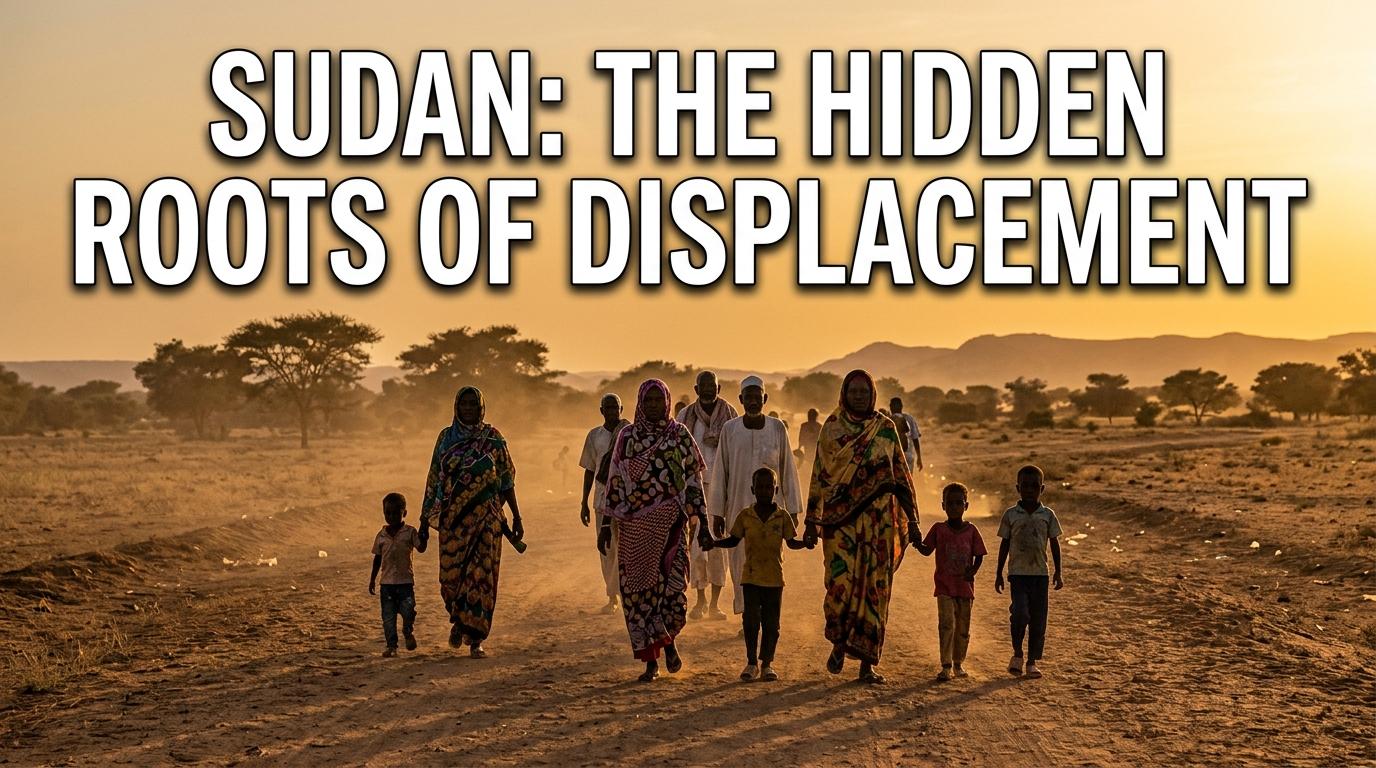
Emergency alerts from international agencies recently pointed to a sharp spike in violence across Sudan. The United Nations Office for the Coordination of Humanitarian Affairs and the International Organization for Migration reported that fresh clashes displaced nearly 10,000 civilians in a matter of days. These localized flare-ups struck communities across North Kordofan and the Blue Nile region, forcing vulnerable families onto dangerous roads (sudantribune.com, un.org).
In North Kordofan, intense fighting in the Um Arada area southwest of El Obeid caused over 4,200 people to flee within 48 hours. Concurrently, drone strikes shook the state capital of El Obeid, placing immense pressure on public infrastructure. Over 15,000 families had already sought refuge in the city before these strikes hit. In the Blue Nile borderlands near Geisan and Kurmuk, heavy combat displaced another 5,400 residents, sending thousands toward the regional capital of Damazin (iom.int, reliefweb.int).
The Historical Fault Lines of Center and Periphery
Modern headlines often present these clashes as random skirmishes. However, students of African history recognize deep structural patterns. Ever since Sudan achieved independence from Anglo-Egyptian colonial rule in 1956, governing power remained concentrated in Khartoum. A small riverine Arab-Nubian elite held control over commerce, civil administration, and the military command (countrystudies.us, caus.org.lb).
This governing elite built wealth along the central Nile corridor while treating peripheral regions as resource reservoirs. Peripheral areas such as Darfur, South Kordofan, and Blue Nile experienced extreme underdevelopment. The state extracted agricultural produce and minerals without investing in local schools, hospitals, or roads. Consequently, this exclusionary system generated widespread resentment and laid the groundwork for recurring uprisings (merip.org, culturalsurvival.org).
Much like the repressive state policies seen throughout global histories of inequality, Khartoum maintained its authority through racialized divide-and-rule tactics. The state privileged Arab-Islamic identity over Indigenous African identities. Non-Arab communities across the southern and western territories were pushed to the margins of national life, sparking armed resistance movements that lasted for generations (ushmm.org, dayan.org).
The Dilemma of the “Two Areas”
The historical grievances of Blue Nile and South Kordofan earned them the legal designation of the “Two Areas.” During the Second Sudanese Civil War, which lasted from 1983 until 2005, fighters from these regions joined the southern-led Sudan People’s Liberation Movement/Army. Even though they were geographically situated in northern Sudan, their communities shared the southern struggle against central tyranny (britannica.com, enoughproject.org).
When the Comprehensive Peace Agreement was signed in 2005, it offered the southern provinces a referendum on independence. However, the Two Areas received no such choice. Instead, the agreement offered vague “popular consultations” to determine their administrative status within northern Sudan (peaceagreements.org, redalyc.org).
These consultations were never completed. When South Sudan seceded in 2011, thousands of northern-based soldiers found themselves stranded north of the border. They organized as the Sudan People’s Liberation Movement-North and resumed fighting against Khartoum. Similar to failed political reconstruction in other historical contexts, peace agreements that leave central grievances unresolved simply guarantee another round of war (wikipedia.org, wikipedia.org).
Factional Splits in the Liberation Front
As fighting dragged on, internal disagreements fragmented the rebel leadership. By 2017, the Sudan People’s Liberation Movement-North divided into two hostile factions. Malik Agar established his primary base in Blue Nile, whereas Abdelaziz al-Hilu maintained authority in the Nuba Mountains of South Kordofan (wikipedia.org, smallarmssurvey.org).
The two leaders held fundamentally different visions for the country. Agar pursued political accommodation, power-sharing, and administrative decentralization through formal negotiations. In contrast, al-Hilu took a firmer stance, demanding complete state secularism and regional military autonomy before considering any disarmament (crisisgroup.org, georgetown.edu).
These conflicting political factions altered the balance of power across the southern borderlands. When civilian protests removed dictator Omar al-Bashir in 2019, the Agar faction signed the 2020 Juba Peace Agreement and entered the national government. Meanwhile, the al-Hilu faction stayed outside the transitional structure, maintaining its armed strongholds (wikipedia.org, accord.org.za).
The Janjaweed and the Rise of the Paramilitary
While the Two Areas fought for autonomy, an equally devastating struggle developed in the western province of Darfur. In 2003, local African populations rebelled against long-standing economic and political neglect. The central government responded by mobilizing nomadic Arab militias known as the Janjaweed (ushmm.org, britannica.com).
The Janjaweed executed brutal counter-insurgency operations, burning villages, conducting mass executions, and displacing millions of non-Arab civilians. These atrocities prompted the International Criminal Court to issue arrest warrants for senior Sudanese officials for war crimes and genocide (hrw.org, wikipedia.org).
Rather than disarming these militias, the regime institutionalized them. In 2013, Omar al-Bashir formally transformed the Janjaweed into the Rapid Support Forces under the command of Mohamed Hamdan Dagalo, known widely as Hemedti. The paramilitary force expanded rapidly, acquiring independent gold mining revenues and serving as a private army for regime protection (theguardian.com, africacenter.org).
The Fatal Failure of Security Sector Reform
Following the 2019 revolution, Sudan attempted a fragile transition toward civilian democracy. However, the coexistence of two massive military structures created an unsustainable dynamic. The national military, led by General Abdel Fattah al-Burhan, stood face-to-face with the paramilitary forces commanded by Hemedti (atlanticcouncil.org, arabcenterdc.org).
International mediators prioritized Security Sector Reform as the foundation for a permanent constitution. This program required the complete disarmament, demobilization, and reintegration of all armed factions into a single, unified national army. Yet, this reform exposed deep mistrust between rival commanders (idea.int, gsdrc.org).
The armed forces demanded that the paramilitary force integrate within two years under standard military command. Conversely, Hemedti demanded a ten-year timeline and an independent command structure answerable only to a civilian president. This standoff escalated into catastrophic urban warfare on April 15, 2023, shattering the transition and destroying central Khartoum (africasacountry.com, cfr.org).
Darfuri Movements and the Joint Defense Coalition
As the civil war intensified, major armed movements in Darfur found themselves caught in the middle. Groups such as the Justice and Equality Movement and factions of the Sudan Liberation Movement had fought the army for decades. Yet, they viewed the paramilitary forces as a direct continuation of the militias that devastated their ancestral lands (darfurwomenaction.org, theowp.org).
To defend key urban centers like El Fasher, several Darfuri factions formed a Joint Protection Force. Over time, prominent rebel commanders abandoned their neutrality and aligned directly with the national military. They recognized that a paramilitary victory would consolidate militia rule across western Sudan (sudantribune.com, polgeonow.com).
This alignment demonstrates the messy realities of wartime survival. Former insurgents now fight alongside their historic oppressors to prevent rival paramilitaries from taking over their home territories. Consequently, the war has turned into a tangled web of shifting fronts and local defense alliances (crisisgroup.org, rosaluxna.org).
The War Economy and the Battle for Resources
Sudan’s military confrontation is sustained by competition over strategic natural wealth. North Kordofan serves as the main transit corridor linking the capital to the agricultural and mineral reserves of western Sudan. The region is also the heartland of the international gum arabic trade (smallwarsjournal.com, fpri.org).
Gum arabic is an essential binding agent used globally in soft drinks, pharmaceuticals, and cosmetics. Sudan produces over seventy percent of the world supply, generating substantial commercial revenue. Controlling trade routes through Kordofan allows warring factions to tax shipments, seize stockpiles, and fund military operations (aa.com.tr, aa.com.tr).
Similarly, Blue Nile commands vital agricultural schemes and major hydroelectric assets at the Roseires Dam. Control over these territories provides food supplies, water access, and cross-border logistics with Ethiopia. As a result, military offensives in these provinces target economic choke points rather than purely military positions (researchgate.net, openedition.org).
Foreign Intervention and Regional Proxy Battles
The conflict inside Sudan is exacerbated by foreign governments supplying armaments and financing to both sides. The Rapid Support Forces receive steady shipments of advanced weaponry and logistics through supply lines operating across neighboring African borders. Gold extracted from western mines provides the currency required to sustain these military networks (africacenter.org, unav.edu).
Conversely, the national armed forces rely on military supplies, drones, and political backing from regional allies like Egypt, Turkey, and Iran. Furthermore, discussions concerning a potential Russian naval logistics facility along the Red Sea coast have drawn major world powers into the dispute (hornreview.org, fpri.org).
These external dynamics make resolving the crisis far more complicated. When international actors treat Sudan as a chessboard for commercial and security influence, local populations pay the price. The influx of modern drones, heavy artillery, and foreign munitions has accelerated the destruction of civilian neighborhoods (bbc.co.uk, voanews.com).
Civilian Resilience Amid Institutional Collapse
In the face of catastrophic state collapse, ordinary Sudanese citizens have organized remarkable networks of mutual aid. When international aid agencies were forced to evacuate staff, local youth and neighborhood activists stepped forward. These grassroots networks, known as Emergency Response Rooms, manage communal kitchens and coordinate medical clinics (reliefweb.int, freedomhouse.org).
These volunteer networks trace their roots directly to the Resistance Committees that led the 2019 pro-democracy revolution. Despite facing harassment, arbitrary arrests, and targeted violence from both armed factions, these activists remain the primary lifeline for millions of trapped families (pbs.org, aljazeera.com).
Reflecting on unresolved postwar tensions throughout Black history, communities repeatedly demonstrate that genuine protection emerges from collective solidarity. While generals fight for state control, ordinary people continue to rescue neighborhoods from total starvation (europeansting.com, facebook.com).
Why Integration Announcements Spark New Conflicts
Recent announcements regarding the integration of former rebel units into state-aligned formations have paradoxically triggered fresh violence. Rather than serving as a transparent peacebuilding program, security integration during active conflict functions as wartime recruitment. Each military faction attempts to absorb smaller militias to bolster its frontlines (sudantribune.com, sudantribune.com).
When one faction absorbs new fighters in Blue Nile or Kordofan, opposing forces launch preemptive offensives to secure border crossings. This dynamic explains why the emergency displacement of 10,000 civilians occurred simultaneously with political declarations from Port Sudan. The peripheral borderlands have become testing grounds for national power consolidation (un.org, accord.org.za).
Lasting peace in Sudan cannot be achieved through backroom bargains between armed commanders. Until the historic center-periphery divide is dismantled and ordinary citizens secure genuine democratic representation, military alliances will continue to fracture. The international community must prioritize civilian protection, demand an end to foreign arms flows, and support grassroots mutual aid networks working to keep Sudan alive (brookings.edu, rosaluxna.org).
About the Author
Darius Spearman is a professor of Black Studies at San Diego City College, where he has been teaching for over 20 years. He is the founder of African Elements, a media platform dedicated to providing educational resources on the history and culture of the African diaspora. Through his work, Spearman aims to empower and educate by bringing historical context to contemporary issues affecting the Black community.
