



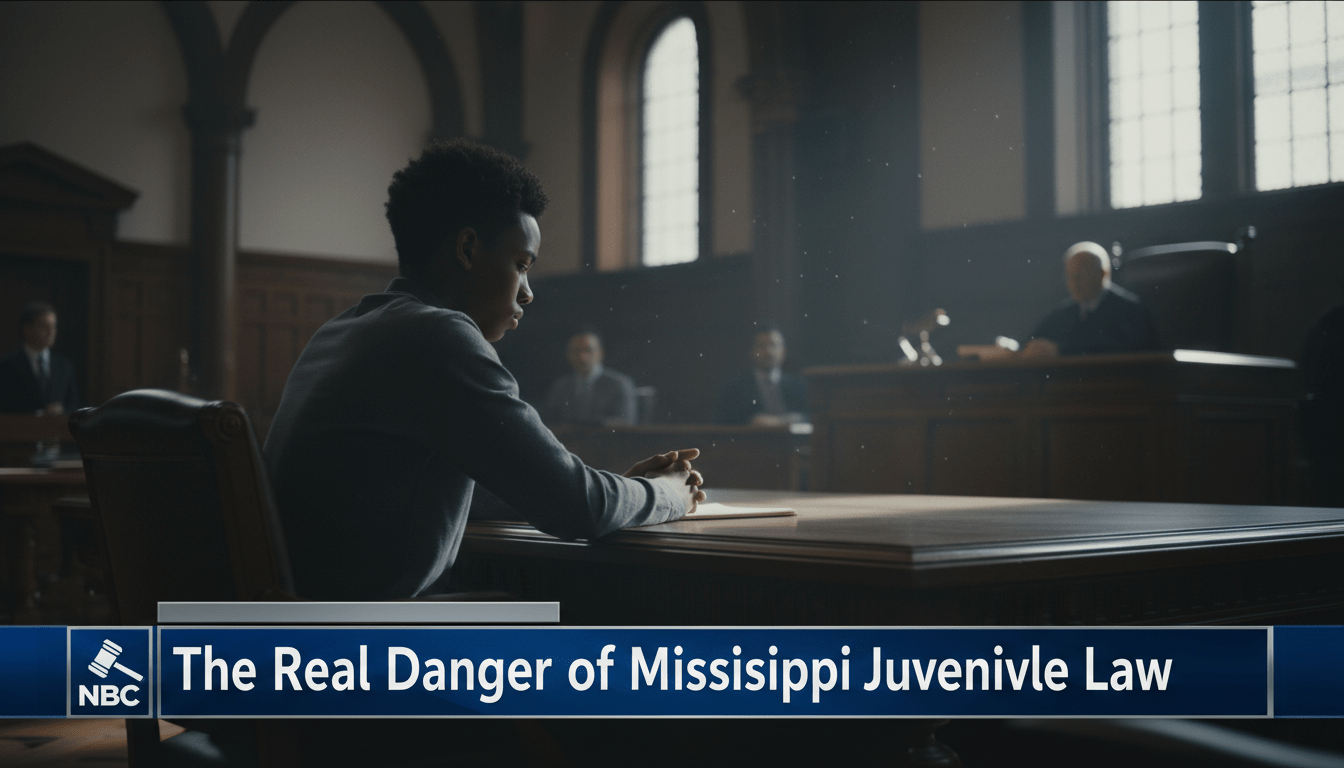
The Real Danger of Mississippi Juvenile Law
By Darius Spearman (africanelements)
Support African Elements at patreon.com/africanelements and hear recent news in a single playlist. Additionally, you can gain early access to ad-free video content.
A Reversal of Justice for Minors
Mississippi lawmakers recently passed Senate Bill 2710. The controversial legislation mandates strict new penalties for young people. It officially takes effect on July 1, 2026. The new law heavily targets teenagers who commit firearm offenses. Under these rules, minors will automatically face trial as adults. This shift marks a massive reversal of previous justice reforms. Mississippi Representative Fabian Nelson strongly opposes the measure. He is the first openly gay Black state legislator in Mississippi. Nelson argues the law completely ignores underlying societal issues. It severely targets symptoms rather than addressing root causes. These negative factors include poverty and a lack of resources.
Nelson firmly believes this punitive approach actively harms communities. Civil rights opponents warn the law will disproportionately target Black youth. They fear it will push countless teenagers directly into adult prisons. State Senator Joey Fillingane originally sponsored the bill. He claims the legislation acts as a strong deterrent. Fillingane wants to send a very strict message against gun violence. He argues that serious crimes demand lengthy adult prison sentences. However, advocates caution against discarding rehabilitation efforts. They emphasize that teenagers require intervention rather than permanent punishment. (blacknews.com)
The Mechanics of the New Mandate
Under Senate Bill 2710, traditional judicial discretion completely disappears. Youth Court judges historically evaluated minors on a case-by-case basis. They decided whether a teenager should face adult court proceedings. The new law removes this protective step completely. Any child 13 or older now falls under this harsh mandate. Committing a crime with a firearm triggers an automatic transfer. Discharging a weapon into a crowd also requires mandatory adult charges. Law enforcement will send these teenagers directly to Circuit Court. This bypasses the private, rehabilitation-focused environment of the Youth Court.
Circuit Court proceedings are fully public and apply adult rules. Minors could easily face 15 to 40 years behind bars. The law applies even if a minor simply possesses a stolen firearm. A teenager does not even have to fire the weapon. Any act committed with a deadly weapon triggers the transfer. Civil rights advocates point out severe flaws in this rigid system. A middle school student could acquire a permanent criminal record. The law applies original jurisdiction immediately upon charging. It treats children exactly like adults from the very beginning. (justia.com)
The Disproportionate Impact on Black Youth
The statistical data reveals a deeply troubling reality. Black youth represent only 43 percent of the at-risk population in Mississippi. This demographic group includes children ages 10 to 17. Despite this lower population share, the justice system treats them differently. Black youth made up 67.6 percent of youth court referrals in 2023. The racial disparity grows much wider when looking at adult transfers. Black teenagers accounted for 82.8 percent of all youth transferred to adult court. They face a massively unequal burden under the law.
Meanwhile, white youth make up 50.5 percent of the at-risk population. White teenagers remain significantly underrepresented at every stage of the justice system. The automatic transfer law will undoubtedly accelerate this unequal trend. Removing judicial discretion eliminates a critical layer of legal protection. Many view this policy as a clear example of how power and racism combine against marginalized groups. The system consistently fails to protect Black children. Advocates argue that mandatory minimums always increase racial gaps. (splcenter.org, mscenterforjustice.org)
Racial Disparity in Youth Transfers (2023)
Echoes of the Superpredator Myth
This aggressive push toward harsh punishment has a long history. The current rhetoric directly mirrors the flawed policies of the 1990s. During that decade, criminologist John DiIulio popularized the superpredator theory. This dangerous myth predicted a massive surge in violent youth crime. DiIulio claimed a generation of brutally remorseless urban youth would emerge. He specifically targeted Black teenagers with this racially charged rhetoric. The predicted national crime wave never actually happened. In fact, youth crime declined sharply throughout the late 1990s.
However, the political damage was already done. The panic led directly to the 1994 Crime Bill. States across the country rapidly passed laws to try minors as adults. Today, Mississippi lawmakers actively use very similar fear tactics. Attorney General Lynn Fitch claims over 200 gangs operate within the state. She points to recent mass shootings at high school homecoming events. A tragic 2025 shooting in Leland left several people dead. Supporters use these horrifying tragedies to justify the sweeping new law. (justice.gov, darkhorsepressnow.com)
Mississippi’s Dark Legacy of Youth Abuse
Mississippi possesses a dark institutional history regarding youth detention. The state originally operated a harshly segregated juvenile justice system. The Oakley Training School primarily housed young Black youth. The Columbia Training School held young white youth. Both isolated facilities became globally infamous for severe abuse. Staff members subjected children to horrific physical and emotional trauma. In 2003, the federal government formally investigated these state institutions. The Department of Justice discovered widespread constitutional violations inside the walls.
Federal reports detailed sickening practices occurring daily. Staff members frequently hog-tied and pole-shackled the confined children. Guards also used excessive pepper spray as a cruel punishment. These shocking findings forced a legally binding 2005 consent decree. The state eventually closed the Columbia facility entirely in 2008. All confined youth were then consolidated into the Oakley location. Critics argue the state chronically struggles to rehabilitate young people. Sending them into the adult penal system only worsens the crisis. (justice.gov, unc.edu)
The Pipeline from Classrooms to Cell Blocks
Harsh school discipline policies heavily fuel the juvenile justice system. Mississippi maintains some of the highest student suspension rates nationwide. According to recent data, the state ranks second for school suspensions. It also holds the third-highest school expulsion rate in the United States. These extreme punitive measures disproportionately impact Black students daily. Black youth are almost four times more likely to face incarceration. This grim reality perfectly illustrates the notorious school-to-prison pipeline. Schools actively push vulnerable students out of classrooms and into courtrooms.
The situation severely complicates the ongoing struggle for economic justice within affected communities. Without proper education, marginalized groups face massive barriers. For twenty years, Mississippi actually reduced overall youth arrests. Youth arrest rates impressively dropped by 82 percent between 2000 and 2020. The state favored youth courts and community rehabilitation programs. The new adult transfer mandate immediately threatens to reverse this vital progress. Advocates demand investment in schools rather than new prison cells. (splcenter.org)
The School-to-Prison Pipeline
2nd
Highest Suspension Rate in U.S.
3rd
Highest Expulsion Rate in U.S.
3.9x
More Likely for Black Youth to be Incarcerated Than White Peers
The Harsh Reality of Adult Lockup
Minors charged as adults face extreme danger before their trials even begin. Federal law technically requires the strict separation of minors from adult inmates. The Juvenile Justice and Delinquency Prevention Act mandates sight and sound separation. Under this rule, minors cannot have physical or verbal contact with adult prisoners. Despite this federal requirement, judges frequently place youth in adult county jails. They use a broad interest of justice exception to bypass safety guidelines. These adult facilities lack specialized care for developing adolescents.
The conditions inside these adult jails are extremely dangerous for children. Youth held in adult facilities face truly terrifying odds of survival. They are eight times more likely to commit suicide while confined. Furthermore, they are 50 percent more likely to suffer a severe weapon attack. Placing vulnerable children in these hostile environments causes permanent psychological trauma. Historically, minors in Hinds County were moved to comply with federal standards. Rehabilitation becomes entirely impossible under such threatening and violent circumstances. (juvjustice.org)
A Lifetime of Collateral Consequences
An adult felony conviction permanently ruins a young person’s future. The devastating consequences extend far beyond a lengthy prison sentence. In Mississippi, specific crimes result in permanent voting disenfranchisement. Section 241 of the state constitution outlines these severe disenfranchising crimes. An adult conviction strips a person of their legal right to vote forever. This permanent loss severely impacts how communities exercise their collective power. It profoundly restricts how freedom defines Black political power in modern society.
Furthermore, an adult criminal record creates massive employment barriers. The unemployment rate for formerly incarcerated Mississippians currently reaches 27 percent. This staggering rate is five times higher than the state average. Unlike Youth Court records, adult Circuit Court convictions remain fully public forever. They appear prominently on background checks for housing and college applications. The teenager enters a brutal cycle of poverty and repeated incarceration. Research confirms that transferred youth re-offend at much higher rates overall. (mscenterforjustice.org, talkpoverty.org)
Dangers of Adult Jails for Minors
Higher Risk of Suicide Compared to Juvenile Centers
Higher Risk of Suffering a Weapon Attack
Adult Unemployment Rate Post-Incarceration
The Search for Meaningful Solutions
Mississippi lawmakers stand at a critical crossroads regarding juvenile justice. Supporters strongly believe Senate Bill 2710 will finally end gang violence. They argue that swift and certain adult consequences serve as a necessary deterrent. Current FBI data shows Mississippi has a low violent crime clearance rate. Politicians claim this necessitates much harsher penalties to maintain public safety. Critics fiercely counter that the new law completely ignores historical facts. Research consistently confirms that deterrence through harsh punishment ultimately fails.
Representative Nelson and civil rights advocates demand major community investments. They emphasize the urgent need for second chance programs and trauma interventions. Fixing root causes requires actively addressing poverty and systemic racism. It requires careful planning and considering the political strategy implications for communities of color. The state must choose between community rehabilitation and permanent mass punishment. Locking children away in adult prisons completely abandons all hope. True justice requires healing the community rather than discarding its youth. (blacknews.com)
About the Author
Darius Spearman is a professor of Black Studies at San Diego City College, where he has been teaching for over 20 years. He is the founder of African Elements, a media platform dedicated to providing educational resources on the history and culture of the African diaspora. Through his work, Spearman aims to empower and educate by bringing historical context to contemporary issues affecting the Black community.
