


Why Are DRC Protests Threatening Congo Presidential Term Limits?
By Darius Spearman (africanelements)
Support African Elements at patreon.com/africanelements and hear recent news in a single playlist. Additionally, you can gain early access to ad-free video content.
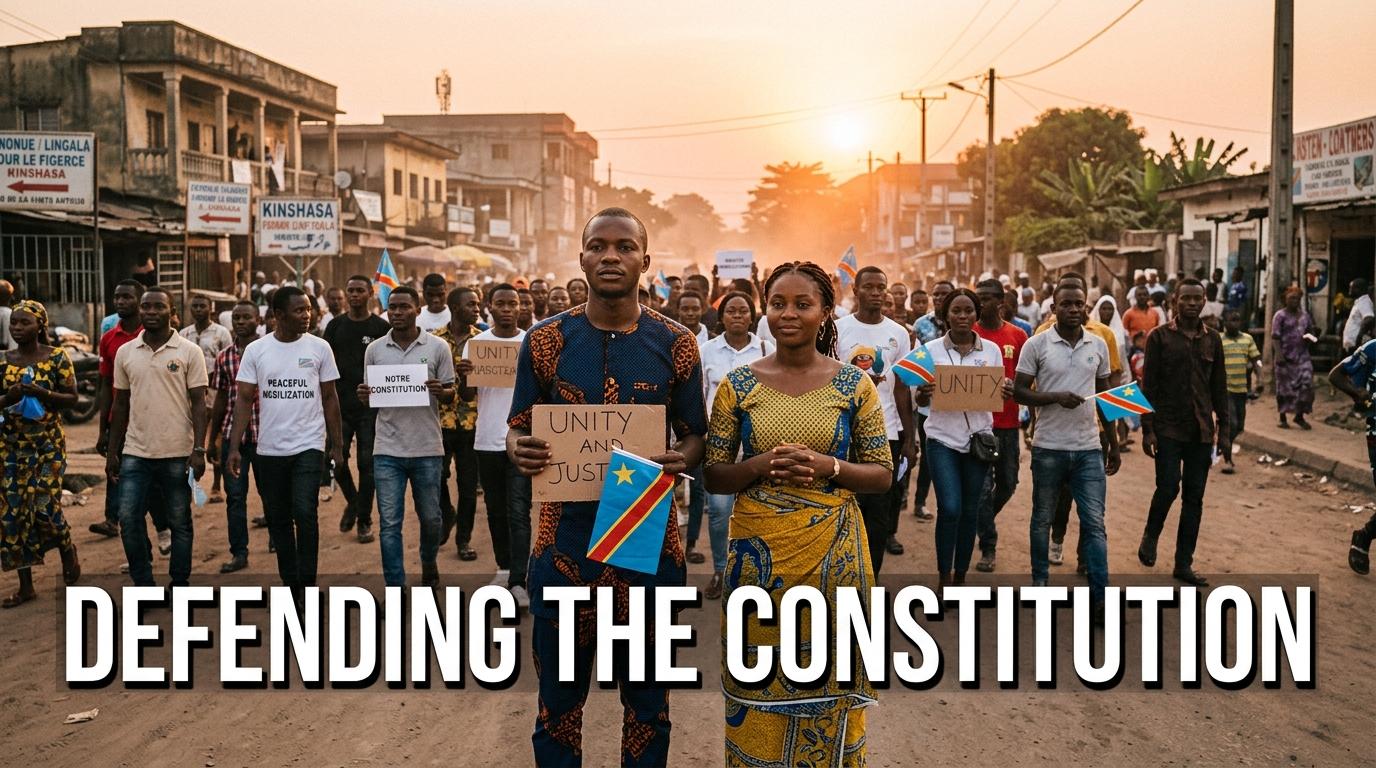
In mid-2026, political tensions reached a boiling point across the Democratic Republic of Congo. Mass civil society demonstrations erupted in major cities like Goma, Bukavu, and the capital city of Kinshasa (brusselstimes.com). Citizens poured into the streets after the Constitutional Court approved a controversial referendum framework (brusselstimes.com). Human rights groups and opposition leaders argue that President Félix Tshisekedi is laying the groundwork to alter the national constitution (brusselstimes.com). They warn that modifying executive term limits threatens fragile democratic frameworks before his second mandate expires in 2028 (brusselstimes.com).
This political flashpoint represents more than a temporary disagreement over referendum rules. It reflects an ongoing struggle over legal constitutions that has shaped Central Africa for decades. The crisis pits a ruling elite seeking to maintain executive authority against a determined civil society. To understand why Congolese citizens are risking their lives in mass protests, one must examine the deep historical roots behind today’s headlines.
From Colonial Ruin to the Sun City Compromise
The democratic struggle in the Congo has unfolded across three distinct constitutional eras (wikipedia.org). The First Republic began with independence from Belgium on June 30, 1960 (wikipedia.org). Prime Minister Patrice Lumumba and President Joseph Kasa-Vubu inherited a state fractured by colonial neglect (wikipedia.org). Severe political instability and foreign intervention quickly plunged the new nation into the chaotic Congo Crisis (wikipedia.org).
In November 1965, General Joseph-Désiré Mobutu seized absolute control through a military coup (wikipedia.org). He inaugurated the Second Republic and renamed the nation Zaire (wikipedia.org). Mobutu established a authoritarian one-party dictatorship that lasted thirty-two years (wikipedia.org). His kleptocratic regime drained public coffers and dismantled democratic institutions (wikipedia.org). The regime finally collapsed in 1997 during the First Congo War (wikipedia.org).
Years of devastating conflict followed during the Second Congo War (wikipedia.org). To end the violence, warring factions and political leaders gathered in Sun City, South Africa (wikipedia.org, constitutionnet.org). They negotiated a peace agreement that led to the Constitution of February 18, 2006 (constitutionnet.org). This document established the Third Republic (wikipedia.org). Congolese voters approved the charter with an eighty-four percent majority in a democratic referendum (wikipedia.org, wikipedia.org). The 2006 Constitution restricted the president to two five-year terms (constitutionnet.org). Crucially, the authors declared that term limits were among provisions that cannot be revised (constitutionnet.org).
The Sacred Mandate of Article 64
The authors of the 2006 Constitution understood the dangers of executive overreach. Therefore, they embedded a powerful safeguard directly into the text (constitutionnet.org). Article 64 commands all Congolese citizens to oppose anyone who attempts to seize power by force (constitutionnet.org). It also mandates resistance against those who exercise authority in violation of the constitution (constitutionnet.org).
This provision transformed civil disobedience from a crime into a constitutional duty (constitutionnet.org). It created a civic shield for popular resistance against government overreach. When former President Joseph Kabila attempted to delay elections between 2015 and 2018, citizens invoked Article 64 (wikipedia.org, wikipedia.org). Kabila used logistical problems and security concerns to prolong his tenure beyond his constitutional term (wikipedia.org). This tactic became known locally as glissement, or slippage (wikipedia.org).
In response, Congolese civil society formed broad coalitions to defend the constitution. They organized massive street demonstrations and general strikes across the nation (wikipedia.org, amnesty.org). Security forces responded with violence, killing dozens of peaceful protesters (hrw.org, amnesty.org). Despite state repression, popular pressure forced Kabila to permit elections in December 2018 (wikipedia.org, wikipedia.org). That history created a strong public expectation that every president must respect term limits.
Youth Movements and Civic Whistleblowers
Young people have consistently stood on the frontline of democracy movements in the DRC. In 2015, activists founded a prominent youth movement named Filimbi (wikipedia.org). The word “Filimbi” means “whistle” in the Swahili language (wikipedia.org). The organization functions as a civic whistleblower against corruption, tyranny, and bad governance (wikipedia.org).
Filimbi works alongside other grassroots civil movements like LUCHA to educate young citizens. They train youth to use non-violent action to demand democratic accountability. Filimbi members host community workshops, organize peaceful sit-ins, and publish educational materials. They remind the public that national sovereignty belongs to the people, not the president.
The state has repeatedly targeted these youth activists with harsh repression (frontlinedefenders.org, frontlinedefenders.org). Security forces have subjected Filimbi leaders to arbitrary arrests, extended detentions, and physical violence (frontlinedefenders.org, frontlinedefenders.org). Despite constant intimidation, youth pressure groups remain central to organizing public demonstrations. When political leaders attempt to alter term limits, Filimbi blows the whistle to mobilize citizens.
Mineral Wealth and the Economics of Power
The conflict over constitutional term limits is deeply connected to economic control. The DRC holds vast reserves of critical minerals like cobalt, coltan, copper, and gold (wikipedia.org, britannica.com). These materials are vital for global electronics, electric vehicles, and defense technology (wikipedia.org). Controlling the presidency grants absolute authority over international trade concessions and mining contracts (wikipedia.org).
This immense resource wealth converts national politics into a winner-takes-all economic prize (wikipedia.org). Executive authority allows political elites to enrich themselves through state contracts and mining revenues. Ruling figures use these resource rents to construct patronage networks and secure political loyalty (wikipedia.org). They also use public funds to finance election campaigns and maintain security services.
Because losing power means forfeiting access to wealth, presidents face huge incentives to extend their tenure. Historical shifts in political power demonstrate how financial control drives leaders to alter legal rules. Extending presidential mandates ensures that the ruling coalition maintains control over lucrative resource streams. Consequently, constitutional debates in Kinshasa are rarely limited to legal theory; they are about economic survival.
Eastern Security Crisis and Political Manipulations
The ongoing security crisis in eastern Congo heavily influences current political debates. Armed insurgencies have destabilized North Kivu and South Kivu provinces for decades (wikipedia.org). The most prominent military threat comes from the March 23 Movement, known as M23 (wikipedia.org). Formed in 2012 by former rebel mutineers, M23 has captured substantial territory in eastern provinces (wikipedia.org, wikipedia.org).
In late 2023, former election commission president Corneille Nangaa established the Congo River Alliance, known as the AFC (wikipedia.org, wikipedia.org). The AFC created a political-military coalition with M23 to overthrow the recognized government in Kinshasa (wikipedia.org, wikipedia.org). Official reports from United Nations experts document that Rwanda provides advanced military support and troops to M23 (wikipedia.org, cfr.org). Observers accuse foreign actors of using proxy forces to plunder eastern mineral deposits (wikipedia.org).
President Félix Tshisekedi argues that the 2006 Constitution limits state capabilities during national security crises (brusselstimes.com). Proponents claim a new constitution is required to strengthen institutions and protect national sovereignty (brusselstimes.com). However, opposition leaders and civil society organizations strongly reject this logic. They note that the military already holds administrative power in eastern provinces under state of siege emergency laws (wikipedia.org). Critics assert that the government is using the security crisis as a pretext to delay elections and reset presidential term limits (brusselstimes.com).
The Shadow of the Tshisekedi Name
The current constitutional controversy touches a sensitive historical legacy. President Félix Tshisekedi is the son of Étienne Tshisekedi, a historical icon of the Congolese democracy movement (wikipedia.org, wikipedia.org). Étienne Tshisekedi founded the Union for Democracy and Social Progress in 1982 (wikipedia.org, wikipedia.org). For over three decades, he led non-violent resistance against the successive dictatorships of Mobutu Sese Seko and Joseph Kabila (wikipedia.org, wikipedia.org).
Étienne Tshisekedi established a national reputation based on strict non-violence and constitutional rule. He repeatedly survived imprisonment, beatings, and internal exile without taking up arms. His decades of struggle made the Tshisekedi family name synonymous with democratic opposition. Félix Tshisekedi relied heavily on his father moral authority during his 2018 presidential campaign.
Today, civil society activists argue that Félix Tshisekedi is betraying his father legacy. They point out that he is adopting tactics similar to those his father spent his life fighting against. By attempting to alter the constitution to extend executive power, Félix faces criticism from former allies. Activists argue that failed political compromises must not replace a family history built on democratic defense.
The Moral Shield of the Catholic Church
When political institutions face crises of legitimacy, the Roman Catholic Church acts as a primary moral authority in the DRC (wikipedia.org). Over half of the Congolese population belongs to the Catholic faith (wikipedia.org, americamagazine.org). During decades of state collapse under Mobutu, the Church expanded to deliver basic social infrastructure (wikipedia.org). Catholic institutions manage over sixty percent of primary schools and forty percent of healthcare facilities nationwide (wikipedia.org).
This structural connection provides church leaders with unmatched credibility and organizational reach (wikipedia.org). Through the National Episcopal Conference of Congo, bishops regularly condemn governance abuses and electoral irregularities (wikipedia.org). During anti-Kabila demonstrations, lay Catholic groups organized nationwide peaceful marches after Sunday Mass (wikipedia.org). Security forces violently attacked those religious rallies, killing worshippers holding crosses and bibles (hrw.org, amnesty.org).
The Catholic Church continues to oppose attempts to eliminate presidential term limits. Church leaders deploy tens of thousands of election observers to safeguard democratic processes. Because political parties are frequently fragmented or co-opted, the Church remains an essential defender of public rights. Its leadership continues to remind citizens that constitutional rules must be preserved.
The C64 Coalition and the Path Ahead
In response to proposed referendum legislation, opposition leaders formed a united front (brusselstimes.com). They named their alliance the C64 Coalition in direct homage to Article 64 of the constitution (brusselstimes.com). Led by prominent figures like Martin Fayulu and Moïse Katumbi, the alliance is organizing nationwide civil mobilization (brusselstimes.com). They demand that the government respect term limits and cancel referendum plans (brusselstimes.com).
The Democratic Republic of Congo stands at a critical crossroads. The outcome of this constitutional confrontation will determine whether the nation maintains its democratic framework. Altering basic governance laws to benefit incumbent leaders risks destabilizing a country already facing severe humanitarian challenges. The widespread public movement against constitutional changes proves that democratic principles remain vital to the population.
Congolese citizens have repeatedly demonstrated their willingness to defend democratic norms against executive overreach. Their ongoing mobilization proves that the spirit of Article 64 remains active across the country. As political leaders pursue legal revisions, the Congolese people continue to insist that term limits must be respected.
About the Author
Darius Spearman is a professor of Black Studies at San Diego City College, where he has been teaching for over 20 years. He is the founder of African Elements, a media platform dedicated to providing educational resources on the history and culture of the African diaspora. Through his work, Spearman aims to empower and educate by bringing historical context to contemporary issues affecting the Black community.
