


Why Drone Strikes and Sexual Violence Siege El Obeid
By Darius Spearman (africanelements)
Support African Elements at patreon.com/africanelements and hear recent news in a single playlist. Additionally, you can gain early access to ad-free video content.
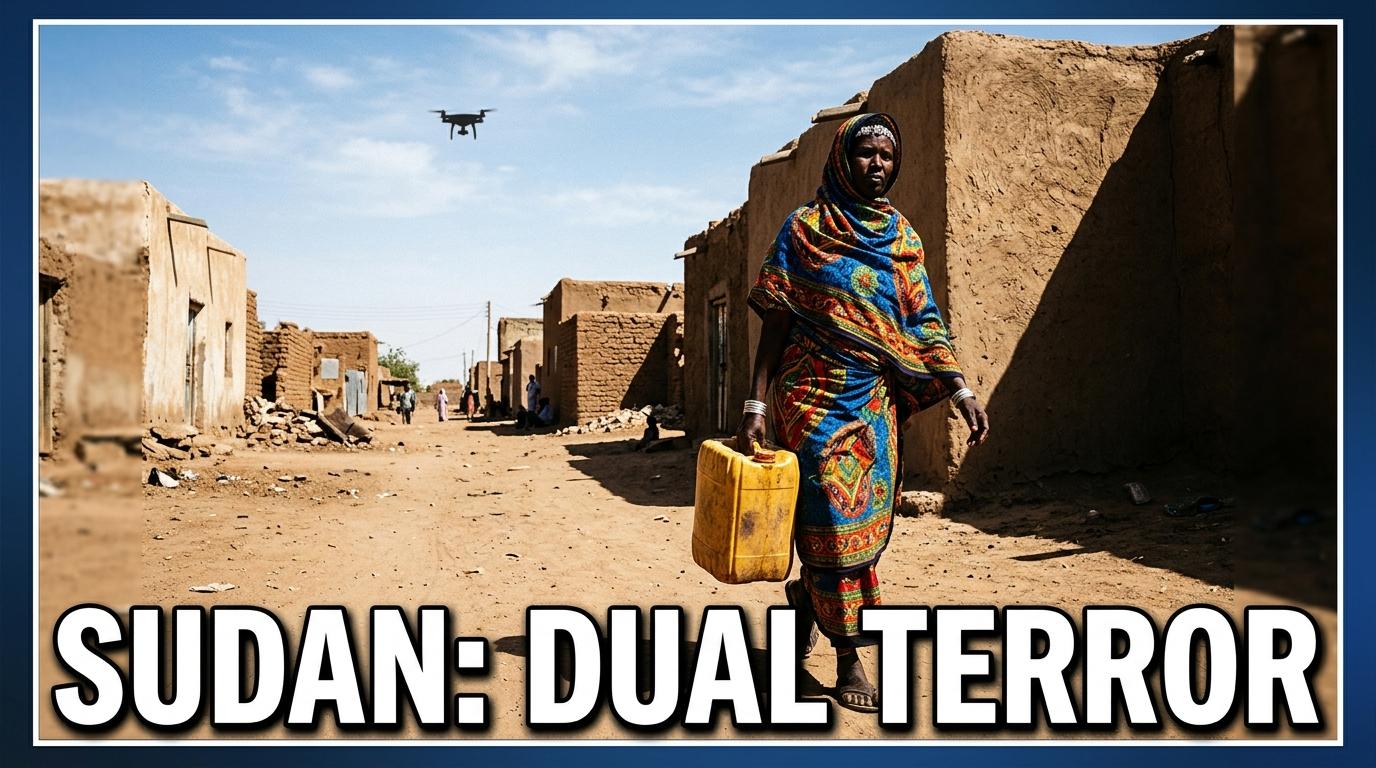
In July 2026, United Nations officials issued a harrowing warning regarding human rights violations in Sudan (un.org). Anna Mutavati, the UN Women Regional Director for East and Southern Africa, described a state of dual terror in El Obeid (reliefweb.int). El Obeid serves as the capital city of North Kordofan state (radiotamazuj.org). Women and girls in the siege-bound city now confront impossible choices every day (reliefweb.int). They must risk their lives to secure basic survival necessities (un.org).
During daylight hours, civilians who search for drinking water risk death from targeted drone strikes (un.org). If they wait for nightfall to hide from aerial threats, armed men stalk the dark pathways (reliefweb.int). Armed militias and soldiers inflict targeted sexual violence and rape upon women collecting water (reliefweb.int). This localized nightmare reflects broader strategic military patterns across the region (amnesty.org). Modern military technology now intersects with deeply rooted tactics of institutional violence (amnestyusa.org).
Sudan Crisis: Scale of Impact (2026 Data)
Source: UN Women and UN OCHA Reports (2026)
Dual Terror in Siege-Bound El Obeid
El Obeid occupies a vital geographical location in Sudan (sudantribune.com). The city connects the national capital of Khartoum with the western Darfur region and southern provinces (sudantribune.com). Because of these crucial transport links, armed factions have besieged the city (reliefweb.int). Over 500,000 long-term residents and 83,000 internally displaced persons remain trapped inside (reliefweb.int). Across North Kordofan state, formal humanitarian camps hold over 105,000 displaced individuals (reliefweb.int). More than 21,700 children reside in the main camp outside El Obeid (reliefweb.int).
The daily struggle to secure clean drinking water has turned lethal (un.org). Warring armies routinely target municipal water collection points and filtration centers (reliefweb.int). Unmanned aerial vehicles strike groups that gather near public wells during the day (reliefweb.int). As a result, women must venture out in total darkness (reliefweb.int). Armed men monitor the travel routes to assault water collectors (reliefweb.int). This calculated trap forces families to choose between dehydration, lethal airstrikes, or sexual assault (un.org, reliefweb.int).
SGBV Versus Conflict-Related Sexual Violence
Humanitarian agencies rely on specific legal definitions to address abuses in war zones (hhrjournal.org). Sexual and Gender-Based Violence serves as a broad umbrella term (migrantwomennetwork.org). It covers any harmful act committed against a person’s will based on socially ascribed gender differences (migrantwomennetwork.org). SGBV includes domestic abuse, forced marriage, intimate partner violence, and physical exploitation (popcouncil.org). These acts can occur in peacetime conditions or during active military campaigns (migrantwomennetwork.org).
Conflict-Related Sexual Violence represents a distinct legal category under international humanitarian law (hhrjournal.org). CRSV includes rape, sexual slavery, enforced prostitution, forced pregnancy, and enforced sterilization (amnesty.org, hhrjournal.org). These crimes share explicit geographic, temporal, or tactical links to an armed conflict (hrw.org, hhrjournal.org). Combatants utilize CRSV deliberately as a tactical instrument of warfare (amnestyusa.org, amnesty.org). The strategy aims to terrorize populations, force displacement, and break social cohesion (amnestyusa.org, hrw.org). The historical resistance of Black women often emerges in response to such systemic intersectional violence (migrantwomennetwork.org, unu.edu).
Comprehensive SGBV services require multi-sectoral emergency care systems (humanitarianaction.info, hias.org). Essential medical intervention includes the Clinical Management of Rape (healthpolicy-watch.news, saludeverywhere.com). Health workers must provide Post-Exposure Prophylaxis within seventy-two hours to prevent HIV transmission (healthpolicy-watch.news). Emergency contraception and immediate physical trauma care remain vital components (healthpolicy-watch.news, saludeverywhere.com). Non-medical assistance requires specialized psychosocial counseling, legal assistance, case management, and secure protection shelters (humanitarianaction.info, hias.org). In siege conditions like El Obeid, blockades prevent these lifesaving medical supplies from reaching victims (reliefweb.int, reliefweb.int).
The Historical Roots of Weaponized Violence
The weaponization of sexual violence in Sudan is not a new development (amnestyusa.org, amnesty.org). Modern operational tactics trace back to the Darfur Genocide that began in 2003 (ushmm.org, wikipedia.org). During that era, the Sudanese government under dictator Omar al-Bashir deployed Arab militia units (ushmm.org, wikipedia.org). These state-backed forces were known as the Janjaweed (wikipedia.org, wikipedia.org). The regime instructed the Janjaweed to suppress rebel uprisings among non-Arab ethnic groups (ushmm.org, wikipedia.org). Target communities included the Fur, Masalit, and Zaghawa populations (ushmm.org, wikipedia.org).
Human rights investigations documented systemic campaigns of gang rape by the Janjaweed (amnestyusa.org, hrw.org). Militias used sexual assaults to destroy family structures and enforce ethnic displacement (amnestyusa.org). These abusive systems parallel historical systems of involuntary servitude that stripped vulnerable populations of physical autonomy (wikipedia.org, amnestyusa.org). In 2013, the Sudanese state formally reorganized the Janjaweed into a disciplined paramilitary army (wikipedia.org). They named this new force the Rapid Support Forces under commander Mohamed Hamdan Dagalo (wikipedia.org).
Evolution of Weaponized Violence in Sudan
When civil war erupted in April 2023, the RSF fought against the Sudanese Armed Forces (wikipedia.org, wikipedia.org). Armed national military forces operated under General Abdel Fattah al-Burhan (wikipedia.org, wikipedia.org). The paramilitary RSF occupied towns using their established methods of territorial capture (amnestyusa.org, amnesty.org). Human rights reports indicate that RSF combatants continued systematic sexual violence patterns across captured areas (amnestyusa.org, hrw.org). The combatants who institutionalized weaponized rape in Darfur remain primary actors in current military operations (wikipedia.org, amnestyusa.org).
Foreign Drones and the Escalation of Proxy Warfare
The conflict in Sudan has evolved into a heavily funded proxy war supported by international actors (washingtonpost.com, thesoufancenter.org). Foreign armaments have poured into the country since hostilities expanded (securitycouncilreport.org, washingtonpost.com). Unmanned aerial vehicles have changed tactical operations in urban warfare (amnestyusa.org, middleeasteye.net). Drones killed at least 880 civilians during the first four months of 2026 alone (amnestyusa.org). These aerial attacks accounted for over eighty percent of recorded civilian casualties in that period (amnestyusa.org).
External governments supply specialized hardware to both main combatant factions (washingtonpost.com, thesoufancenter.org). The United Arab Emirates acts as the primary backer of the Rapid Support Forces (washingtonpost.com, thesoufancenter.org). Reports show the UAE provides military equipment, including Chinese-made FH-95 kamikaze drones and GB50A guided bombs (washingtonpost.com, thesoufancenter.org). Conversely, Iran supplies the Sudanese Armed Forces with combat unmanned aircraft (middleeasteye.net, iranintl.com). Iranian shipments include Mohajer-6 and Ababil-3 aerial drones to enhance army strikes (middleeasteye.net, iranintl.com).
Turkey also supplies advanced military hardware to the national armed forces (japantimes.co.jp). Turkish defense contractors have delivered Bayraktar TB2 and Akinci strike drones to SAF bases (japantimes.co.jp). In exchange, Turkish firms gain strategic economic influence and port development access (japantimes.co.jp). Furthermore, Russian entities maintain active mercenary links and weapons distribution routes (securitycouncilreport.org, washingtonpost.com). Russian officials have negotiated for naval facilities near Port Sudan (securitycouncilreport.org). Foreign interventions escalate domestic destruction while isolating civilians inside combat zones (securitycouncilreport.org, thesoufancenter.org).
Foreign Arms Flowing to Combatants
• Private Networks: Logistics and weapons supply lines
• Turkey: Bayraktar TB2 and Akinci Armed Drones
• Russia: Arms deals and naval base negotiations
Internal Displacement and Humanitarian Collapse
The civil war has generated the world’s largest internal displacement crisis (reliefweb.int, unocha.org). Between eleven and fourteen million people have fled their homes since April 2023 (unocha.org, unhcr.org). International legal standards draw clear distinctions between displaced categories (unhcr.org, unhcr.org). An Internally Displaced Person flees conflict but remains within national borders (refugees.org, unhcr.org). Conversely, refugees cross internationally recognized borders into foreign nations (unhcr.org, unhcr.org).
This legal distinction significantly alters humanitarian protection levels (refugees.org, unhcr.org). Refugees fall under formal international legal frameworks like the 1951 Refugee Convention (unhcr.org, unhcr.org). UN agencies provide legal status and host-nation protections to refugee groups (unhcr.org, unrefugees.org). IDPs remain under the legal jurisdiction of their domestic government (refugees.org, unhcr.org). When that national government perpetrates or permits violence, IDPs lose effective legal protection (refugees.org, unhcr.org). Over nine million Sudanese live as IDPs without international legal safeguards (unocha.org, unhcr.org).
Humanitarian operations rely heavily on two core United Nations institutions (unocha.org, saludeverywhere.com). The United Nations Office for the Coordination of Humanitarian Affairs organizes overall relief efforts (unocha.org). OCHA mobilizes international donor funding and leads operational cluster groups (unocha.org, humanitarianaction.info). The World Health Organization leads emergency medical cluster operations (healthpolicy-watch.news, saludeverywhere.com). WHO tracks disease outbreaks, distributes medical stockpiles, and supports local clinics (healthpolicy-watch.news, saludeverywhere.com). Rapid shifts in critical political narratives often affect international funding and response speeds for these relief agencies (unocha.org, house.gov).
Disease outbreaks now compound physical security threats across displacement sites (healthpolicy-watch.news, reliefweb.int). Active cholera outbreaks spread rapidly through crowded informal camps (healthpolicy-watch.news, saludeverywhere.com). Clean water scarcity forces families to consume contaminated groundwater (healthpolicy-watch.news, reliefweb.int). Concurrently, severe acute malnutrition weakens millions of children and mothers nationwide (unocha.org, wfpusa.org). Weakened immune systems increase mortality rates from preventable waterborne illnesses (healthpolicy-watch.news, saludeverywhere.com). Siege conditions in El Obeid prevent aid convoys from delivering essential water purification supplies (reliefweb.int, reliefweb.int).
Broken Accountability and International Failures
International justice mechanisms have struggled to stop military violence in Sudan (nextcenturyfoundation.org, un.org). The International Criminal Court issued arrest warrants for former president Omar al-Bashir (nextcenturyfoundation.org, un.org). ICC prosecutors charged al-Bashir with genocide, war crimes, and crimes against humanity (nextcenturyfoundation.org, un.org). Other warrants targeted top regime officials Ahmad Harun and Abdel Raheem Hussein (nextcenturyfoundation.org, un.org). In July 2026, the ICC terminated proceedings against rebel leader Abdallah Banda due to deteriorated evidence (un.org).
Despite these formal charges, top suspects avoid prosecution (nextcenturyfoundation.org, egyptindependent.com). Popular protests ousted Omar al-Bashir from political power in 2019 (wikipedia.org, egyptindependent.com). Military authorities held al-Bashir in domestic detention facilities before moving him to Merowe military hospital in September 2024 (egyptindependent.com). Sudanese state officials repeatedly refused to surrender al-Bashir to The Hague (nextcenturyfoundation.org, egyptindependent.com). Regional political bodies also undermined international enforcement efforts (nextcenturyfoundation.org, polity.org.za). The African Union previously advised member states not to execute ICC arrest warrants against sitting leaders (polity.org.za). South Africa notably refused to detain al-Bashir during a 2015 diplomatic summit (polity.org.za).
Impunity persists because current war leaders emerged from al-Bashir’s former military apparatus (wikipedia.org, wikipedia.org). General Burhan and General Dagalo held senior operational commands during earlier Darfur campaigns (wikipedia.org, wikipedia.org). Neither military faction possesses domestic incentive to enforce ICC warrants or investigate war crimes (nextcenturyfoundation.org, hrw.org). Consequently, military commanders operate without fear of judicial punishment (amnestyusa.org, amnesty.org). This persistent climate of impunity allows historical tactics of weaponized sexual assault to continue uninterrupted (amnestyusa.org, amnesty.org).
Diaspora Advocacy and United States Policy
The Sudanese humanitarian disaster connects directly to Black diaspora foreign policy advocacy (youtube.com, house.gov). African American leaders have historically mobilized against atrocities committed on the African continent (youtube.com, house.gov). The Congressional Black Caucus played a vital role during the 2003 Darfur genocide (house.gov, hornreview.org). CBC members pressured the United States Congress to declare Janjaweed actions as genocide (house.gov, hornreview.org). They pushed for sanction regimes and supported humanitarian interventions (house.gov, hornreview.org). These organizing traditions parallel the contributions of Black women who led anti-oppression movements across global fronts (youtube.com, house.gov).
In April 2026, CBC Chair Yvette D. Clarke issued an official policy statement regarding Sudan (house.gov). Caucus members explicitly condemned human rights violations committed by both the SAF and RSF (house.gov). They urged the United States State Department to pressure external sponsors (house.gov). The CBC demanded an immediate halt to arms transfers from the UAE, Iran, and Russia (house.gov). Caucus leaders highlighted how foreign military aid directly fuels human rights abuses against African populations (house.gov, washingtonpost.com).
Historically Black Colleges and Universities also hold rich histories of international advocacy (youtube.com, amnestyusa.org). Institutions like Howard University hosted historical rallies and policy debates during early Darfur crises (youtube.com, amnestyusa.org). HBCU student organizations organized divestment initiatives targeting companies that financed oppressive regimes (youtube.com, amnestyusa.org). Today, Sudanese diaspora groups organize rallies outside federal buildings in Washington (youtube.com, youtube.com). They work alongside civil rights groups to demand effective diplomatic interventions (house.gov, youtube.com). Activists push international bodies to confront intersectional oppression wherever state violence occurs (house.gov, amnestyusa.org).
Historical Continuity on the Battlefield
The modern siege of El Obeid demonstrates an tragic continuity in Sudan’s conflict history (reliefweb.int, amnestyusa.org). The state-backed Janjaweed relied on ground horseback raids and physical isolation twenty years ago (ushmm.org, wikipedia.org). In 2026, rebranded paramilitary forces use advanced foreign drones alongside sexual assault tactics (reliefweb.int, amnestyusa.org). Remote-piloted technology coordinates with ground militia blockades to isolate urban centers (reliefweb.int, washingtonpost.com). The operational objective remains identical: controlling territory through fear and physical destruction (amnestyusa.org, amnesty.org).
By denying safe access to drinking water, warring factions weaponize basic human survival (un.org, reliefweb.int). The intersection of lethal daylight airstrikes and nighttime sexual violence creates inescapable traps for women (reliefweb.int). Disease outbreaks and malnutrition further erode community survival (healthpolicy-watch.news, reliefweb.int). As international institutions issue urgent warnings, the ongoing destruction in El Obeid reveals a clear truth (un.org, reliefweb.int). In Sudan’s military conflicts, combatants continuously convert the bodies of women and girls into central battlegrounds (amnestyusa.org, amnesty.org).
About the Author
Darius Spearman is a professor of Black Studies at San Diego City College, where he has been teaching for over 20 years. He is the founder of African Elements, a media platform dedicated to providing educational resources on the history and culture of the African diaspora. Through his work, Spearman aims to empower and educate by bringing historical context to contemporary issues affecting the Black community.
