


Why HBCU Clean Energy Grants Are Changing the Economy Today
By Darius Spearman (africanelements)
Support African Elements at patreon.com/africanelements and hear recent news in a single playlist. Additionally, you can gain early access to ad-free video content.
A Historic Investment in Black Innovation
On the morning of May 18, 2026, the Department of Energy announced a historic initiative to transform higher education. The federal agency awarded ninety-four million dollars in rapid-funding grants directly to Historically Black Colleges and Universities. This massive financial package focuses specifically on developing sustainable technology infrastructure and funding student-led clean energy startups. The announcement marks a significant turning point in how the government supports academic innovation in minority communities. Officials designed the program to accelerate new energy technologies while building a robust and inclusive clean energy workforce. (ed.gov)
This initiative builds upon a cumulative 5.8 billion dollars distributed to these critical institutions since 2021. However, this moment represents a much longer and more complex story. The relationship between Black academic institutions and federal research has evolved significantly over the past 150 years. Early educators fought fiercely for basic survival and fundamental recognition. Today, modern universities stand at the center of high-level research and entrepreneurial development. Understanding the true impact of this ninety-four million dollar grant requires a deep look into the historical struggles that made this modern partnership possible. (ed.gov)
The Origins of Black Land-Grant Institutions
Long before modern energy grids existed, Black educators fought for the most basic academic resources. The earliest historically Black institutions, such as Cheyney University established in 1837, emerged to educate African Americans during an era of systemic and violent exclusion. Obtaining an education served as a radical act of defiance against a hostile society. By the late nineteenth century, the federal government had to address deep inequalities in higher education across the nation. This urgent need led to the passage of the Second Morrill Act of 1890. (wikipedia.org)
The 1890 legislation required states to provide land-grant institutions for Black students if those students faced exclusion from existing public universities. Eighteen states, primarily located in the South and border regions, chose to establish separate institutions rather than integrate their classrooms. This formalized a separate but equal doctrine in the American higher education system. These 1890 institutions, including renowned schools like Florida A&M and North Carolina A&T, laid the foundation for agricultural and environmental science in the Black community. Yet, they faced severe and chronic underfunding compared to white-led schools. The legacy of these early struggles heavily shaped shaping political dynamics for generations of students. (wikipedia.org)
Building Capacity Through Federal Recognition
The struggle for equitable funding continued well into the twentieth century. A major turning point occurred with the passage of the Higher Education Act of 1965. Title III of this monumental civil rights legislation provided the first formal legal definition of Historically Black Colleges and Universities. This legislation created a vital lifeline for these schools, allowing them to compete for federal capacity-building funds. Title III enabled institutions to construct new classrooms, upgrade scientific laboratories, and improve overall fiscal stability. This act recognized that these schools served high-need student populations and required targeted federal assistance to survive. (hbculibraries.org)
As the civil rights movement evolved, academic leaders sought more direct federal intervention in scientific research. In 1980, President Jimmy Carter signed Executive Order 12232. This directive officially established the White House Initiative on HBCUs. The systematic effort aimed to identify and eliminate bureaucratic barriers that prevented Black colleges from participating fully in federally sponsored programs. These legal frameworks provided the necessary structure for future high-level research partnerships. They allowed academic scholars to navigate the complex world of federal grants while addressing the often conflicting elements of Black Nationalism and mainstream integrationist policies. (ed.gov)
The Fossil Fuel Era of HBCU Research
When the Department of Energy emerged in 1977, it inherited a highly specialized research landscape that largely excluded minority scientists. For several decades, the agency directed its support for Black colleges through the National Energy Technology Laboratory. Between 1995 and 2017, this program awarded approximately 25.6 million dollars in federal grants to minority institutions. However, this funding primarily focused on fossil energy resource utilization. (osti.gov)
University researchers concentrated heavily on traditional areas like carbon capture and coal utilization. This narrow focus aimed to increase the competitiveness of minority scientists within existing energy sectors. At the same time, it effectively limited Black researchers to a legacy fossil fuel industry. High-risk fundamental research in cleaner fields remained largely inaccessible due to smaller budgets and a lack of partnership with the broader Office of Science. While this era built crucial technical capacity and laboratory experience, it kept brilliant scientists working within traditional energy paradigms rather than pioneering alternative environmental solutions. (osti.gov)
The Push for Climate Justice
The global conversation around energy eventually shifted from managing fossil fuels to mitigating the harsh impacts of global warming. Climate justice provides a framework that links environmental degradation directly to systemic social inequities. Low-income communities and people of color often face the earliest and most severe impacts of climate change. They endure higher heat exposure and severe flooding, despite contributing the least to the carbon emissions that cause these disasters. (bullardcenter.org)
The Justice40 Initiative, introduced in 2021, served as a major catalyst for policy change. This directive mandates that forty percent of the overall benefits from certain federal investments must flow directly to disadvantaged communities. The initiative transformed the funding criteria within the Department of Energy. Federal benefits are now defined by measurable outcomes like direct job creation, reduced energy burdens, and the cleanup of toxic legacy pollution. Because many Black colleges are located in frontline communities in the Southeast, they became primary geographical targets for these new clean energy investments. (thirdway.org)
Bridging the Entrepreneurial Wealth Gap
Despite their small institutional numbers, Black colleges remain immense powerhouses for cultivating scientific talent. They represent only three percent of all universities in the United States. Yet, they produce twenty percent of all Black graduates in science, technology, engineering, and mathematics. Furthermore, these specific schools graduate forty percent of all Black engineers nationwide. Their profound impact on the professional technological workforce is completely undeniable. (ed.gov)
However, a significant financial gap exists between education and business ownership. A comprehensive 2022 study revealed that seventy-five percent of these institutions offer entrepreneurship courses to their students. In stark contrast, only six percent provide academic programs with direct seed funding for new startups. The rapid-funding initiative announced on May 18 specifically addresses this glaring entrepreneurial wealth gap. By providing immediate capital, the government helps students transform their laboratory research into viable commercial businesses. This economic strategy mirrors how early Black entrepreneurs built foundational wealth despite facing massive societal obstacles. (thirdway.org)
Cultivating Clean Energy Startups on Campus
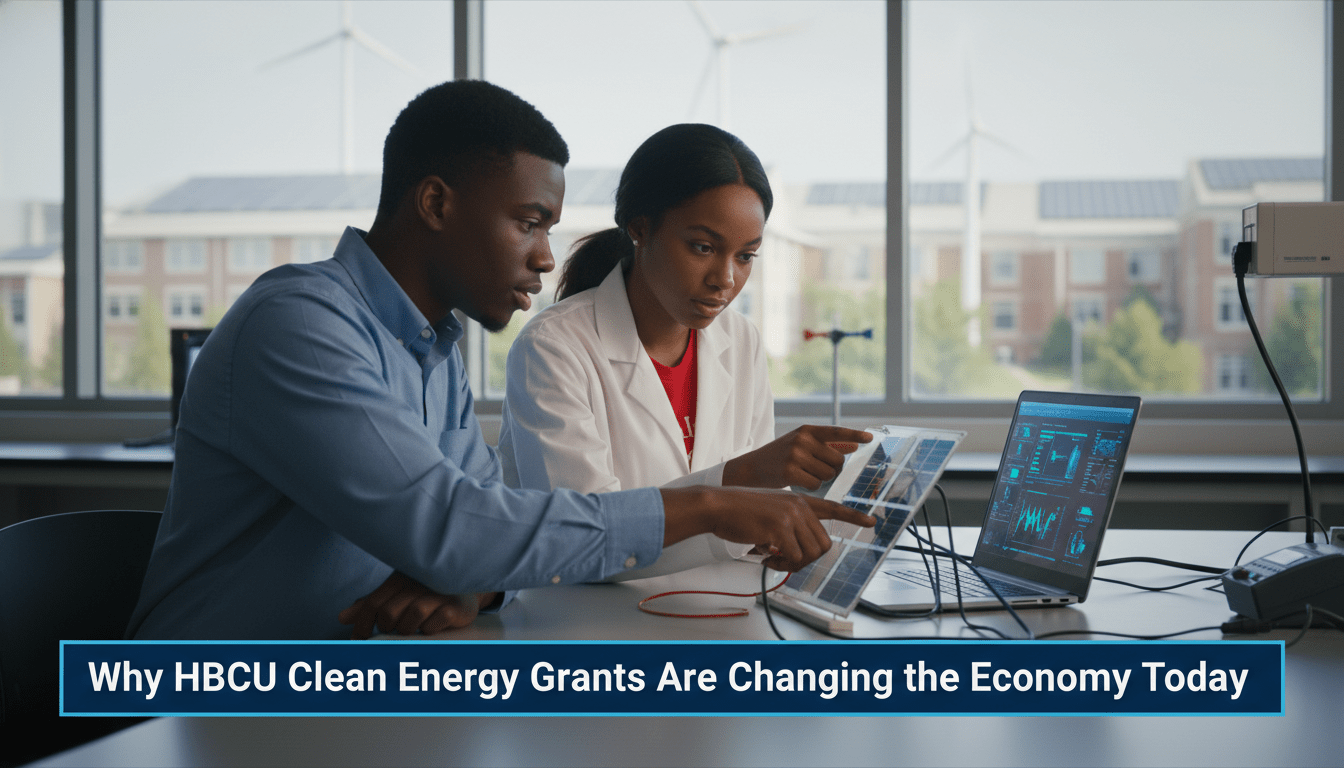
The recent grant announcement heavily emphasizes the active development of student-led business ventures. In this specific context, a clean energy startup is a campus-incubated project that moves technology directly from the laboratory to the commercial marketplace. Students are designing innovative mobile applications for community energy management and creating local solar installation companies. They are building customized technological solutions tailored to the specific needs of their own neighborhoods. (dillard.edu)
One prominent innovation emerging from these campuses is the field of agrivoltaics. This dual-use system allows agricultural workers to grow crops underneath elevated solar panels, which dramatically improves land efficiency in the rural South. Startups focusing on these technologies provide crucial economic mobility for marginalized communities. They ensure that graduates enter the expanding green economy as proud owners and innovators, rather than merely as laborers. Programs like the HBCU Clean Energy Education Prize previously awarded vital funds to schools like Dillard University to quickly develop these necessary industry partnerships. (dillard.edu, sourceenergyglobal.org)
Resilience Hubs as Community Anchors
Physical infrastructure represents a major component of the May 2026 funding package. The specific grants support the creation of sustainable campus facilities that actively protect vulnerable populations. Many historically Black institutions reside in the coastal Southeast, a geographic region heavily battered by intense hurricanes and extreme heat waves. These academic campuses increasingly serve as resilience hubs for their surrounding residential neighborhoods. (bullardcenter.org)
A resilience hub is a community-managed facility designed to support local residents before, during, and after severe climate disasters. Unlike temporary emergency shelters, these specialized hubs operate year-round to benefit the public. They typically feature solar-ready power systems and robust battery microgrids. When the main electrical grid fails during a storm, these centers provide essential cooling, medical supply refrigeration, and phone charging capabilities. Organizations like the HBCU Green Fund have long advocated for equipping university campuses with these life-saving technologies. These upgraded buildings function as true community anchors that offer ongoing climate preparedness education to everyday citizens. (bullardcenter.org)
Accelerating Innovation for Energy Dominance
The May 18 announcement allocates specific funds to rapidly deploy new infrastructure rather than waiting on slow studies. Traditional federal grant processes often take well over a year from the initial proposal to the final monetary payout. The new rapid-funding model completely bypasses these bureaucratic delays. It provides immediate liquidity to educational institutions that historically lacked massive financial endowments. This financial speed is critical for keeping pace with modern technological advancements and changing global markets. (ed.gov)
This ninety-four million dollar investment aligns seamlessly with President Trump’s broader Energy Dominance agenda. The current administration aims to bolster domestic energy orderbooks by utilizing homegrown talent for massive grid-scale solutions. To meet these ambitious national goals, the Department of Energy launched associated initiatives like Funding for Accelerated, Inclusive Research. These specific programs build essential research capacity at minority-serving institutions across the country. By engaging historically excluded scientific voices, the federal government hopes to solve the most pressing challenges in the modern energy sector. (ed.gov)
Empowering the Next Generation of Leaders
The monumental shift toward clean energy entrepreneurship marks a profound evolution in federal policy. For well over a century, Black academic institutions focused primarily on basic institutional survival and fighting for fundamental recognition. They operated under constant financial strain while striving to provide the highest quality education possible. The transition from conducting limited fossil fuel research to funding multi-million dollar technology startups represents a massive leap forward for the entire culture. (energyconnects.com)
Today, these historic universities are actively shaping the future of global power systems. By funding sustainable infrastructure and innovative student businesses, federal agencies are expanding political power through true economic ownership. The May 18 clean energy grants are an incredibly important step in a very long journey toward justice. The brilliant graduates of these modern scientific programs will undoubtedly lead the transition to a more sustainable, resilient, and equitable world. (energyconnects.com)
About the Author
Darius Spearman is a professor of Black Studies at San Diego City College, where he has been teaching for over 20 years. He is the founder of African Elements, a media platform dedicated to providing educational resources on the history and culture of the African diaspora. Through his work, Spearman aims to empower and educate by bringing historical context to contemporary issues affecting the Black community.
