



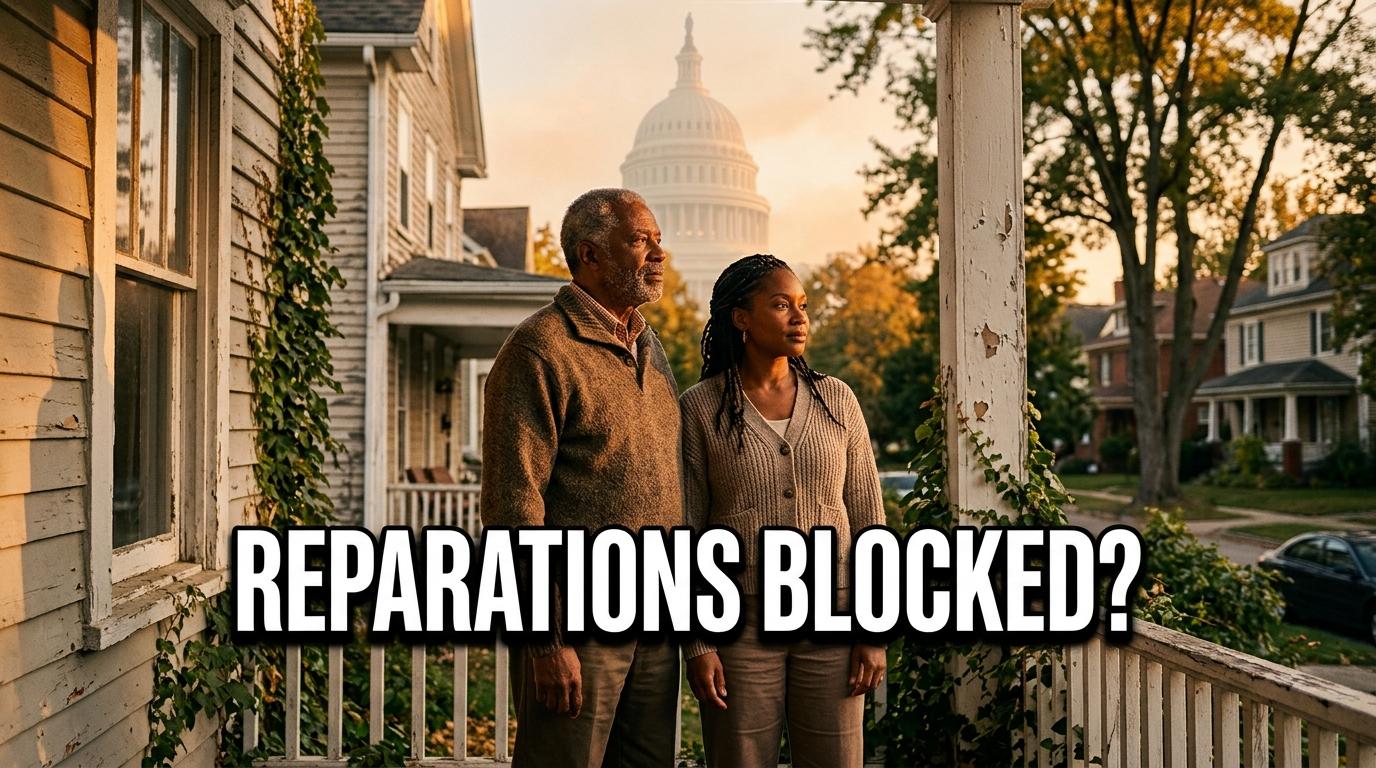
Why Is the DOJ Blocking Evanston Reparations for Black Residents?
By Darius Spearman (africanelements)
Support African Elements at patreon.com/africanelements and hear recent news in a single playlist. Additionally, you can gain early access to ad-free video content.
The federal government has taken a dramatic step to halt a historic program. In June 2026, the United States Department of Justice filed a motion to intervene in a federal lawsuit (justice.gov). Known as *Flinn v. City of Evanston*, this battle threatens to dismantle the first municipal reparations program in the nation (washingtonpost.com, dailynorthwestern.com). The program uses local tax revenue to provide housing grants to Black residents who suffered from historical segregation (fox32chicago.com, chicagocrusader.com).
The Department of Justice, led by Acting Attorney General Todd Blanche and Civil Rights Division chief Harmeet Dhillon, argues that the program is unconstitutional (justice.gov, justice.gov). They claim that providing housing grants specifically to Black residents is racially discriminatory (fox32chicago.com, chicagocrusader.com). Consequently, this federal intervention has sparked an intense national debate. It raises crucial questions about history, law, and justice. The outcome of this case could determine the future of racial equity programs across the United States.
Milestones of the Evanston Reparations Movement
Resolution 126-R-19 passes, establishing the local Reparations Fund.
The Restorative Housing Program launches, offering $25,000 grants.
Judicial Watch files the class-action lawsuit Flinn v. City of Evanston.
Federal Judge John F. Kness denies Evanston’s motion to dismiss.
U.S. DOJ files a motion to intervene to block the program.
A New Federal Mandate Takes Aim at Reparations
The intervention by the Department of Justice signals a major shift in federal civil rights enforcement. Under the leadership of Todd Blanche and Harmeet Dhillon, the Department has reprioritized its legal efforts (justice.gov). This new direction focuses heavily on scaling back race-conscious programs across the country. Federal attorneys argue that public funds must not be distributed based on racial categories (justice.gov). The sudden move against Evanston has shocked local leaders who spent years designing the program to withstand legal challenges.
In the motion to intervene, the Department of Justice claims the Evanston program violates the Fair Housing Act and the Equal Protection Clause of the Fourteenth Amendment (fox32chicago.com, justice.gov). Assistant Attorney General Harmeet Dhillon declared that distributing funds based on race is illegal discrimination (justice.gov). The federal government argues that the city did not establish a narrowly tailored remedy for specific, documented injuries (justice.gov). Instead, federal officials claim the program relies on broad historical generalizations to justify racial classifications (justice.gov). This federal pressure has turned a local policy dispute into a national constitutional battle.
The Roots of Segregation in Evanston
To understand why Evanston created this program, one must look at the local history of housing discrimination. Between 1919 and 1969, the city actively engineered a segregated community (luc.edu, cityofevanston.org). In 1919, Evanston passed its very first zoning ordinance (cityofevanston.org, cityofevanston.org). This ordinance laid the groundwork for systematic racial exclusion. Real estate brokers and local banks worked together to confine Black residents to the Fifth Ward (luc.edu).
This exclusion was not accidental. White homeowners used racially restrictive covenants to prevent Black families from buying homes in other neighborhoods (luc.edu, digitalchicagohistory.org). Banks routinely denied mortgages to Black applicants, a practice known as redlining (luc.edu). A comprehensive study commissioned by the city in 2021 documented these systematic abuses (cityofevanston.org). The study revealed that local policies prevented Black families from building home equity and intergenerational wealth for decades (cityofevanston.org). Consequently, a massive racial wealth gap persisted in the city (luc.edu). The historical evidence shows that the city government was directly responsible for creating and maintaining these segregated patterns.
The Birth of the First Municipal Initiative
The local push for reparative justice began in earnest in 2019. Alderman Robin Rue Simmons championed the effort to address the lingering effects of local segregation (firstrepair.org). In November 2019, the Evanston City Council passed Resolution 126-R-19, which established the reparations fund (cityofevanston.org, cityofevanston.org). The city pledged to commit ten million dollars over ten years to help Black residents build wealth through housing (cityofevanston.org). Later, the city committed an additional ten million dollars to the fund, showing a deep local commitment to the initiative (cityofevanston.org).
The program officially began distributing twenty-five thousand dollar grants in 2021 (cityofevanston.org). To qualify, applicants had to be Black residents who lived in Evanston between 1919 and 1969, or their direct descendants (cityofevanston.org, cityofevanston.org). Initially, recipients could only use these grants for home repairs, mortgage assistance, or down payments (cityofevanston.org). However, in 2023, the city amended the program to allow direct cash payments after residents requested more flexibility (cityofevanston.org). This program served as a primary model for other local governments, including the first-in-a-nation task force designed to study reparations on a broader scale. Municipalities watched Evanston closely to see how a local government could successfully implement reparative justice.
Funding Reparations Through Cannabis and Real Estate
Evanston chose a highly symbolic revenue stream to fund its reparations program. The city decided to use a three percent local sales tax on adult-use recreational cannabis (cityofevanston.org, cityofevanston.org). Supporters called this decision a form of poetic justice. Prior to legalization, the enforcement of marijuana laws disproportionately targeted Black residents (drugfree.org). While Black residents made up only sixteen percent of the population, they accounted for seventy-one percent of all cannabis arrests in the city (luc.edu). Linking reparations to cannabis sales aimed to redirect profits to the communities most harmed by the historic war on drugs.
However, the cannabis tax did not meet initial financial expectations. The city projected the tax would generate one million dollars annually, but it actually brought in only about one hundred thousand dollars per year (dailynorthwestern.com, cityofevanston.org). Due to slow dispensary rollouts and low sales, Evanston had to find other funding sources (dailynorthwestern.com). In 2022, the city council redirected a portion of its real estate transfer tax to cover the budget shortfall (cityofevanston.org). Despite these financial hurdles, the city has successfully distributed more than seven million dollars to eligible Black residents (dailynorthwestern.com, cityofevanston.org). This financial adaptability proved that local officials were determined to keep their promises to the community.
Racial Disparity in Evanston Prior to Cannabis Legalization
The Legal Challenge and the Battle Over Standing
The explicit use of race as an eligibility criterion quickly drew the attention of conservative legal groups. In May 2024, the Washington, D.C.-based organization Judicial Watch filed a class-action lawsuit (washingtontimes.com, dailynorthwestern.com). The lawsuit, filed on behalf of six non-Black residents, argued that the program was unconstitutional (washingtontimes.com, dailynorthwestern.com). These plaintiffs were descendants of Evanston residents from the segregation era, but they were excluded because of their race (washingtontimes.com, dailynorthwestern.com).
Evanston fought to dismiss the lawsuit by arguing that the plaintiffs lacked legal standing (dailynorthwestern.com, dailynorthwestern.com). The city asserted that because the plaintiffs never actually applied for the program, they had not suffered a concrete injury (dailynorthwestern.com). However, in March 2026, U.S. District Judge John F. Kness denied the city’s motion to dismiss (dailynorthwestern.com). Judge Kness ruled that applying would have been a futile gesture because the program explicitly barred non-Black residents (dailynorthwestern.com). Therefore, the lawsuit was allowed to proceed to trial. This ruling was a major victory for opponents of the program, setting the stage for the federal government to step in.
The Fourteenth Amendment and Colorblind Law
The core of the legal debate centers on the interpretation of the Fourteenth Amendment. Opponents of reparations advocate for a theory of constitutional colorblindness (legalnewsline.com, americancornerstone.org). This theory asserts that the government cannot make any distinctions based on race, even to correct historical injustices (legalnewsline.com). The plaintiffs and the Department of Justice rely heavily on recent Supreme Court rulings, such as the decision that ended affirmative action in college admissions (legalnewsline.com, cornell.edu).
This legal strategy represents a controversial shift in the use of civil rights laws. The Fourteenth Amendment was originally ratified during Reconstruction to protect newly freed Black citizens (wikipedia.org). Today, however, conservative groups use the amendment to challenge policies designed to assist Black communities (legalnewsline.com). Lawyers for the city argue that the program is constitutional because it remedies specific, documented housing discrimination enacted by the local government itself (cityofevanston.org, cityofevanston.org). They believe that local governments have a duty to fix the problems they directly caused.
Cannabis Tax Revenue Performance (Annual)
The National Future of Reparations
The outcome of the Evanston lawsuit will have profound consequences for the national reparations movement. For years, local governments have looked to Evanston as a pioneer and a blueprint (firstrepair.org). Municipalities across the country, inspired by the reparations commission in New York and similar initiatives, are waiting to see if these programs can survive federal scrutiny. A defeat in court could halt dozens of local initiatives before they even begin.
Conversely, a victory for Evanston would demonstrate how cities can legally address the economic legacy of Jim Crow-era policies. It would show that targeted local legislation can survive strict constitutional review if it is backed by clear historical evidence. For now, the program remains paused as the federal court prepares to rule on the future of municipal reparative justice. The nation is watching as this small Chicago suburb defends its landmark policy on the global stage.
Community Impact and the Push for Systemic Change
While the legal battle rages in federal court, the residents of Evanston continue to deal with the real-world impact of the program. Over two hundred and fifty residents have received the twenty-five thousand dollar grants (dailynorthwestern.com, cityofevanston.org). For many Black families, these funds have provided a crucial opportunity to repair homes, secure mortgages, or pass down property to the next generation (cityofevanston.org). However, some community members argue that housing grants alone cannot fully repair decades of state-sponsored harm.
This internal debate highlights the complexity of local reparative justice. Many advocates stress that housing is only the first step in a much larger struggle for equity (firstrepair.org). The deep wealth disparities, health inequities, and housing insecurity in Evanston require a sustained, comprehensive approach (luc.edu). Despite the criticisms, the program has succeeded in distributing over seven million dollars, showing that local initiatives can make a tangible difference (dailynorthwestern.com, cityofevanston.org). The community remains determined to defend the program, viewing it as a necessary step toward true healing.
About the Author
Darius Spearman is a professor of Black Studies at San Diego City College, where he has been teaching for over 20 years. He is the founder of African Elements, a media platform dedicated to providing educational resources on the history and culture of the African diaspora. Through his work, Spearman aims to empower and educate by bringing historical context to contemporary issues affecting the Black community.
