


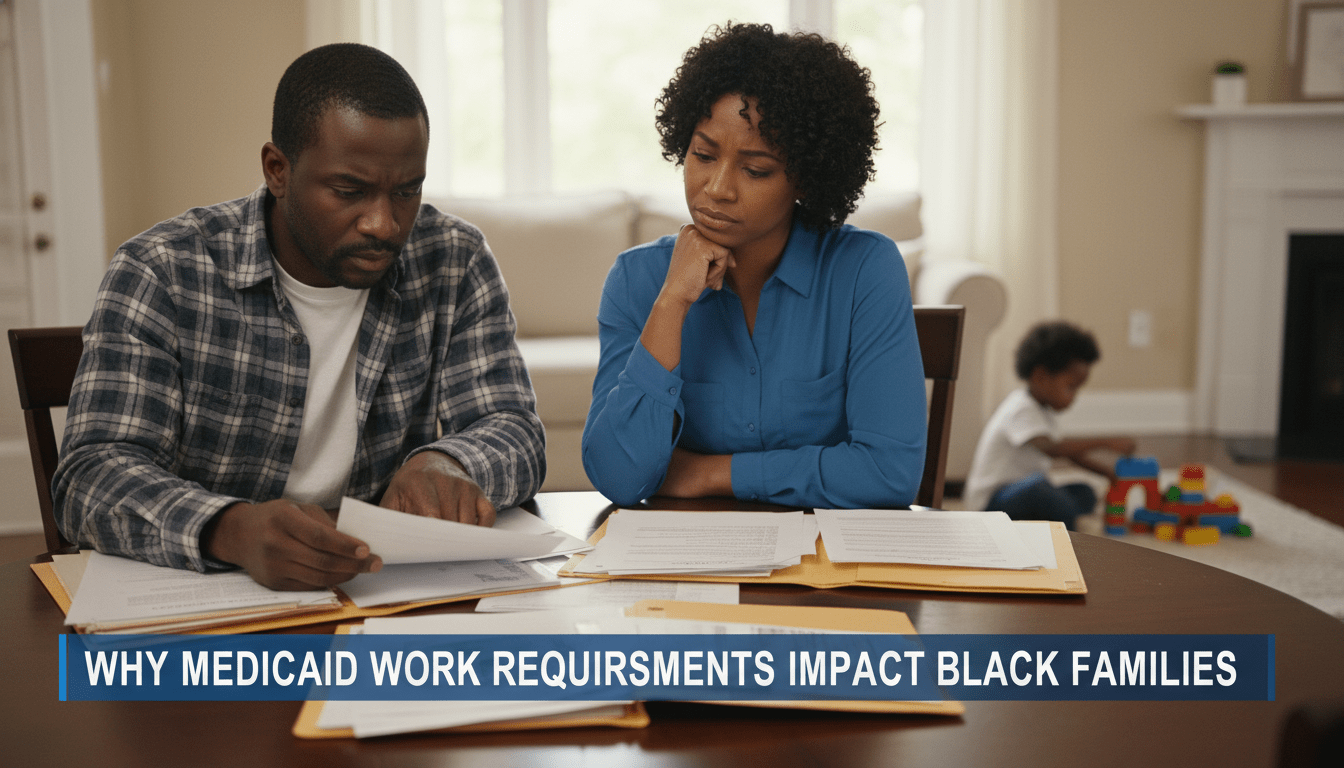
Why Medicaid Work Requirements Impact Black Families
By Darius Spearman (africanelements)
Support African Elements at patreon.com/africanelements and hear recent news in a single playlist. Additionally, you can gain early access to ad-free video content.
The Roots of the Medicaid Crisis
Advocacy groups report a terrifying surge in uninsurance rates this week. New monthly work mandates disproportionately affect Black families in expansion states. The political conflict over Medicaid actually spans sixty complex years. It officially started during the height of the Civil Rights era. The Medicaid program officially emerged in the year 1965. Lawmakers created it as Title XIX of the Social Security Act. Medicare was built as a universal social insurance program for elders. However, Medicaid was initially tied strictly to cash assistance programs. It connected directly to the Aid to Families with Dependent Children (modernmedicaid.org).
This origin baked a specific social stigma into the entire system. Eligibility was often viewed as a temporary benefit instead of care. Many policymakers constantly debated the true purpose of the healthcare program. They argued whether the system was a health or welfare program. This philosophical divide established a lasting political conflict in American government. It shaped how society viewed low-income citizens seeking essential medical help. The fundamental tension dictates modern policy debates around basic healthcare access. It creates severe hurdles for minority communities seeking basic medical stability.
The Turn Toward Personal Responsibility
The 1996 welfare reform fundamentally altered the American social safety net. President Bill Clinton signed the controversial Personal Responsibility and Work Opportunity Act. This legislation replaced the old system with Temporary Assistance for Needy Families. The sweeping reform introduced strict work mandates as a core element. It required labor in exchange for essential federal government assistance programs (ballotpedia.org).
Technically, this massive law severed the connection between Medicaid and welfare. The separation should have established healthcare as an independent human right. However, the reform established a highly destructive political precedent for policies. The new standard suggested that public benefits require constant personal responsibility. It completely shifted how lawmakers viewed low-income support systems across America. The history of African American labor shows struggles against similar systemic barriers. Lawmakers increasingly believed that government assistance should function strictly as incentives. They viewed poverty as a personal failure rather than a systemic issue. This mindset laid the direct groundwork for modern Medicaid work mandates. It transformed the healthcare safety net into a conditional privilege today.
The Affordable Care Act Era
The Affordable Care Act completely transformed the Medicaid system in 2010. The law expanded the program to include nearly all low-income adults. It removed the outdated rules regarding rigid categorical health insurance eligibility. Historically, poor citizens could only receive coverage if they fit categories. These rigid categories included children, pregnant women, elders, or disabled individuals. Low-income childless adults were historically excluded entirely from the medical system (kff.org).
The massive expansion moved Medicaid much closer to a universal model. The shift to Modified Adjusted Gross Income rules simplified the application. The legislation aimed to close massive coverage gaps for vulnerable citizens. Ten states, mostly located in the South, have still declined expansion. Residents in non-expansion states often fall into a dangerous coverage gap. They earn too much money for traditional state Medicaid health coverage. Simultaneously, they earn too little money to receive essential marketplace subsidies (kff.org).
The expansion states successfully reduced the uninsured gap for Black adults. Between 2013 and 2018, this specific racial disparity decreased by half (modernmedicaid.org). The historic expansion represented a massive victory for health equity advocates.
The Rise of Demonstration Waivers
The first Donald Trump administration introduced a turbulent era of policy. The Centers for Medicare and Medicaid Services began approving demonstration waivers. These federal legal mechanisms allow states to bypass standard Medicaid rules. States frequently use them to test experimental policy changes on populations. The controversial waivers permitted states to implement aggressive community engagement requirements (kff.org).
Arkansas became the very first state to test this harsh approach. The state implemented a strict monthly work requirement for all enrollees. Within seven short months, 18,000 individuals lost their critical health coverage. This staggering number represented roughly one quarter of the target population. Research later revealed a highly troubling reality about the massive loss. Studies showed that most impacted people already met the required hours. Alternatively, they should have qualified for exemptions due to caregiving duties. However, participants failed to navigate the highly complex online reporting systems (kff.org).
Federal courts eventually struck down these early state demonstration Medicaid waivers. Judges ruled the waivers completely failed to promote primary healthcare objectives. The Biden administration officially rescinded all such controversial waivers in 2021. However, the policy concept remained highly popular among conservative lawmakers nationwide.
Enrollees Who Lost Coverage (25% of target population)
Those Affected Who Already Met Requirements or Were Exempt (95%)
The One Big Beautiful Bill Act
The massive surge in uninsurance is tied directly to new legislation. The One Big Beautiful Bill Act became law on July Fourth. This sweeping conservative legislation mandates strict new rules for expansion states. Able-bodied adults must complete eighty hours per month of qualifying activities. These activities include traditional work, community service, or approved vocational education. Enrollees must meet these high thresholds to maintain their essential coverage. The national mandate takes full effect across the country in 2027. However, several states utilized early adoption options beginning in early 2026 (ballotpedia.org).
Reports from April indicate a terrifying spike in statewide program disenrollments. The first wave of eligibility redeterminations triggered severe consequences for families. Advocacy groups are sounding massive alarms across the entire country today. Georgia remains a prominent early adopter with its Pathways to Coverage. State rules define community service and education very narrowly for participants. Simply looking for a job fails to meet the qualifying standards. Participants must document that their service fulfills a useful community purpose (pshpgeorgia.com). The strict documentation rules create massive barriers for everyday working citizens.
Administrative Traps and Paperwork
The massive disenrollment numbers rarely reflect a lack of actual labor. Advocacy groups note that the uninsurance surge is largely administrative today. Families are losing health coverage because they cannot navigate complex portals. They severely struggle to provide verified participation documents before strict deadlines. This devastating phenomenon is commonly known as dangerous administrative paperwork churn. Eligible individuals frequently lose their coverage due to frustrating procedural hurdles. Their actual financial eligibility remains completely unchanged during the bureaucratic process (kff.org).
Churn disproportionately harms Black households and Hispanic households across the nation. Black families face significantly higher rates of monthly household income fluctuation. These sudden financial shifts frequently trigger unexpected and burdensome eligibility checks. Disenrolling and re-enrolling a single child costs states massive administrative fees (kff.org). Temporary loss of coverage creates severe health risks for vulnerable families. Patients often delay primary care visits or miss essential daily medications. This dangerous delay leads to higher emergency room visits and hospitalizations. The paperwork trap effectively punishes the working poor instead of helping. It functions as a systemic barrier masquerading as personal responsibility initiatives.
Black Share of Population
Black Share of Affected Group
The Disproportionate Racial Impact
Historical data consistently shows that work mandates disproportionately harm Black families. Systemic barriers in modern labor and housing markets create severe disadvantages. A comprehensive 2020 study analyzed the policy impact in five states. African American adults consistently represented the largest share of targeted populations. In Mississippi, Black adults made up most of the affected individuals. This extreme disparity occurred despite Black residents comprising a small minority (georgetown.edu). Lack of reliable transportation severely limits the ability to verify participation.
A recent study found massive racial disparities in vehicle ownership rates. Black Medicaid enrollees are twice as likely to lack private vehicles (kff.org). The average cost of ride-hailing for a month of commuting skyrockets. Workers in states with extremely low minimum wages find costs impossible. They simply cannot afford to travel to mandatory reporting sites weekly. Georgia does not cover non-emergency medical transportation for most program adults (georgia.gov). Thus, Black family resilience is constantly tested by these logistical hurdles. The transportation gap transforms a work mandate into an impossible barrier.
Threats to Maternal Health
Work mandates present specific and highly severe dangers to maternal health. The constant administrative hurdles cut off critical care during postpartum periods. Black women are three times more likely to face pregnancy fatalities. Medicaid expansion has historically successfully reduced this severe and deadly disparity. The expansion resulted in significantly fewer maternal deaths per live births (kff.org). Roughly forty percent of all births rely on federal Medicaid coverage.
Procedural disenrollment severely threatens care during the crucial first twelve months. Nearly thirty percent of all maternal deaths occur during this timeframe. Mothers frequently lose coverage entirely during the strict and confusing redetermination. They profoundly struggle to produce work documentation while caring for newborns (kff.org). Black women also face significantly higher risks for dangerous medical conditions. These serious conditions include life-threatening preeclampsia and severe postpartum clinical depression. Effective treatment requires absolutely continuous and uninterrupted health insurance coverage always. Work requirements directly undermine the struggle for black liberation through health.
People Projected to Become Newly Uninsured
Reversing Years of Health Equity
The new monthly work mandates severely threaten to erase health progress. Before these strict rules, Medicaid expansion significantly improved minority health outcomes. The inclusive policies successfully narrowed the uninsurance gap in participating states. Now, the Congressional Budget Office has released absolutely devastating new projections. The non-partisan federal agency officially evaluates the financial impact of legislation (kff.org). Analysts accurately estimate the new work requirements will cause massive disruptions.
The agency specifically projects millions will become newly uninsured by 2034. This staggering figure represents a massive reversal of critical equity achievements (modernmedicaid.org). Black workers frequently occupy unstable low-wage, gig, or temporary seasonal jobs. These demanding positions often feature highly volatile and incredibly unpredictable hours. Rigid monthly thresholds completely ignore the true reality of labor markets. Meeting exactly eighty hours every single month becomes an administrative nightmare. Workers often fall short through absolutely no fault of their own. Black political power must heavily focus on dismantling systemic bureaucratic traps.
What the Future Holds for Families
The uninsurance surge observed this exact week serves as dire warnings. The One Big Beautiful Bill Act is rapidly reshaping American healthcare. Early adopters like Georgia and Nebraska are actively demonstrating tragic fallout. The strict monthly requirement operates primarily as a devastating paperwork trap. It aggressively forces thousands of eligible citizens completely out of healthcare. The national mandate will officially encompass all remaining states by 2027 (goodrx.com).
Advocates relentlessly continue to fight against these highly burdensome administrative regulations. The deep historical tension between healthcare as a right versus welfare continues. The original harmful stigma from 1965 remains deeply embedded in policy. Conservative policymakers frequently use loaded terms to justify aggressive benefit reductions. However, this specific terminology completely ignores caregivers and older sick adults (kff.org). Black communities will undoubtedly disproportionately bear the extreme brunt of politics. The ongoing struggle for equitable healthcare access remains a critical issue. The current massive uninsurance surge demands immediate and sustained political attention.
About the Author
Darius Spearman is a professor of Black Studies at San Diego City College, where he has been teaching for over 20 years. He is the founder of African Elements, a media platform dedicated to providing educational resources on the history and culture of the African diaspora. Through his work, Spearman aims to empower and educate by bringing historical context to contemporary issues affecting the Black community.
