



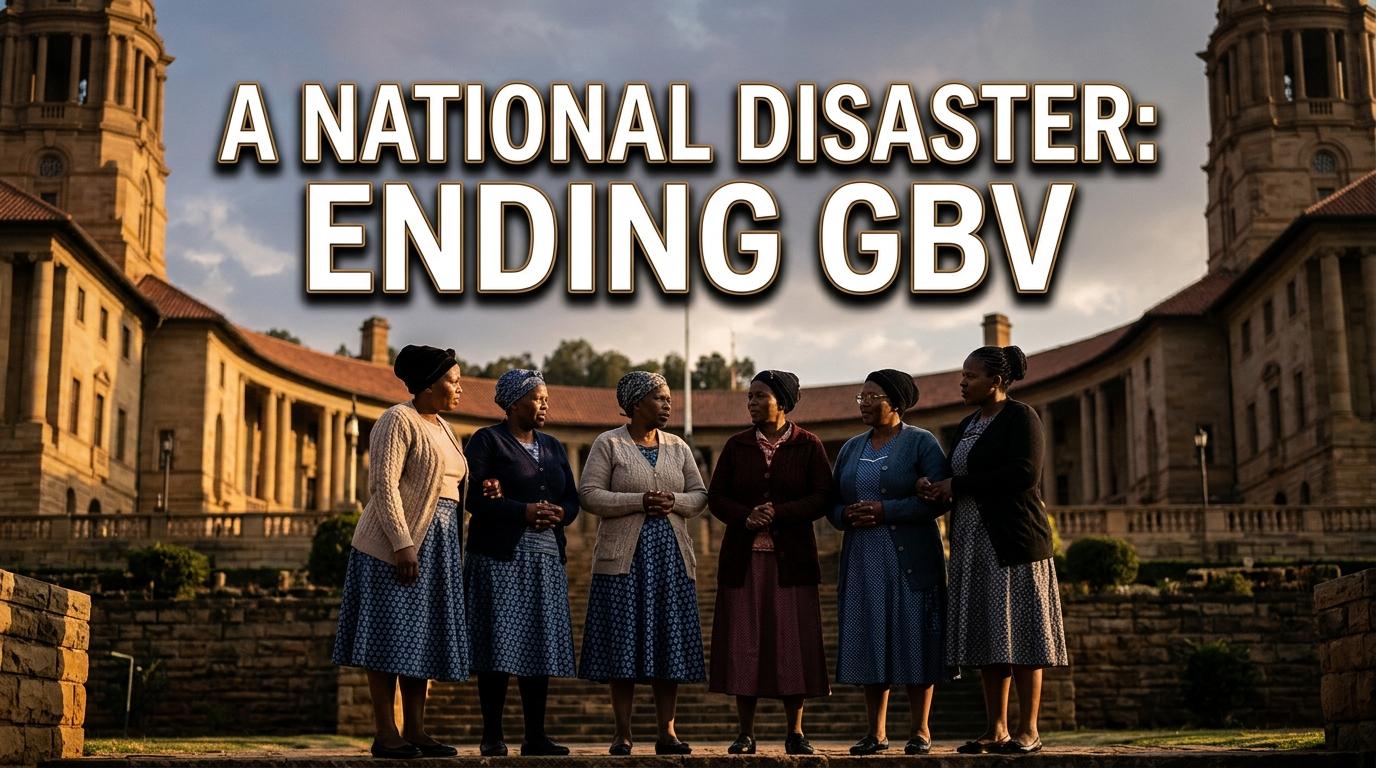
Why Ramaphosa Called South Africa’s GBV Crisis a Disaster
By Darius Spearman (africanelements)
Support African Elements at patreon.com/africanelements and hear recent news in a single playlist. Additionally, you can gain early access to ad-free video content.
Echoes of Resistance at the Union Buildings
On August 9, President Cyril Ramaphosa addressed thousands gathered at the Union Buildings in Pretoria (www.gov.za). The venue holds immense historical significance for South Africa (wikipedia.org). Sixty-eight years earlier, thousands of women marched on this exact site to confront state-sanctioned racial oppression (wikipedia.org, sahistory.org.za). In his address, Ramaphosa drew a direct line between anti-apartheid resistance and the current struggle against violence (www.gov.za, thepresidency.gov.za).
The President declared gender-based violence and femicide a national disaster (thepresidency.gov.za, www.gov.za). Under apartheid, Black women lived under constant fear of state harassment (sahistory.org.za). Today, women face systemic physical and sexual threats in their homes and communities (amnesty.org.za, hrw.org). Ramaphosa noted that Prime Minister J.G. Strijdom avoided meeting female protesters in 1956 (wikipedia.org, thepresidency.gov.za). In contrast, Ramaphosa stated that his administration would remain present and accountable (thepresidency.gov.za).
South Africa GBVF Crisis: Key Metrics
5 Times Global Average
Over 42,000 Reported Annually
The Legacy of 1956: Striking the Rock
Understanding National Women’s Day requires examining the events of August 9, 1956 (wikipedia.org). On that day, 20,000 women of diverse racial backgrounds marched to the Union Buildings (wikipedia.org, sahistory.org.za). They protested proposed extensions of apartheid pass laws to Black women (wikipedia.org, saha.org.za). Laws like the Population Registration Act restricted basic movement and employment (wikipedia.org). The regime designed passbooks to break families and control labor (sahistory.org.za, sahistory.org.za).
The march was coordinated by the Federation of South African Women and the ANC Women’s League (wikipedia.org, sahistory.org.za). Leaders like Lilian Ngoyi, Helen Joseph, Rahima Moosa, and Sophia Williams-De Bruyn mobilized thousands across South Africa (wikipedia.org). Prime Minister Strijdom refused to meet the delegation (wikipedia.org, wikipedia.org). The marchers left over 100,000 signed petitions outside his office door (wikipedia.org, wikipedia.org). They then stood in complete silence for thirty minutes (wikipedia.org, wikipedia.org).
Following the silence, the women sang a freedom song that echoed across the nation (wikipedia.org, wikipedia.org). The phrase “Wathint’ abafazi, wathint’ imbokodo” translates to “You strike a woman, you strike a rock” (wikipedia.org, wikipedia.org). The apartheid government responded with increased police harassment and forced pass issuances in late 1956 (sahistory.org.za, sahistory.org.za). March organizers were arrested and charged in the multi-year 1956 Treason Trial (wikipedia.org, sahistory.org.za). Despite state suppression, the demonstration established August 9 as a symbol of resistance (wikipedia.org, sahistory.org.za).
The Broken Legacy of Apartheid’s Social Structure
Contemporary gender-based violence does not exist in a vacuum. Apartheid policies purposefully dismantled Black family structures through the migrant labor system (sahistory.org.za, sahistory.org.za). African men were forced into single-sex mining hostels far from their families (sahistory.org.za, sahistory.org.za). Women remained restricted to underdeveloped rural reserves known as Bantustans (sahistory.org.za, sahistory.org.za). This institutionalized separation eroded social cohesion and fostered environments of domestic strain (sahistory.org.za, scielo.org.za).
Economic deprivation forced many Black women into financial dependency on men for survival (hrw.org, sahistory.org.za). Forced removals uprooted entire communities and destroyed traditional support networks (sahistory.org.za, sahistory.org.za). Modern South Africa inherited these deep structural inequalities (sahistory.org.za, scielo.org.za). Historical trauma, coupled with economic inequality, continues to fuel high rates of interpersonal conflict (hrw.org, scielo.org.za). Unraveling these systemic patterns requires addressing both past history and present historical exploitation.
Apartheid spatial planning also segregated healthcare services along racial lines (aho.org, nih.gov). The regime heavily underfunded public hospitals in Black townships and homelands (aho.org, nih.gov). Wealthier urban areas enjoyed world-class private facilities (aho.org, nih.gov). Today, a dual healthcare system persists in South Africa (aho.org). Approximately eighty-four percent of the population relies on under-resourced public health infrastructure (aho.org, nih.gov). This gap directly impacts Black working-class women seeking care (aho.org, hrw.org).
Economic Cost of GBVF in South Africa
A National Disaster: Femicide and State Response Today
The scale of gender-based violence in South Africa remains severe (amnesty.org.za, hrw.org). Femicide refers specifically to the intentional, gender-motivated murder of women (hrw.org). Intimate partners perpetrate the vast majority of these fatal acts (amnesty.org.za, hrw.org). South Africa’s female homicide rate stands at five times the international average (amnesty.org.za, hrw.org). Police crime data shows that a woman is murdered every three hours (sabcnews.com, amnesty.org.za).
The financial impact on the country is equally devastating (borgenproject.org, globalcitizen.org). A landmark study by KPMG quantified the macroeconomic costs of gender-based violence (borgenproject.org, globalcitizen.org). The research revealed that GBVF costs the economy between R28.4 billion and R42.4 billion every year (borgenproject.org, globalcitizen.org). This figure represents up to 1.3 percent of South Africa’s Gross Domestic Product (borgenproject.org, globalcitizen.org). The financial drain stems from lost workplace productivity, court processing, healthcare costs, and police deployment (borgenproject.org, globalcitizen.org).
In response, the state established the National Strategic Plan on GBVF 2020–2030 (gbvf.org.za, gbvf.org.za). The government allocated R1.6 billion to an Emergency Response Action Plan (gbvf.org.za, gbvf.org.za). These funds cleared forensic laboratory DNA backlogs and expanded specialized police units (gbvf.org.za, gbvf.org.za). Parliament passed key legislative updates to tighten bail laws and enforce protection orders (parliament.gov.za, justice.gov.za). Furthermore, the National Council on Gender-Based Violence and Femicide Act was signed into law in 2024 (parliament.gov.za). This act established a statutory body to oversee multi-sectoral accountability (parliament.gov.za).
Mobilizing Men: The Call for Societal Accountability
In his address, President Ramaphosa emphasized that violence against women is not a female issue (www.gov.za, thepresidency.gov.za). It is a societal problem rooted in violent male behavior and patriarchal norms (www.gov.za, thepresidency.gov.za). Ramaphosa called on men to challenge toxic behavior within their families and social circles (www.gov.za, thepresidency.gov.za). He stressed that passive bystanders share responsibility for allowing abusive environments to persist (www.gov.za, thepresidency.gov.za).
Civil society organizations have stepped forward to address male accountability directly (facebook.com, briefly.co.za). The #NotInMyName movement was established in 2017 following the murder of Karabo Mokoena (facebook.com, briefly.co.za). Activists Siyabulela Jentile and Themba Masango founded the initiative to mobilize men against abuse (facebook.com, briefly.co.za). The movement urges men to take active public pledges and intervene against mistreatment (facebook.com, briefly.co.za). Organizing efforts connect directly with broader civil rights and liberation movements across the globe.
Grassroots campaigns work alongside traditional leaders and religious institutions to change cultural perceptions (www.gov.za, facebook.com). Community workshops focus on emotional intelligence, conflict resolution, and positive fatherhood (facebook.com, briefly.co.za). Activists monitor court proceedings to ensure justice for victims and survivors (facebook.com). These civil society efforts aim to dismantle deep-seated patriarchy at the neighborhood level (facebook.com, briefly.co.za).
Presidential Action Pillars for Women’s Rights
1. Statutory Oversight
Enactment of NCGBVF Act 9 of 2024 to enforce multi-departmental government accountability.
2. Healthcare Equity
Expanding maternal health, cervical cancer screenings, and mobile rural clinic infrastructure.
3. Legal & Forensic Reform
R1.6B ERAP funding to process DNA backlogs and upgrade specialized FCS police units.
Healthcare Access as a Constitutional Right
President Ramaphosa placed health equity at the center of social justice (www.gov.za, thepresidency.gov.za). Bodily autonomy requires guaranteed access to comprehensive healthcare services (www.gov.za, aho.org). Under public health goals, the state guarantees reproductive rights, maternal care, and family planning (www.gov.za, aho.org). Preventative healthcare initiatives focus on early cervical cancer screening and targeted HIV prevention for young women (www.gov.za, aho.org).
Survivor support systems have expanded through specialized facilities (justice.gov.za). Thuthuzela Care Centres operate as one-stop crisis management sites (justice.gov.za). These centers provide medical treatment, forensic documentation, and psychological counselling in safe environments (justice.gov.za). The government aims to establish additional facilities in under-resourced rural areas (www.gov.za, justice.gov.za). Expanding mobile health units bridges geographic barriers for women living in farming communities (www.gov.za, aho.org).
Equitable healthcare access remains essential for economic participation (aho.org, hrw.org). Illness and untreated trauma prevent women from entering the workforce (hrw.org, borgenproject.org). By prioritizing maternal health and trauma care, the government seeks to restore basic dignity (www.gov.za, thepresidency.gov.za). Strengthening the public health infrastructure addresses historically created economic divisions (aho.org, nih.gov).
Transnational Lessons and the Black Diaspora
The South African freedom struggle shares deep historical ties with the global Black diaspora (antiapartheidlegacy.org.uk, stanford.edu). During the twentieth century, African American activists organized divestment campaigns against apartheid (antiapartheidlegacy.org.uk, stanford.edu). U.S. civil rights organizations protested Jim Crow segregation alongside South African pass laws (antiapartheidlegacy.org.uk, stanford.edu). Leaders from both movements drew strategic inspiration from shared nonviolent protests (antiapartheidlegacy.org.uk, stanford.edu). Exploring unity and political strategy highlights these cross-continental connections.
The Black Consciousness Movement, led by Steve Biko, drew direct influence from Diaspora political thought (antiapartheidlegacy.org.uk, stanford.edu). Ideological exchanges with the U.S. Black Power movement shaped youth mobilization in South Africa (antiapartheidlegacy.org.uk, stanford.edu). Both movements recognized that legal freedom remains incomplete without economic self-determination and physical safety (hrw.org, antiapartheidlegacy.org.uk). Addressing systemic violence requires continuous international solidarity (antiapartheidlegacy.org.uk, stanford.edu).
Today, the struggle against gender-based violence reflects a global fight for human rights (unwomen.org, hrw.org). Women across the Black diaspora face disproportionate rates of economic hardship and state neglect (unwomen.org, hrw.org). South Africa’s legislative framework offers valuable blueprints for state-level response (parliament.gov.za, gbvf.org.za). Moving from policy creation to daily protection remains the ultimate test (amnesty.org.za, hrw.org). The spirit of 1956 continues to guide modern demands for total emancipation (wikipedia.org, thepresidency.gov.za).
About the Author
Darius Spearman is a professor of Black Studies at San Diego City College, where he has been teaching for over 20 years. He is the founder of African Elements, a media platform dedicated to providing educational resources on the history and culture of the African diaspora. Through his work, Spearman aims to empower and educate by bringing historical context to contemporary issues affecting the Black community.
