



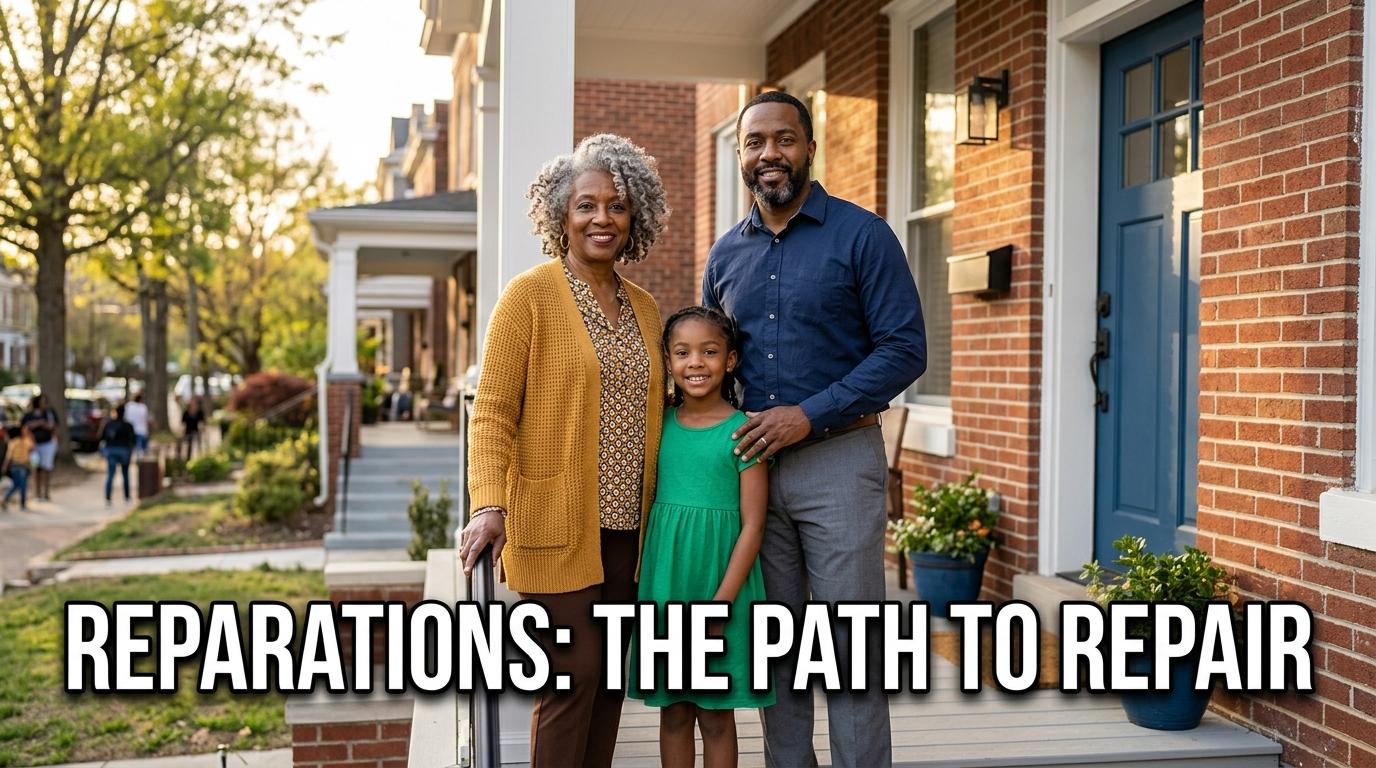
Why Support for Black Reparations Just Hit a Record High
By Darius Spearman (africanelements)
Support African Elements at patreon.com/africanelements and hear recent news in a single playlist. Additionally, you can gain early access to ad-free video content.
A profound transformation is occurring across the American political landscape. Public support for federal and local reparatory justice for Black Americans has reached a historic high of 56 percent (einpresswire.com). This number marks a dramatic leap from 46 percent recorded in previous polling (nationalcollaborative.org). In addition, an overwhelming 92 percent of the public supports teaching complete, unaltered African American history in public schools (einnews.com). These findings stem from the annual Heart of America Survey conducted by the National Collaborative for Health Equity (nationalcollaborative.org).
For generations, critics dismissed economic restitution and true history curricula as fringe issues (washingtonmonthly.com). Today, however, mainstream opinion views these two ideas as deeply connected solutions. Learning a truer historical narrative directly inspires public demand for tangible economic repair (theblackwallsttimes.com). This current moment rests upon over a century of persistent activism, legal challenges, and educational battles. Understanding the history behind today’s headlines reveals why public sentiment is shifting so rapidly.
The Broken Promises of Land and Liberty
The demand for economic repair is as old as emancipation itself. In early January 1865, Union General William Tecumseh Sherman met with twenty Black community leaders in Savannah, Georgia (blackpast.org). When asked what freed people required to secure true liberty, the Reverend Garrison Frazier declared that land was necessary to care for themselves (georgiaencyclopedia.org). Four days later, Sherman issued Special Field Order No. 15, setting aside 400,000 acres of coastal land for newly emancipated families in 40-acre plots (nps.gov).
However, this original promise of repair was short-lived. Following the assassination of President Abraham Lincoln, President Andrew Johnson abruptly rescinded the order in the fall of 1865 (blackpast.org). The federal government stripped the land from 40,000 Black farmers and returned it to former Confederate rebels (georgiaencyclopedia.org). Consequently, the federal government systematically denied Black families the primary wealth-building asset of the nineteenth century. This betrayal illustrates how post-Civil War Reconstruction failed to establish long-term economic independence (nps.gov).
Early Legal Battles: Callie House and the Pension Movement
During the late nineteenth century, formerly enslaved people organized the first national movement for reparations. Callie House, a formerly enslaved widow and washerwoman, co-founded the National Ex-Slave Mutual Relief, Bounty and Pension Association in 1898 (tnstate.edu). House traveled across the South to organize local chapters (tennesseeencyclopedia.net). At its peak, the organization gathered nearly 300,000 dues-paying members to petition Congress for pensions for aging former slaves (vanderbilt.edu).
When Congress refused to act, House pursued legal remedies through the judicial system. In 1915, her legal team filed a landmark class-action lawsuit named Johnson v. McAdoo against the United States Treasury (archives.gov). The lawsuit demanded 68 million dollars collected through federal cotton taxes between 1862 and 1868 (vanderbilt.edu). The plaintiffs argued that because enslaved people produced that cotton through uncompensated forced labor, the tax revenues belonged to them in equity (tennesseeencyclopedia.net).
The federal courts ultimately dismissed the suit by invoking sovereign immunity (constitutioncenter.org). Sovereign immunity is a legal doctrine derived from English common law stating that the government cannot be sued without its explicit consent (uscourts.gov). Furthermore, state sovereign immunity is protected under the Eleventh Amendment of the Constitution (constitutioncenter.org). Outraged by her organizing power, federal authorities targeted House directly (tnstate.edu). Postal officials used the Comstock Act of 1873 to issue fraud orders against her organization (archives.gov). In 1916, federal prosecutors indicted House on trumped-up mail fraud charges (vanderbilt.edu).
Internal government records revealed that the fraud charges were merely a pretext (tnstate.edu). Federal officials feared that House was creating political unrest among Black citizens across the country (tennesseeencyclopedia.net). Prosecutors presented no individual victims during the trial and failed to show that House profited personally (vanderbilt.edu). Nevertheless, an all-white, all-male jury convicted House in 1917, sentencing her to a year in prison (tnstate.edu). Although her imprisonment disrupted the association, her legal crusade established the legal foundation for modern reparations claims.
Building the Blueprint: Queen Mother Moore and H.R. 40
During the mid-twentieth century, Black women activists reframed the reparations debate. Audley “Queen Mother” Moore emerged as a primary leader in this movement (blackagendareport.com). She argued that Black Americans were not asking for government charity or pensions (aaihs.org). Instead, she insisted that the nation owed reparations for human rights violations committed during slavery and Jim Crow (blackagendareport.com). Her philosophy aligned closely with the broader ideology of Black nationalism, which emphasizes self-determination, economic independence, and self-governing institutions (aaihs.org).
Moore’s persistent political organizing directly influenced federal policy strategies. In 1989, Representative John Conyers of Michigan introduced federal bill H.R. 40 (house.gov). The bill was named in honor of the original forty-acre promise (wikipedia.org). Officially titled the Commission to Study and Develop Reparation Proposals for African Americans Act, the bill does not instantly mandate direct payments (house.gov). Rather, it creates a national commission to examine historical discrimination from 1619 to the present (wikipedia.org).
Following the passing of Conyers and later champion Representative Sheila Jackson Lee, Representative Ayanna Pressley reintroduced H.R. 40 in January 2025 (house.gov). The proposed commission aims to study the federal government’s role in supporting slavery and ongoing systemic inequalities (wikipedia.org). By focusing on research and policy remedies, H.R. 40 remains the flagship legislative blueprint for federal reparatory justice (house.gov).
Miseducation and the Fight for Truthful History
The record 92 percent public support for comprehensive history curricula builds upon a legacy of educational activism (nationalcollaborative.org). Dr. Carter G. Woodson, known as the Father of Black History, pioneered this struggle (ebsco.com). Woodson earned a doctorate from Harvard University and dedicated his life to documenting African American contributions (wvstateu.edu). In 1926, he established Negro History Week, selecting February to coincide with the birthdates of Abraham Lincoln and Frederick Douglass (nps.gov).
Woodson argued that omitting Black history from public education was a deliberate strategy of racial control (ebsco.com). In his famous 1933 book, The Mis-Education of the Negro, he explained that controlling a person’s thinking eliminates the need to dictate their actions (wvstateu.edu). In 1976, the federal government officially recognized Black History Month (nps.gov). Today, historians continue Woodson’s mission by demonstrating that complete history is necessary for informed citizenship.
Classroom Censorship Versus Public Consensus
Despite strong public backing for truthful history, political state-level restrictions have escalated in recent years (k12dive.com). In 2022, Florida passed the Individual Freedom Act, commonly called the Stop W.O.K.E. Act (mtsu.edu). The legislation restricts how public schools and private businesses discuss race, systemic privilege, and historical oppression (courthousenews.com). Specifically, the law prohibits instructions that cause individuals to feel guilt or anguish regarding past actions committed by members of their race (mtsu.edu).
In 2023, state officials used this framework to block the College Board’s new Advanced Placement African American Studies course (apnews.com). Founded in 1899, the College Board is a national non-profit educational association that administers standardized tests and advanced high school curricula (collegeboard.org). State officials objected to course materials addressing contemporary reparations and systemic racism (apnews.com). Officials claimed these topics lacked educational value (k12dive.com).
However, the legal system and public sentiment are challenging these legislative restrictions. In July 2026, the Eleventh U.S. Circuit Court of Appeals ruled that restricting higher education professors under the Stop W.O.K.E. Act violated First Amendment free speech protections (courthousenews.com). Furthermore, the survey showing 92 percent public support proves that political efforts to restrict history curricula directly conflict with voter preferences (nationalcollaborative.org).
Local Victories and Municipal Policies
Because federal legislation remains stalled in Congress, municipal and state governments are implementing localized reparatory policies. In 2021, Evanston, Illinois, created the nation’s first municipal reparations initiative (dailynorthwestern.com). Local organizers recognized that while Black residents comprised 16 percent of Evanston’s population, they accounted for 71 percent of local marijuana arrests (northbynorthwestern.com). Consequently, the city allocated revenue from a 3 percent tax on recreational cannabis to fund housing grants for Black residents (harvard.edu). These grants provide 25,000 dollars for home purchases and repairs, assisting families in building generational wealth (dailynorthwestern.com).
Simultaneously, state-level initiatives are establishing standards for economic redress. California established the nation’s first statewide Reparations Task Force in 2020 (calmatters.org). To comply with state laws prohibiting race-based policy preferences, the task force voted to base eligibility on direct lineage (ca.gov). Individuals qualify if they can prove direct descent from an enslaved African American or a free Black person residing in the United States prior to 1900 (precinctreporter.com).
To implement these recommendations, the California Legislature passed Senate Bills 437 and 518 in September 2025 (ca.gov). This legislation established the Bureau for Descendants of American Slavery to oversee eligibility audits (latimes.com). In addition, state universities were directed to establish research frameworks to assist citizens in tracing their ancestral records (ca.gov). These administrative structures convert abstract debates into concrete public administration.
Reparations as a Public Health Imperative
Modern research increasingly connects economic restitution to community public health outcomes (nih.gov). Public health experts emphasize that racial wealth gaps directly create chronic racial health disparities (rwjf.org). Wealth provides financial security that reduces psychological stress and prevents stress-related illnesses such as hypertension and heart disease (wellesleyinstitute.com). Consequently, targeted asset redistribution serves as a direct public health strategy (communitysolutions.com).
Furthermore, capital grants enable families to secure safer housing and access preventive health care (huduser.gov). Dr. Gail C. Christopher, Executive Director of the National Collaborative for Health Equity, notes that closing racial economic divides improves overall population health (nationalcollaborative.org). By addressing the social determinants of health, reparatory policies offer economic solutions alongside measurable health benefits (rwjf.org).
Healing the Nation on the Road to 2026
As the United States commemorates its 250th anniversary, public demand for democratic accountability continues to grow (nationalcollaborative.org). National surveys reflect a citizenry seeking to align American ideals with economic reality (nationalcollaborative.org). The rising support for both reparations and truthful history demonstrates that public consciousness is evolving (einpresswire.com).
As Dr. Gail C. Christopher remarked, citizens are actively naming the work required to achieve national wholeness (nationalcollaborative.org). Uncovering true historical narratives provides the foundation for systemic reconciliation (theblackwallsttimes.com). Restoring economic justice honors long-standing promises made to descendants of enslaved Black Americans (georgiaencyclopedia.org).
About the Author
Darius Spearman is a professor of Black Studies at San Diego City College, where he has been teaching for over 20 years. He is the founder of African Elements, a media platform dedicated to providing educational resources on the history and culture of the African diaspora. Through his work, Spearman aims to empower and educate by bringing historical context to contemporary issues affecting the Black community.
