


Why NY Halted an Elmhurst Black Burial Ground Sale
By Darius Spearman (africanelements)
Support African Elements at patreon.com/africanelements and hear recent news in a single playlist. Additionally, you can gain early access to ad-free video content.
A Sacred Resting Place Beneath Queens Asphalt
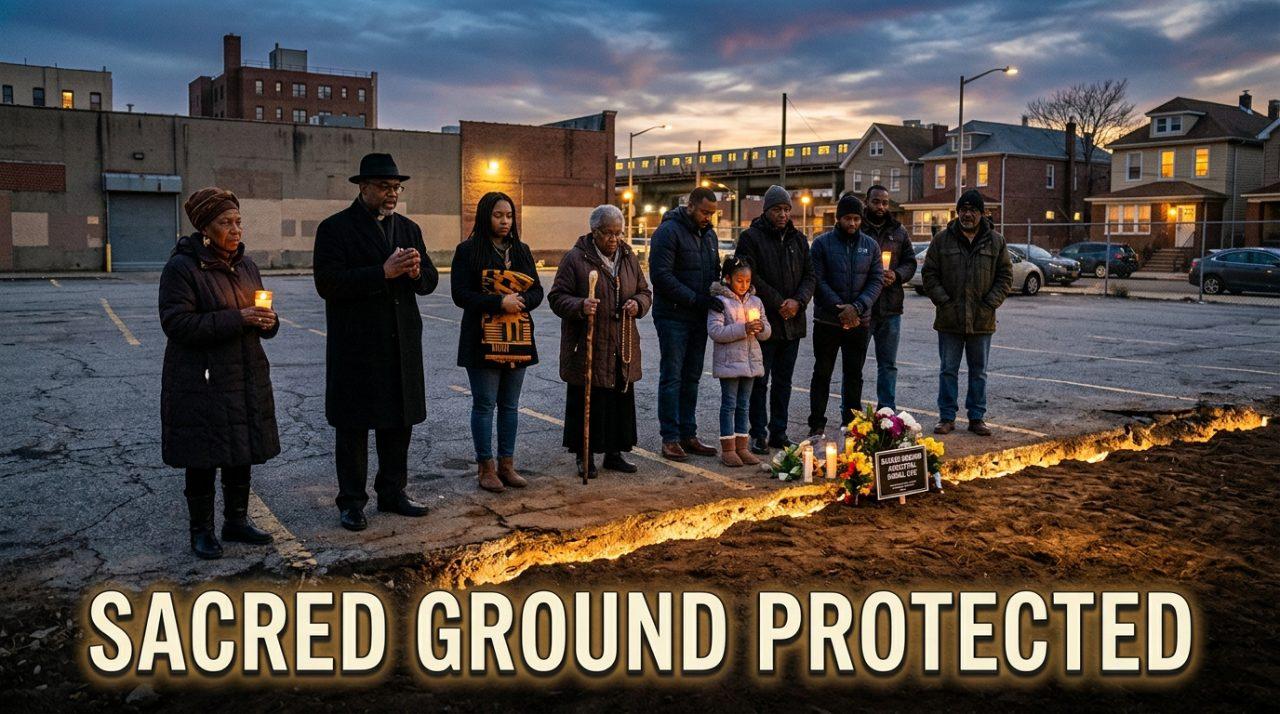
Beneath a cracked layer of asphalt in Elmhurst, Queens, lies a sacred piece of African American history. For years, commercial tow trucks and junk cars parked directly over the remains of more than three hundred free and formerly enslaved Black New Yorkers (ny.gov, therealdeal.com). This paved lot at 47-11 90th Street was once the vibrant heart of an autonomous nineteenth-century Black community (ny.gov, blknewsnow.com).
In September 2026, the property faced a sudden court-ordered foreclosure auction (ny.gov, therealdeal.com). The sale threatened to deliver this cemetery into the hands of real estate developers without preservation requirements (ny.gov). New York Attorney General Letitia James intervened in New York Supreme Court to halt the transaction (ny.gov, ny.gov). The legal action mandates that any future transfer must honor state burial protection laws and safeguard the ancestors resting below (ny.gov).
Timeline: The Struggle for Newtown Burial Ground
Free and enslaved Black residents establish burials on a Newtown hillside, formally deeding the land through the United African Society.
St. Mark A.M.E. relocates. The City of New York denies petitions to disinter ancestral remains, leading to commercial development over the cemetery.
Construction excavation breaches an iron coffin containing the remarkably preserved body of a nineteenth-century African American woman.
The New York Attorney General halts a commercial foreclosure auction, demanding permanent statutory preservation under burial protection laws.
The Hidden History of Slavery in New York
Many Americans associate chattel slavery strictly with the southern plantation economy. Yet New York operated as one of the largest slaveholding states in the northern United States prior to the Civil War (thirteen.org). Enslaved laborers cleared the forests, constructed early roads, and built the agricultural wealth of Long Island and Queens County (thirteen.org, ironcoffinmummy.com). They faced brutal legal codes and daily exploitation at the hands of Dutch and English landholders.
In 1799, the state legislature enacted the Act for the Gradual Abolition of Slavery. This statute granted delayed freedom to children born to enslaved mothers only after decades of forced indentured labor (thirteen.org). Complete statutory abolition did not arrive across the state until July 4, 1827 (thirteen.org). As contemporary debates surround reparations and historical accountability, recognizing the northern roots of bondage remains essential. Freedom was fought for through organized community action long before the law caught up.
The Founding of Newtown and St. Mark A.M.E.
Even before legal emancipation, Black New Yorkers secured ground for community life and spiritual protection. In 1818, Black families in the rural Queens hamlet of Newtown began burying their dead on an open hillside (ny.gov, blknewsnow.com). In 1828, five pioneering trustees formed the United African Society of Newtown (ny.gov, ny.gov). They purchased two acres from local farmer William Hunter to build a church, a parsonage, and an independent school (ny.gov, blknewsnow.com).
The settlement quickly grew into a thriving sanctuary of self-determination and education. Renowned abolitionist Reverend Dr. James W.C. Pennington served as one of its early spiritual leaders (ny.gov, ny.gov). Pennington had escaped bondage in Maryland before becoming the first Black student to attend classes at Yale Divinity School (ny.gov). The congregation eventually incorporated into the African Methodist Episcopal denomination as St. Mark A.M.E. Church (ny.gov, stmarkamenyc.org). For more than a century, members laid family, veterans, and elders to rest within their churchyard cemetery (ny.gov, stmarkamenyc.org).
The Meaning of Autonomy: Resisting the Potter’s Field
A potter’s field is a public burial ground designated for the indigent, the unknown, and the unclaimed. Historically, municipal potter’s fields relied on mass trenches, kept careless records, and stripped human beings of their names and dignity. Furthermore, early public burial grounds in New York enforced strict racial segregation (thirteen.org). They also exposed impoverished Black deceased individuals to constant threats of grave robbing and anatomical dissection by nineteenth-century medical students.
For African Americans, establishing independent consecrated burial grounds was an indispensable act of resistance. By owning their cemetery, the members of the United African Society ensured their loved ones received Christian burial rites surrounded by their community (ny.gov, blknewsnow.com). Independent cemeteries protected Black ancestors from municipal neglect and desecration. Sacred spaces represented institutional freedom in a society that denied Black citizens basic dignity during life and death.
By the Numbers: Elmhurst Burial Ground Legacy
300+
Ancestors Interred
1818
First Informal Burials
$14M
Commercial Market Value
2023
Burial Act Enacted
Urban Displacement and Decades of Desecration
By the late 1920s, rapid urbanization completely transformed the once-rural hamlet of Newtown into modern Elmhurst. Transportation expansions brought industrial changes, pushing longtime African American residents out of their historic village enclave. In 1928, St. Mark A.M.E. Church prepared to relocate north toward Jackson Heights to stay close to its growing congregation (ny.gov, stmarkamenyc.org).
The church trustees petitioned the City of New York for permission to disinter the burials and transfer them to Mount Olivet Cemetery (ny.gov, stmarkamenyc.org). Municipal authorities denied the request, citing heavy financial costs and health regulations (ny.gov). Left with few options, the church had to sell the land (ny.gov, stmarkamenyc.org). Commercial developers subsequently cleared the buildings, using the sacred ground as an auto garage, an industrial machine shop, and a scrap yard (ny.gov, therealdeal.com).
The Woman in the Iron Coffin
The forgotten cemetery dramatically resurfaced on October 4, 2011 (ironcoffinmummy.com, iflscience.com). While clearing ground for a planned condominium building, a construction backhoe struck an iron container four feet beneath the surface (ironcoffinmummy.com, cbsnews.com). Inside lay the naturally mummified body of a young African American woman dressed in a white nightgown, an embroidered chemise, and knitted stockings (ironcoffinmummy.com, iflscience.com).
Forensic archaeologist Scott Warnasch determined the woman was buried inside a Fisk metallic burial case (ironcoffinmummy.com, iflscience.com). Almond Dunbar Fisk patented these airtight cast-iron caskets in 1848 to halt decay and quarantine infectious disease (ironcoffinmummy.com, iflscience.com). Archival research and census records revealed the woman was Martha Peterson, who died of smallpox around 1850 at age twenty-six (ironcoffinmummy.com, iflscience.com). Her father was a founding trustee of the United African Society (blknewsnow.com, ironcoffinmummy.com). In 2016, St. Mark A.M.E. Church finally laid Martha Peterson to rest at Mount Olivet Cemetery with full community honors (blknewsnow.com, iflscience.com).
Corporate Speculation and the Paved Cemetery
The 2011 discovery halted condominium construction, yet corporate disrespect continued. The corporate landowner, 90 Queens LLC, held an asset valued between 13.8 million and 14 million dollars (therealdeal.com). Instead of collaborating with community members to preserve the land, the ownership paved the cemetery with thick asphalt (ny.gov, therealdeal.com). The developer then leased the parcel as a commercial storage depot for impounded and towed vehicles (ny.gov, therealdeal.com).
Community advocates and civic leaders protested this clear desecration for over ten years (ny.gov, therealdeal.com). City inspectors issued repeated violations against the owner for unpermitted commercial parking on the sensitive site (therealdeal.com). Commercial operators ignored the ancestral remains beneath the dirt. This neglect reflects how commercial real estate interests frequently disregard African American cultural memory and sacred landmarks.
The Path to Preservation: Legal Mechanism
Loan Default: Commercial owner 90 Queens LLC defaults on mortgage debt, triggering a private lender foreclosure action.
Auction Block: Queens County court referee schedules public auction without binding protections for the burial ground.
State Intervention: AG Letitia James files in Supreme Court to mandate statutory compliance with the 2023 Burial Act.
Memorial Transformation: Speculative value collapses under encumbrances, clearing paths for community ownership and memorial parks.
Who Speaks for the Dead: Defining Descendant Communities
Under historic preservation policies, identifying who holds legal and moral authority over unmarked graves is essential. Under New York’s Unmarked Burial Site Protection Act of 2023, a descendant community is not limited strictly to biological relatives (nysenate.gov). Tracing bloodline genealogies across centuries of racial oppression is often impossible. Therefore, the law establishes formal standing for culturally affiliated groups and successor institutions (nysenate.gov).
St. Mark A.M.E. Church serves as the primary recognized descendant institution for the Elmhurst burial ground (ny.gov, stmarkamenyc.org). The congregation nurtured these souls, held their funeral services, and maintained their memory when city agencies turned away (ny.gov, stmarkamenyc.org). As historical promises from early America mirror modern systemic promises left unfulfilled, legal recognition allows church leaders and preservation coalitions to hold developers accountable. Cultural kin maintain the right to decide how their ancestors are honored.
How the Foreclosure Stoppage Clears the Way for a Memorial
The intervention by the New York Attorney General fundamentally alters the future of the Elmhurst site (ny.gov, ny.gov). When a commercial mortgage defaults, a property is usually auctioned to the highest private bidder. An ordinary foreclosure referee has no statutory obligation to protect cultural heritage. Without legal intervention, another commercial developer could have acquired the deed and restarted construction disputes (ny.gov).
Attorney General Letitia James secured court orders that bind any prospective purchaser to state preservation mandates (ny.gov, ny.gov). Any buyer must disclose the human remains on title records and consult directly with St. Mark A.M.E. Church before touching the ground (ny.gov, ny.gov). These severe legal restrictions eliminate commercial development value for private speculators. Consequently, local leaders and preservation trusts gain the leverage needed to acquire the parcel and construct a permanent memorial park (ny.gov, therealdeal.com).
A Statewide Reckoning for Ancestral Sites
The legal fight in Elmhurst is part of a larger, necessary reckoning across the state. In earlier decades, New York was one of only four states without comprehensive laws safeguarding unmarked human remains on private land. The adoption of the Unmarked Burial Site Protection Act in 2023 finally established civil and criminal penalties for desecrating historic graves (nysenate.gov). This statute grants the state significant authority to intervene when private real estate ventures threaten historic sites (ny.gov, nysenate.gov).
This initiative mirrors past ancestral recoveries across New York City. The African Burial Ground in Lower Manhattan and the 126th Street Harlem African Burial Ground demonstrate the vital necessity of reclaiming Black sacred spaces. Asserting state-level civil rights power to halt commercial foreclosure sales sets a critical precedent. The ancestors buried beneath the Elmhurst asphalt built the foundations of Queens. The state now recognizes that their resting place is sacred ground that must never be sold off to the highest bidder.
About the Author
Darius Spearman is a professor of Black Studies at San Diego City College, where he has been teaching for over 20 years. He is the founder of African Elements, a media platform dedicated to providing educational resources on the history and culture of the African diaspora. Through his work, Spearman aims to empower and educate by bringing historical context to contemporary issues affecting the Black community.
